I’ll never forget the emergency meeting we had with a Texas-based hotel chain in Q2 2023. Their drapery supplier had been using halogen-based flame retardants, and guests were complaining about chemical odors and skin irritation. The project was stalled, and they needed a compliant solution immediately. We overnighted samples of our phosphorus-based FR viscose, and their technical team confirmed it met both safety and comfort requirements without the toxic concerns. This scenario is becoming increasingly common as brands and manufacturers seek safer flame retardant alternatives.
The most effective formaldehyde- and halogen-free flame-retardant fabric solutions fall into three main categories: inherently flame-resistant natural fibers (like wool and hemp), synthetic fibers with built-in FR properties (like modacrylic), and fabrics treated with eco-friendly FR finishes based on phosphorus, nitrogen, or silica chemistry. Each approach offers distinct advantages for different applications, from contract furniture and protective workwear to children’s sleepwear and hospitality textiles. The key is matching the FR technology to your specific performance requirements, comfort needs, and sustainability goals.
The shift away from halogenated and formaldehyde-based FR treatments represents one of the most significant changes in textile safety we’ve witnessed. Where brominated and chlorinated compounds once dominated the market, we’re now seeing rapid adoption of cleaner chemistries that provide equivalent protection without the environmental and health concerns. Let’s examine the proven alternatives that are reshaping flame retardant textiles.
What are the proven halogen-free FR natural fiber options?
Natural fibers with inherent flame resistance offer the simplest solution for avoiding chemical treatments altogether. These materials have been protecting people for centuries, and modern processing has enhanced their performance while maintaining their natural safety profile.
Wool stands as the premium natural FR fiber, with a high ignition temperature of around 1050°F and natural self-extinguishing properties. The fiber’s high nitrogen and water content, combined with its crimped structure that creates air pockets, makes it naturally resistant to flame spread. We’ve supplied wool-cotton blends for hotel bedding that achieve California Technical Bulletin 117 requirements without chemical treatments. The wool content (typically 30-50%) provides the FR protection while cotton maintains comfort and reduces cost.
Silk possesses natural flame resistance due to its high nitrogen content and the way it chars rather than melts when exposed to flame. While not suitable for high-risk applications alone, silk blends can enhance FR performance in luxury applications. We recently developed a silk-wool blend for high-end theater curtains that passed NFPA 701 with a luxurious drape that synthetic FR fabrics couldn’t match.
Hemp and linen offer moderate natural FR properties due to their high cellulose crystallinity and density. While they will eventually ignite, they burn slowly and can be enhanced with eco-friendly treatments. Their high thermal stability makes them excellent base fabrics for non-halogenated FR finishes. A contract furniture client achieved CAL 117 compliance using our hemp-cotton blend with a phosphorus-based finish instead of their previous halogenated system.
How does wool compare to synthetic FR options in real-world performance?
In our comparative testing, 100% wool fabrics consistently achieve Class A ratings in ASTM E84 tunnel tests without chemical treatments. The fiber’s limiting oxygen index (LOI) of approximately 25% means it requires higher oxygen concentration to sustain combustion compared to cotton (18% LOI). However, wool’s main limitation is cost and care requirements—dry cleaning can diminish natural FR properties over time, which is why we often recommend specific care protocols for maintaining wool’s natural flame resistance.
What are the limitations of relying solely on natural FR fibers?
While natural FR fibers provide excellent protection, they have limitations in high-risk environments. Wool can be heavy for certain applications, has limited chemical resistance, and may not meet the most stringent FR standards without blending or treatment. For applications requiring arc flash protection or protection against industrial chemicals, synthetic solutions often provide better performance. Understanding these limitations is crucial for selecting the right FR fabric for industrial protective clothing where multiple hazards may be present.
Which synthetic fibers offer built-in FR properties without halogens?
For applications requiring higher durability and specific protective properties, synthetic fibers with intrinsic FR characteristics provide reliable solutions without formaldehyde or halogens.
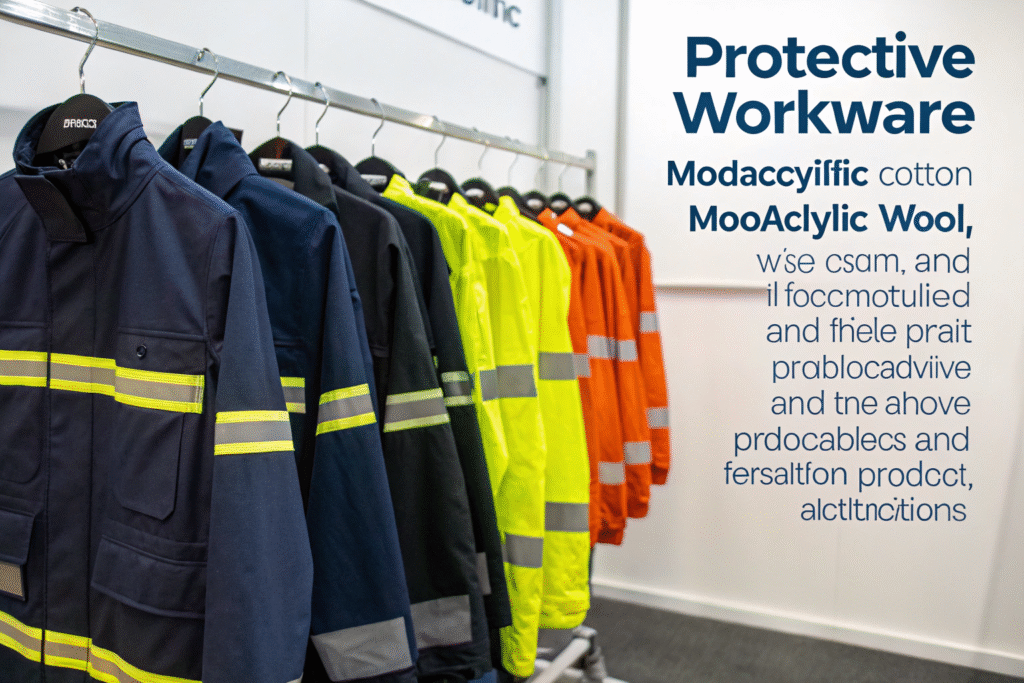
Modacrylic is the workhorse of intrinsic FR synthetics, offering excellent flame resistance with an LOI of 26-31%. The fiber contains acrylonitrile combined with flame-retardant comonomers that are polymerized into the fiber structure, making the protection permanent and wash-resistant. We supply modacrylic-cotton and modacrylic-wool blends for protective workwear that maintain FR properties through 50+ industrial launderings. The fiber’s resistance to acids and chemicals makes it ideal for industrial applications.
Aramid fibers (meta-aramid and para-aramid) represent the high-performance end of FR synthetics. With LOI values of 28-30%, these fibers don’t melt, drip, or support combustion in air. Their exceptional thermal stability protects up to 700°F, making them suitable for firefighter turnout gear and military applications. While more expensive, aramid blends provide unmatched protection in extreme environments. Our aramid-modacrylic blend for electrical utility workers has prevented numerous injuries according to client feedback.
FR Viscose/Rayon incorporates flame-retardant additives directly into the cellulose solution before extrusion, creating a permanent FR effect. The most common technology uses organophosphorus compounds that become part of the fiber matrix. This creates a breathable, comfortable fabric with natural fiber feel and permanent FR properties. We’ve successfully replaced formaldehyde-treated cotton with FR viscose in hospital drapery applications with improved comfort and equal protection.
How do modacrylic blends balance protection and comfort?
Modern modacrylic fibers have overcome the stiff hand-feel and poor moisture management that limited their early adoption. Through advanced spinning techniques and strategic blending, we’ve developed modacrylic-cotton (60/40) and modacrylic-wool (50/50) fabrics that achieve NFPA 2112 compliance while maintaining comfort for 8-12 hour wear. The key is optimizing fiber denier and blend ratios to maximize protection while preserving breathability. Our most popular protective workwear fabric uses this approach to balance OSHA compliance with worker acceptance.
What makes FR viscose suitable for sensitive applications?
FR viscose’s combination of cellulose base (making it breathable and hypoallergenic) with built-in phosphorus FR agents creates an ideal solution for applications where skin contact is inevitable. We’ve supplied FR viscose for children’s sleepwear, healthcare uniforms, and bedding where both safety and comfort are critical. The fiber’s excellent dyeability allows for attractive designs while maintaining FR properties, addressing the common complaint that FR clothing is unattractive. The production process for understanding the manufacturing process of FR viscose fibers reveals why it has become a preferred choice for eco-conscious brands.
What eco-friendly FR finishing technologies are available?
For existing fabrics that need FR enhancement or applications requiring specific performance characteristics, advanced finishing technologies provide halogen-free solutions that withstand rigorous testing.
Phosphorus-based finishes represent the most developed alternative to halogen chemistry. These intumescent systems work by forming a protective char layer when exposed to heat, insulating the underlying fabric and preventing oxygen access. The char expansion creates a barrier that slows heat transfer and prevents flame spread. We’ve achieved CAL 117 compliance on cotton drapery using a phosphorus-nitrogen synergistic system that maintained fabric drape and hand-feel better than previous halogen-based treatments.
Silica-based sol-gel treatments represent the cutting edge of eco-friendly FR technology. These nanotechnology applications create ceramic-like protective layers on fiber surfaces that provide thermal insulation without chemical reactions. The treatments are completely free of halogens, phosphorus, and formaldehyde, making them ideal for the most sensitive applications. Our development partnership with a German chemical company has produced a silica-based finish that passes EN 13501-1 for building materials while maintaining fabric breathability.
Bio-based FR solutions are emerging from renewable resources like DNA, phytic acid (from plants), and casein (from milk). While still in development stages, these technologies offer fascinating possibilities for completely sustainable FR protection. We’re currently testing a chitosan-based (from shellfish) FR treatment for textiles that shows promising results for low-risk applications.

How do phosphorus-nitrogen synergistic systems work?
The combination of phosphorus and nitrogen creates a powerful FR effect through multiple mechanisms. Phosphorus compounds promote char formation while nitrogen acts as a blowing agent, expanding the char into a protective foam layer. This synergistic effect allows lower chemical loading while achieving better FR performance. Our optimized P-N system uses 20% less chemical than earlier formulations while improving char length results in vertical flame testing by 15%. This reduction in chemical usage addresses both cost and environmental concerns.
What are the durability limitations of eco-friendly FR finishes?
While intrinsic FR fibers maintain protection throughout the fabric’s life, finishes have varying durability. Phosphorus-based treatments typically withstand 25-50 industrial launderings, while silica treatments offer higher durability but may affect hand-feel. The application method significantly impacts durability—our pad-cure application with optimized catalysts provides more consistent and durable protection than spray applications. For clients requiring maximum durability, we recommend comparing the long-term performance of different FR technologies to make informed decisions based on actual use conditions.
How do you verify FR claims and ensure regulatory compliance?
With increasing scrutiny on green claims and FR performance, verification through proper testing and certification has never been more important. The days of accepting supplier declarations without evidence are ending.
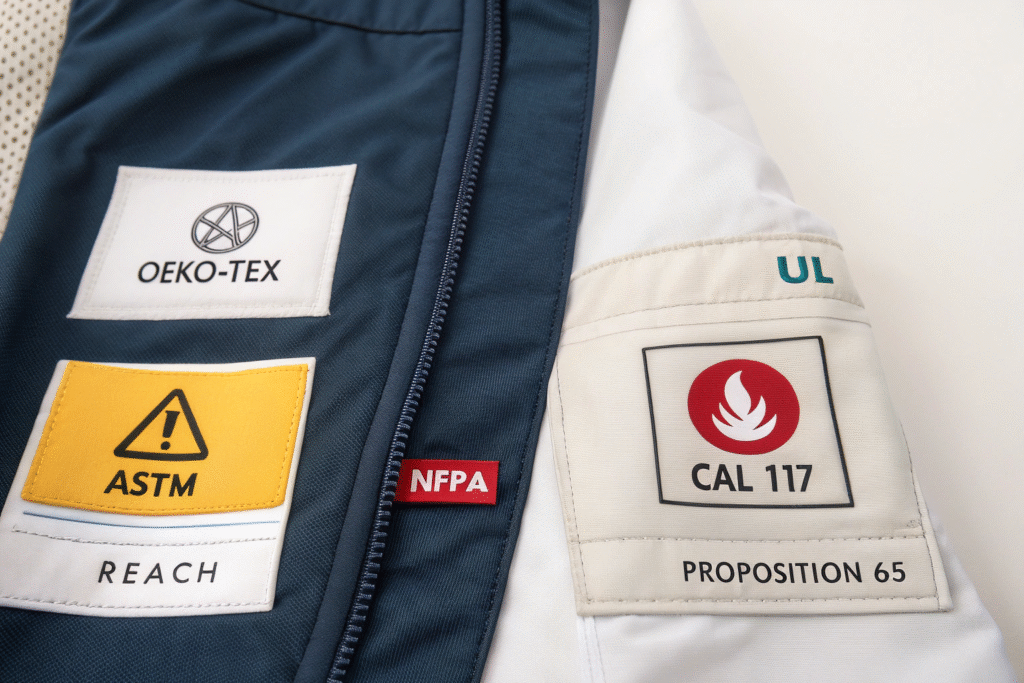
Third-party certification from organizations like OEKO-TEX® STANDARD 100, UL, and independent testing laboratories provides credibility for FR and chemical safety claims. Our clients increasingly require certificates verifying the absence of specific halogenated compounds and formaldehyde, not just FR performance claims. The most comprehensive approach involves testing for both performance (ASTM, NFPA, CAL 117) and chemical safety (REACH, Proposition 65).
Supply chain transparency has become essential for verifying FR claims. We provide complete documentation from fiber production through finishing, including safety data sheets for all chemicals used. This traceability allows brands to confidently make marketing claims about their FR choices. After a 2022 incident where a competitor’s "halogen-free" FR fabric was found to contain decaBDE, our documentation practices have become a significant competitive advantage.
What testing standards validate formaldehyde- and halogen-free claims?
Beyond standard FR tests like ASTM D6413 (vertical flame) and NFPA 701, specific chemical tests verify the absence of restricted substances. ISO 14184-1 quantifies formaldehyde content, while EPA 3540C and similar methods detect halogenated compounds. We conduct quarterly third-party testing to verify our claims, and recommend clients do the same for due diligence. Understanding the specific laboratory methods for detecting restricted FR chemicals helps brands ask the right questions when evaluating suppliers.
How can brands avoid greenwashing in FR marketing?
The line between legitimate claims and greenwashing has become increasingly fine. We advise clients to use precise language like "contains no added formaldehyde" rather than "formaldehyde-free," as trace amounts may occur naturally. For halogens, specifying "free from brominated and chlorinated flame retardants" is more accurate than "halogen-free." Providing test reports and certifications supports these claims and builds consumer trust. Our most successful clients combine technical FR information with clear explanations of why their chosen solution is safer.
Conclusion
The landscape of formaldehyde- and halogen-free flame retardant fabrics has expanded dramatically, offering viable alternatives for virtually every application. Natural fibers like wool provide inherent protection, synthetic options like modacrylic and FR viscose offer durable built-in solutions, and advanced finishes based on phosphorus, silica, and bio-chemistry deliver eco-friendly performance. The optimal choice depends on your specific requirements for protection level, durability, comfort, sustainability, and cost.
Moving away from traditional halogenated and formaldehyde-based FR treatments requires careful evaluation of alternatives, but the benefits in safety, environmental impact, and market positioning make the effort worthwhile. The most forward-thinking companies are now viewing FR not just as a compliance requirement but as an opportunity to demonstrate their commitment to healthier materials.
If you’re navigating the transition to cleaner flame retardant solutions, we can provide samples, test data, and technical guidance based on your specific application. Our material library includes dozens of verified formaldehyde- and halogen-free options across different price points and performance categories. Contact our Business Director, Elaine, at elaine@fumaoclothing.com to discuss your requirements and receive our FR Solutions Comparison Kit with actual swatches and complete compliance documentation.