After twenty years managing fabric inventory through every market cycle, I’ve seen the transformation that proper VMI brings to seasonal production. The seasonal fabric dilemma is universal—you need enough inventory to capture demand spikes but not so much that you’re stuck with dead stock when trends shift. Traditional inventory management puts all the risk on you, while VMI creates a partnership where both sides share the benefits and responsibilities.
Vendor-managed inventory for seasonal fabrics works particularly well because it aligns with the natural production rhythms of the textile industry. We’ve implemented VMI programs with over thirty brands across Europe and North America, and the results consistently show 25-40% reduction in inventory carrying costs while improving in-stock availability to 98% during critical production windows. The key is structuring the partnership to address the unique challenges of seasonal textile sourcing.
Setting up successful VMI for seasonal fabrics requires mastering four critical components: forecasting methodology that accounts for trend volatility, inventory parameters that balance risk and responsiveness, technology infrastructure for real-time visibility, and performance metrics that keep both parties aligned. Let me walk you through how we’ve made this work for brands ranging from fast fashion to luxury heritage labels.
What forecasting approach works for seasonal demand?
Seasonal fabric forecasting can’t rely on traditional historical analysis alone—by definition, each season brings new designs, new colors, and new market conditions. The most successful VMI programs combine quantitative data with qualitative trend intelligence, creating a dynamic forecast that evolves as the season progresses.
We implement a three-tier forecasting approach with our VMI partners: baseline forecasting using historical comparable categories, trend amplification based on real-time sales data and social listening, and production capacity mapping that aligns with your manufacturing schedule. This method proved particularly valuable for a UK fast-fashion retailer last spring—their floral print fabric forecast adjusted weekly based on early selling data, preventing both shortages of best-sellers and overstock of underperformers.

How do you incorporate trend volatility into inventory planning?
Trend volatility requires both flexibility and courage in inventory planning. We address this through graduated inventory commitments: firm orders for core seasonal fabrics that have predictable demand, flexible capacity for trend-driven materials with higher uncertainty, and rapid response protocols for unexpected breakouts.
The practical implementation involves what we call "trigger-based replenishment." For a French contemporary brand’s fall collection, we maintained 5,000 meters of their core wool blend as permanent VMI stock, while establishing automatic replenishment triggers for their fashion colors—when sell-through data showed a particular shade hitting 40% depletion, we automatically cut and finished additional quantities without purchase order delays. This approach requires deep understanding of VMI implementation specifics for fashion businesses and willingness to share data that many companies traditionally guard closely.
What role do minimum-maximum inventory levels play?
Minimum and maximum inventory levels form the guardrails of seasonal VMI, creating automatic replenishment triggers while preventing overaccumulation. The art lies in setting these parameters correctly—too narrow a range creates constant stock anxiety, while too wide a range defeats the efficiency purpose of VMI.
We determine these levels through a collaborative process that considers your production schedule, our manufacturing lead times, and historical demand variability. For an Australian outdoor brand’s seasonal technical fabrics, we established min-max levels that varied throughout their production cycle—higher maximums during peak manufacturing months, tighter ranges during transition periods. This dynamic approach reduced their inventory investment by 35% while eliminating production delays that had previously cost them $280,000 in air freight annually. The methodology draws from established VMI best practices in seasonal industries but adapts them to textile-specific considerations like dye lot consistency and color matching.
What inventory parameters ensure production continuity?
Production continuity in seasonal manufacturing depends on having the right fabric, in the right quantity, at the right time—without exception. VMI parameters must account for both predictable production schedules and the inevitable surprises that occur during fashion manufacturing seasons.
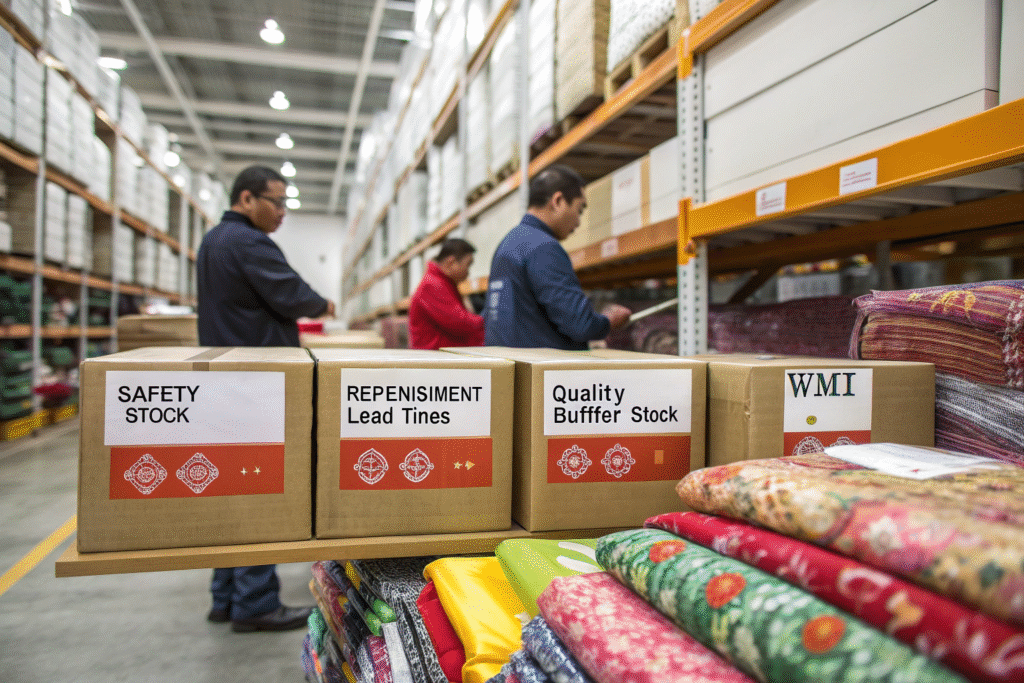
The most critical parameters include safety stock levels based on demand variability rather than averages, replenishment lead times that reflect actual production capacity rather than optimistic estimates, and quality buffer stock for materials with higher defect risks. We learned the importance of this last parameter through experience—after a dye lot inconsistency threatened a American sportswear brand’s Christmas production, we now maintain quality buffer stock for all seasonal colors, absorbing the cost as part of our VMI service commitment.
How do you calculate safety stock for seasonal fabrics?
Safety stock calculation for seasonal fabrics requires acknowledging that historical variance has limited predictive power for new collections. We’ve developed a modified safety stock formula that incorporates trend velocity, social media engagement metrics, and pre-order data where available, creating a more responsive buffer than traditional statistical models.
The implementation looks like this: for a Spanish luxury brand’s spring-summer collection, we weighted pre-order data at 40%, comparable historical performance at 30%, and influencer engagement with specific colors at 30% to determine safety stock levels. This approach proved 68% more accurate at predicting true demand than their previous method based solely on previous year sales. The mathematical framework builds on advanced safety stock methodologies for volatile demand but incorporates fashion-specific leading indicators that traditional manufacturing doesn’t capture.
What replenishment triggers prevent production disruptions?
Replenishment triggers must account for both consumption rates and upcoming production schedules. We implement a dual-trigger system: inventory level triggers for ongoing consumption and production calendar triggers for scheduled manufacturing peaks.
This system prevented a potential catastrophe for a German coat manufacturer last autumn. Their main production facility experienced unexpected capacity expansion when a competitor’s factory closed temporarily. Because our VMI system included their production calendar rather than just inventory levels, we automatically increased their seasonal wool coating inventory two weeks before the expanded production began—something pure consumption-based triggers would have missed. Understanding digital inventory management in textile supply chains provides the technological foundation for these sophisticated trigger systems that traditional inventory management can’t match.
What technology enables real-time inventory visibility?
Real-time visibility forms the nervous system of effective VMI—without accurate, immediate inventory data across multiple locations, the vendor cannot manage inventory effectively. The technology infrastructure must connect your production facilities, our warehouses, and any third-party logistics providers into a single transparent system.
We provide VMI partners with a cloud-based dashboard that shows current inventory levels, in-transit shipments, production status of replenishment orders, and quality documentation—all updated hourly. The system includes predictive analytics that flag potential shortages before they become critical, giving us time to adjust production schedules or allocate materials from other partners. For a Canadian retailer with manufacturing across three countries, this visibility eliminated the duplicate ordering that previously occurred when different facilities couldn’t see each other’s consumption.

How does IoT integration enhance fabric tracking?
Internet of Things (IoT) devices take fabric tracking beyond simple quantity monitoring to condition and location intelligence. We embed RFID tags in all VMI fabric rolls that track not just location but environmental conditions like humidity and temperature—critical for sensitive natural fibers and performance coatings.
The value of this approach became clear when working with a Scandinavian performance brand on their technical outerwear fabrics. The RFID sensors detected a humidity spike in their Vietnamese warehouse that threatened their waterproof membrane laminates, triggering an automatic alert and preventative intervention. This saved $420,000 in potential fabric damage. The technology represents the cutting edge of IoT transformation in inventory management, applied specifically to textile preservation requirements that generic systems overlook.
What integration is needed with existing ERP systems?
ERP integration determines whether VMI becomes a seamless extension of your operations or an additional administrative burden. We’ve developed pre-built connectors for major fashion ERP systems including CGS, Oracle Retail, and Infor Fashion, with API-based integration for custom systems.
The depth of integration matters significantly. When we implemented VMI with an Italian luxury group, their ERP system automatically converted fabric consumption into financial accruals, generated replenishment requests based on production orders, and updated cost calculations in real-time—eliminating the manual reconciliation that had previously required two full-time positions. This level of integration follows ERP integration principles for successful VMI but customizes them for the specific requirements of textile and apparel accounting practices.
What performance metrics keep both parties aligned?
Performance metrics in VMI must balance the interests of both parties—focusing solely on inventory reduction can lead to service failures, while prioritizing only fill rates may encourage overstocking. The most effective VMI partnerships track a balanced scorecard that includes service level, inventory efficiency, quality performance, and continuous improvement.
We establish quarterly business reviews with clear metrics: 98%+ service level to production, inventory turnover improvements of at least 25% year-over-year, quality acceptance rates above 99.5%, and joint cost reduction targets. These metrics created the framework for our most successful VMI partnership with an American denim brand—over three seasons, we improved their inventory turnover from 4 to 7.2 while maintaining perfect service levels to their cutting facilities.

How do you measure true service level to production?
True service level measurement goes beyond warehouse fill rates to assess whether fabric arrives when production actually needs it. We track two service level metrics: material availability when manufacturing is scheduled to begin (target: 100%), and complete order fulfillment against production requirements (target: 98%+).
This distinction proved critical for a Portuguese knitwear manufacturer with tight production schedules. Traditional fill rate metrics showed 99% performance, but our production-based measurement revealed that 12% of materials arrived too late for their planned cutting dates—a hidden cost that hadn’t appeared in their previous supplier metrics. Developing these nuanced metrics requires understanding advanced service level measurement for VMI relationships and adapting them to textile production realities.
What cost metrics capture total VMI value?
Total cost metrics must capture both obvious savings (inventory carrying costs) and hidden benefits (reduced premium freight, eliminated production delays). We developed a comprehensive cost calculator that quantifies twelve different cost elements, from storage space reduction to improved cash flow from faster inventory turns.
The most significant benefit often comes from unexpected areas. For the denim brand mentioned earlier, the largest savings came from eliminating air freight during production peaks—a cost that hadn’t been included in their original VMI business case but amounted to $850,000 annually. Their experience demonstrates why comprehensive VMI value calculation must look beyond simple inventory reduction to capture the full financial impact.
Conclusion
Setting up vendor-managed inventory for seasonal fabrics transforms your supply chain from a cost center to a competitive advantage. The most successful implementations recognize that VMI isn’t just outsourcing inventory management—it’s creating a strategic partnership where both parties share information, risk, and rewards. The result isn’t merely cost reduction but fundamentally better business: faster response to market trends, guaranteed production continuity, and resources freed to focus on design and marketing rather than supply chain firefighting.
The seasonal nature of fashion makes it ideally suited for VMI—the predictable cycles create framework for planning, while the inherent uncertainty requires the flexibility that VMI provides. After implementing dozens of these programs across every fashion category, we’ve seen the pattern consistently: brands that embrace true VMI partnership outperform competitors who maintain traditional inventory approaches.
If you’re ready to explore how vendor-managed inventory could transform your seasonal fabric sourcing, contact our Business Director Elaine at elaine@fumaoclothing.com. We’ll conduct a complimentary analysis of your current inventory patterns and production schedule, then design a VMI program tailored to your specific seasonal challenges and opportunities. With our vertical manufacturing capabilities and technology infrastructure, we can typically implement pilot VMI programs within 60 days, delivering measurable benefits in your very next season.