Let’s be honest – I’ve been in this fabric business for over twenty years, and this question? It comes up all the time. Choosing between polyester and silk chiffon isn’t just a technical decision – it’s emotional, really. It impacts your budget, your design vision, everything. Personally I think many of our clients, especially those ordering from the U.S., they struggle with this exact balance. Cost on one side, that undeniable quality on the other.
Here’s the real breakdown – and I’m not afraid to say it: polyester chiffon gives you affordability, honestly, and serious durability – perfect for big orders where budget’s tight. Silk chiffon? That’s your go-to for pure luxury – a natural sheen, breathability… it’s in a league of its own, but the price? Well, it shows.
Navigating this doesn’t have to be a nightmare, though. This guide – built on our two decades of shipping worldwide – will break it all down. Cost, quality, the best uses… we’ll cover it. Let’s get into the nitty-gritty, the stuff that actually affects your bottom line.
What are the real cost differences – I mean, the genuine numbers?
When you’re placing an order, the price per meter – that’s the first thing you look at, right? The difference between polyester and silk chiffon… it’s not small. It comes down to their origins, to be honest. Polyester is man-made, from petroleum – mass-produced, costs kept low. Silk? A natural protein fiber. It comes from silkworms – a process that’s labour-intensive, time-consuming… honestly, it’s an art.
Look at the numbers – just look. Wholesale polyester chiffon typically sits between $1.5 and $4 per meter. Silk chiffon? It starts at around $15. Can easily go past $30. So you’re looking at something that’s 5 to 10 times more expensive. That initial cost – it’s a huge part of your final calculation. For large runs, this difference… it’s massive.

How do the raw materials – you know, the source – actually set the price?
The journey of the raw materials – it’s a huge part of the story. Polyester relies on petrochemicals. The whole process is industrialised, scalable. Costs are stable – mostly. They shift with global oil prices, but generally, it’s moderate. The materials are abundant, which… well, it keeps everything down.
Silk – that’s a different world. It depends on sericulture. Farming silkworms. It’s delicate, it can’t be rushed. You need thousands of silkworms – thousands – for just one kilogram of silk thread. And it’s vulnerable. To disease, to environmental factors. Supply shortages happen. Price volatility? Part of the deal. The labour involved in harvesting, reeling the filaments… it all adds up. When you choose silk, you’re paying for a rare, natural resource. Personally I think it’s worth it – for the right project.
And the hidden costs – what don’t you see on the price tag?
The price per meter… it’s just the opening act. You’ve got to consider processing. Handling. Silk chiffon is delicate. It needs special handling – during cutting, sewing. You might need more experienced staff, a slower production line. That increases labour costs. And dry cleaning – usually a must. That affects the care labels, the customer’s experience.
Polyester chiffon – sturdier, yes. But sometimes it needs extra finishing. To make it feel softer, like silk, it might need chemical treatments. But its durability means fewer damaged goods – a better yield, overall. Then there’s shipping. Both are lightweight, true. But a large silk order represents a much higher value crammed into a small space – insurance costs can reflect that. Thinking about eco-options? Certified recycled polyester might carry a small premium – but it aligns with modern goals.
How does the quality and performance – in daily, real use – really compare?
Beyond the cost, how the fabric behaves – how it lasts – that’s what matters to the person wearing it. The performance gap here is… wide. Silk chiffon is known for its luxury. A soft, slightly dry hand feel. A subtle luster – hard to replicate, actually. It’s breathable – comfortable on the skin. But it’s delicate. It can snag. It can tear.
Polyester chiffon – inherently stronger. More durable. It resists wrinkles, shrinking – better than silk, in my experience. Its colourfastness is generally superior – vibrant prints, dyes, they last. Through washes, sunlight. The downside? Sometimes a plastic-like feel – if it’s not finished well. Less breathable. Can be uncomfortable in the heat. Modern finishing, though – it’s closing that gap.

Which fabric, honestly, offers better durability and easier care?
For durability and easy care – and I’m being straight with you – polyester chiffon wins. Its synthetic fibers are strong. Resistant to abrasion, tearing – in the factory, in daily life. Machine washable. Holds its shape. Dries fast. Little to no ironing. This easy-care profile – it’s a major selling point for everyday wear.
Silk chiffon – it demands patience. Gentle care. Almost always dry cleaning. Or very, very careful hand washing. Cold water, mild detergent. It weakens when wet. Harsh spinning? Wringing? Can damage it. It wrinkles – so easily. Needs a cool iron. It’s delicate, yes. But its natural protein structure gives it a hidden strength – when dry. Its value is in its luxury, not its toughness.
Drape, sheen, hand feel – how do they actually differ to the touch?
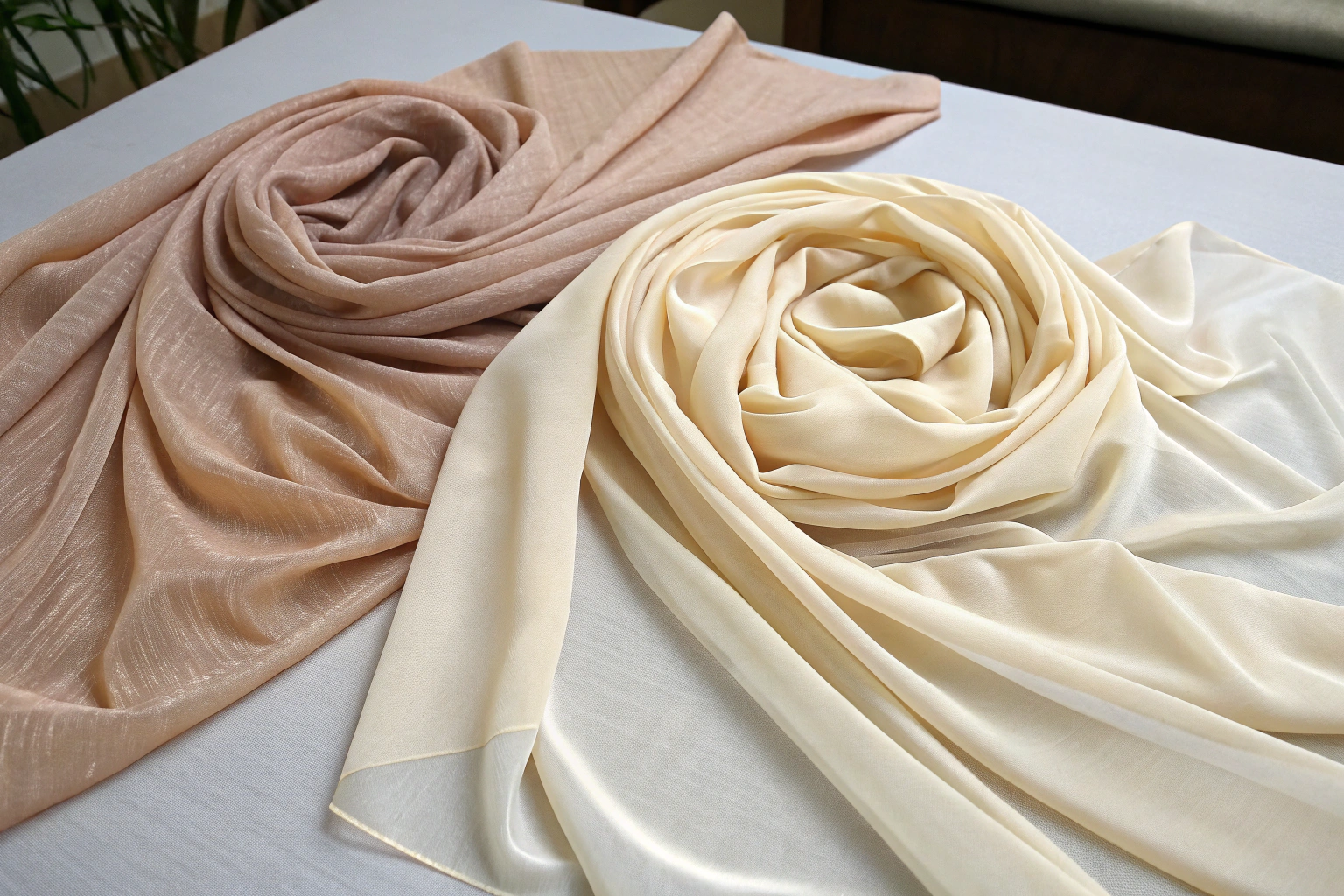
The aesthetic side – the feel – this is where it gets personal. Silk chiffon has a drape that’s… exquisite. Fluid, graceful, elegant. Its sheen is natural. Soft. Luminous – not shiny. The hand feel is lightweight, soft. A unique, slightly textured grip – not slippery. This combination… it’s why silk means luxury.
Polyester chiffon – the drape is good. But it can feel heavier. Less fluid than silk of the same weight. The sheen is often brighter. More consistent – which can look less natural, to be honest. The hand feel ranges – from crisp to soft, depending on the finish. But with advanced techniques – we can make polyester that mimics silk’s dry, soft feel. It’s a fantastic alternative, cost-wise.
Which chiffon is genuinely better for sustainable production – what’s the real story?
Sustainability – it’s not a trend anymore, it’s core. The environmental story for both fabrics? Complicated. Polyester comes from a non-renewable resource – petroleum. Not biodegradable. But the industry has moved forward – recycled polyester (rPET), made from plastic bottles, it reduces waste. Lowers energy use, significantly.
Silk – natural, biodegradable. The farming of mulberry trees can be sustainable. But traditional production… it has its issues. It can be water-intensive. And the common practice – boiling cocoons with the live silkworm inside – it raises ethical questions for some. Peace silk is an alternative – lets the moth emerge. But it’s more expensive, and the fiber? Often shorter, less lustrous.

What are the true environmental impacts – the full picture?
Polyester’s main issue – fossil fuels. Microplastic pollution, especially when washed. Not biodegradable. It sits in landfills – for centuries. The production is energy-intensive, can involve chemicals. On the plus side? Its durability means clothes last. And rPET offers a more circular model. At our place, our green investment lets us offer GRS-certified rPET chiffon – it meets modern demands.
Silk’s impact is mostly agricultural. Mulberry trees – they’re good for the soil. Don’t need heavy pesticides. The main impacts are land use, water use – for the trees and the degumming process. And the ethics of silkworm cultivation. But it’s a natural protein fiber – completely biodegradable. It returns to the earth. No synthetic microfibers left behind. That’s a powerful thing to market.
How do certifications – the real, verifiable ones – guide an eco-choice?
Certifications – they’re your best friend for verifying claims. For polyester chiffon, look for the Global Recycled Standard (GRS) or the Recycled Claim Standard (RCS). They trace the recycled content – give you confidence. OEKO-TEX Standard 100 – crucial for both. Tests for harmful substances. Ensures skin safety.
For silk, organic certifications exist – but they’re less common than for cotton. They govern the farming – no synthetic pesticides, fertilizers. A universal organic standard for silk isn’t fully established yet. So you look for transparency. Suppliers who are open about their practices. Partnering with a supplier like us – with a CNAS-lab for testing – it’s essential for a genuine sustainable choice.
How do you match the right chiffon – I mean, the perfect one – to your specific product line?
Making the final call – it’s about alignment. Your product’s purpose, your market, your business model. There’s no single answer. You weigh the factors – cost, performance, aesthetics, sustainability – against your specific goals. A detailed analysis of your collection’s needs… it points the way.
We often suggest a simple decision matrix. List your key priorities. Budget, luxury feel, durability, washability, eco-credentials. Weight them – by importance. Then score both fabrics. The one with the highest score? That’s your likely winner. It takes the emotion out – grounds the choice in strategy.

When should you, honestly, choose polyester chiffon for your designs?
Choose polyester chiffon when your priority is, frankly:
- Budget Control – High-volume production, where cost per unit is everything.
- Durability & Easy Care – Garments for frequent wear, machine washing a must.
- Vibrant, Lasting Prints – Excellent colourfastness for those bold digital designs.
- Consistency & Availability – A steady supply, uniform quality – for big, reliable orders.
- Sustainable rPET Options – An eco-friendly angle, without silk’s high cost.
It’s the workhorse – for fast fashion, contemporary brands, large-scale lines.
And when is silk chiffon – no question – the only right choice?
Choose silk chiffon when your priority is unmistakably:
- Ultimate Luxury – High-end collections, evening wear, bridal – where the fabric makes the statement.
- Superior Drape & Aesthetics – That specific, fluid, graceful fall – nearly impossible to fake.
- Natural Fiber Benefits – Marketing a 100% natural, biodegradable product to a discerning clientele.
- Brand Prestige – The "silk" label – it carries weight, justifies a premium price.
It’s the fabric for when experience, feel, and status trump practicality and cost.
Conclusion
Choosing between polyester and silk chiffon – it’s a fundamental decision. It balances cost against quality, application. Polyester chiffon – affordable, durable, low-maintenance. A smart, strategic pick for volume-driven fashion. Silk chiffon – the champion of luxury. Unmatched drape, natural sheen, breathability. For high-end, aspirational pieces – it’s still king.
We at Fumao Textiles – we’re here to do more than just sell you fabric. We co-create value. We offer samples, technical data, insights from twenty-plus years in the game. Let us help you make the perfect choice. If you’re ready to source top-quality chiffon and develop your own line with a partner you can trust, get in touch with our Business Director, Elaine. She’ll make sure you get the service and guidance you need. Honestly, just reach out. Contact Elaine directly at elaine@fumaoclothing.com – and let’s start this conversation.