
Navigating US customs clearance presents significant challenges for fabric importers, primarily because missing or incorrect documentation can trigger a chain reaction of negative consequences. Specifically, incomplete paperwork often leads to customs holds, which subsequently cause costly delays, storage fees, and even shipment rejections. Having witnessed these issues repeatedly with clients over our 20 years in the textile industry, I’ve identified that the root cause typically stems from insufficient understanding of US Customs and Border Protection’s (CBP) precise documentation requirements. Consequently, this documentation uncertainty disrupts supply chain timelines and ultimately impacts your profitability.
The solution lies in systematically preparing a complete document package centered around three core documents: the Commercial Invoice, Packing List, and Bill of Lading, supplemented by specialized certificates for fiber content and origin. Mastering this documentation process serves as your primary defense against customs complications. Therefore, proper preparation ensures your quality fabrics reach production facilities without unnecessary interruptions.
Let’s examine this process step by step. Understanding these requirements proactively will save time and resources while minimizing stress, ultimately allowing you to concentrate on your core business of creating exceptional apparel.
What is the essential documents checklist for fabric import?
Implementing a systematic checklist approach transforms complex customs procedures into manageable tasks. Without such a system, importers frequently overlook critical documents, as demonstrated by a recent client experience: they encountered a two-week customs delay simply because they omitted a single certificate. Following that incident, we developed a comprehensive checklist that has since prevented similar occurrences for all our partners.
The foundational documents for US fabric import consist of the Commercial Invoice, Packing List, Bill of Lading, and Certificate of Origin, which collectively form the basis of your customs entry. These documents provide CBP with essential information for shipment assessment. Moreover, they establish the framework for additional specialized documentation that might be required based on fabric type and origin.

Why is a detailed Commercial Invoice non-negotiable?
The Commercial Invoice serves as the cornerstone of your customs submission because it comprehensively describes the goods, their value, and origin. When this document contains vague or inaccurate information, it immediately raises red flags with customs officials. Therefore, it must precisely identify both buyer and seller while providing detailed fabric descriptions including fiber composition, weight, width, and construction specifics. At our company, we generate meticulously prepared invoices that incorporate all required elements, which has consistently prevented clearance issues at US ports. For authoritative guidance, consult the U.S. Customs and Border Protection official page on invoices. Additionally, correct Harmonized System (HS) code assignment proves crucial, which you can verify using International Trade Administration’s resources.
How does the Bill of Lading facilitate your shipment?
The Bill of Lading functions as a triple-purpose document: shipping contract, goods receipt, and title document. Its importance becomes evident when considering the two primary variants – "Telex Release" for electronic shipments versus "Original" hard copies – with the former generally enabling faster processing. Since any discrepancy between the BL and other documents triggers customs complications, we coordinate closely with logistics partners to ensure perfect alignment. Consequently, our integrated supply chain management guarantees accurate documentation synchronization, eliminating mismatched document concerns for our clients.
How to ensure compliance with fabric product description?
Inaccurate product descriptions represent one of the most frequent and costly customs errors because they prevent proper tariff classification and regulation enforcement. For instance, generic descriptions like "fabric roll" inevitably prompt customs queries and physical examinations. Therefore, precision in product description isn’t merely beneficial but mandatory for smooth clearance.
Compliant fabric descriptions must systematically include five key elements: material composition, weight per square meter, width, construction type, and intended use. This comprehensive approach enables customs to accurately classify fabrics under the Harmonized Tariff Schedule (HTS). Accordingly, we embed this detailed information directly into all product documentation and commercial invoices to ensure complete transparency.
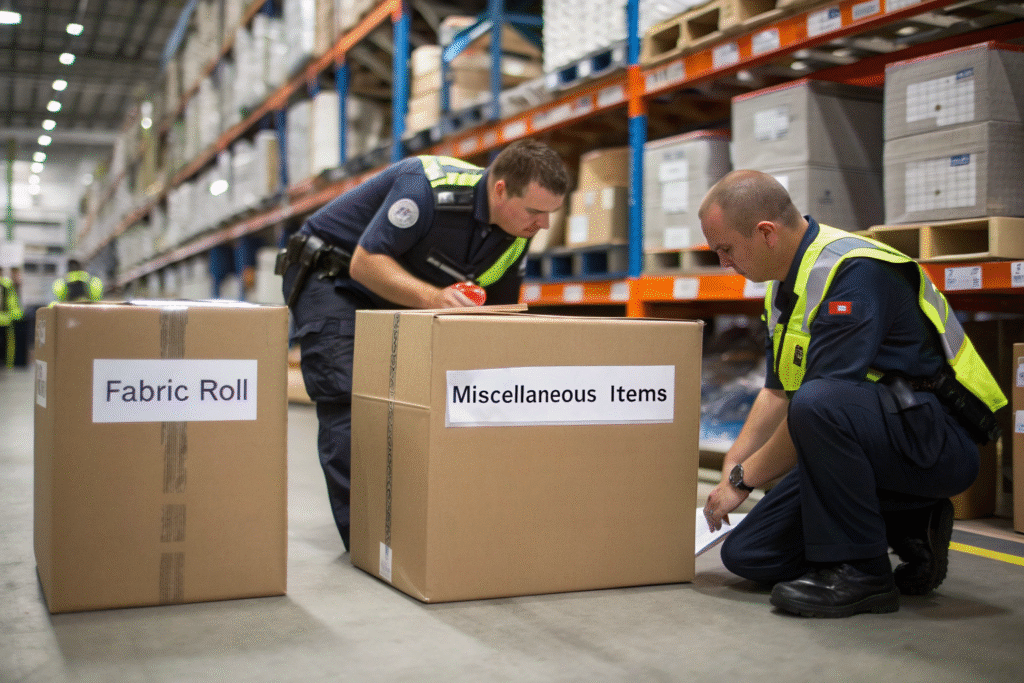
What specific details must a fabric description include?
Effective fabric descriptions eliminate ambiguity by incorporating precise technical specifications. For example, instead of "Polyester Fabric," the description should read "100% Recycled Polyester, 140GSM, 58-inch width, Plain Weave, Knitted Fabric for Sportswear." This detailed approach encompasses all critical characteristics that customs officials require. Our CNAS-accredited testing center provides verified composition and weight data that we integrate directly into documentation. This practice aligns with detailed specification requirements from major brands, further detailed by the American Apparel & Footwear Association (AAFA).
Why is the correct HTS code critical for tariffs?
The HTS code directly determines duty rates, making accurate classification financially crucial. When codes are incorrect, importers face either overpaying duties or penalties for underpayment. Since code assignment depends entirely on detailed product descriptions, we provide partners with precise technical specifications needed for proper HTS determination. As a result, our 20 years of industry expertise helps clients avoid unexpected costs while ensuring full customs compliance.
Are there special certificates needed for fabric imports?
Beyond core documentation, certain fabrics require specialized certificates addressing fiber content, origin, or safety characteristics. Overlooking these supplementary documents proves equally damaging as missing primary documentation. Therefore, our quality control team proactively identifies certificate requirements specific to each shipment.
Special certificates are frequently necessary, most commonly Certificates of Origin (for preferential duty treatment) and fiber-specific documentation for materials like cotton or wool. For example, cotton shipments often require additional documentation verifying origin and confirming absence from sanctioned regions.

When is a Certificate of Origin mandatory?
Certificates of Origin become mandatory when shipments claim preferential duty treatment under free trade agreements. Even without preferential claims, some CBP ports request non-preferential COOs to verify manufacturing origin. We guide clients through this process to obtain correct COOs, potentially generating significant duty savings. Furthermore, our expertise with "Belt and Road" and RCEP initiatives helps navigate complex origin rules for client benefit.
What certifications prove eco-friendly or functional claims?
Fabrics with special claims require supporting certifications to validate marketing statements and prevent customs issues. For organic cotton, GOTS (Global Organic Textile Standard) certification represents the global benchmark. Similarly, performance fabrics need test reports from accredited labs like SGS or our CNAS-certified facility. Consequently, we provide relevant certifications and test reports as standard service components, ensuring claim validation and compliance.
How to manage logistics and financial documents smoothly?
The final documentation phase involves coordinating transport and financial instruments that connect sellers, buyers, shippers, and customs. Inefficiency here can delay otherwise perfectly prepared shipments, making systematic management essential.
Efficient document management requires reliable freight forwarders, proper insurance certificates, and clear payment terms understanding through instruments like Letters of Credit. Implementing proactive approaches to these documents prevents last-minute complications.

What is the role of a freight forwarder in documentation?
Freight forwarders act as documentation coordinators, preparing Bills of Lading, arranging insurance certificates, and submitting Importer Security Filings (ISF) to US customs 24 hours before loading. Through our established relationships with trusted forwarders understanding textile industry specifics, we ensure all transport documents remain synchronized and timely submitted. This coordination leverages Keqiao’s multimodal hubs for optimal efficiency.
How do payment methods impact document preparation?
Payment methods directly determine required financial documents. Letters of Credit demand strict document conformity to LC terms, where any discrepancy causes banks to refuse payment. Alternatively, T/T payments involve direct document transmission to importers. Our experienced team excels at preparing LC-compliant documents, supported by strategic banking partnerships that ensure uninterrupted cash flow for bulk orders.
Conclusion
Successful fabric importation into the US fundamentally depends on meticulous, systematic document preparation. From foundational Commercial Invoices and Bills of Lading to specialized Certificates of Origin and product testing reports, each document plays an interconnected role in seamless customs clearance. By thoroughly understanding these requirements and partnering with a supplier possessing integrated quality control and documentation expertise, you can eliminate delays, control costs, and maintain reliable supply chains.
Ready to streamline fabric sourcing and eliminate customs uncertainties? Let’s discuss your next project. For comprehensive partnership covering development through delivery, contact our Business Director Elaine at elaine@fumaoclothing.com. We’re committed to helping weave your success story.