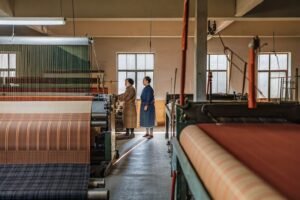
You’ve just pulled a “crimson red” linen blazer out of the shipping box, rubbed a white tissue against the sleeve, and watched in horror as pink dye transferred onto the paper like cheap lipstick. That sinking feeling is the realization that your entire production run might be a liability. Color fastness failure is not a cosmetic flaw; it’s a business-ending catastrophe waiting to happen. A customer wears your linen dress on a sweaty summer day, and the dye bleeds onto their leather car seat. A boutique owner steams a wrinkled linen shirt before display, and the color fades unevenly under the heat. These are not hypothetical scenarios—they’re real warranty claims that destroy wholesale relationships and trigger chargebacks. The textile industry is littered with brands that chose a “visually identical” cheap linen, only to discover that the dye sat on the fiber surface like a bad paint job, ready to peel at the first sign of moisture or friction.
Yes, we absolutely guarantee a 4.0+ rating on the key fastness indicators—washing, rubbing, and light—for our premium linen range, and we back that guarantee with a CNAS-accredited lab report shipped alongside your bulk order. At Shanghai Fumao, we don’t guess about color fastness; we engineer it into the fiber before the dye bath ever touches the fabric. Linen is a notoriously difficult fiber to dye because its smooth, crystalline cellulose structure resists dye penetration. Cheap mills take shortcuts: they over-use salt to force the dye, creating a weak bond that washes out, or they skip the post-dye soaping step, leaving unfixed dye molecules on the surface. Our process is entirely different. We use a two-stage reactive dyeing protocol with a controlled temperature ramp, a precise alkali dosing curve, and a high-temperature soaping-off at 95°C that strips away every unfixed dye molecule. The result is a covalent chemical bond between the dye and the linen fiber—not a surface coating that rubs off on a white leather couch.
I’ve stood next to our lab technicians running wet-rub crock tests on our navy linen, watching the white cloth come back practically spotless, and I know the peace of mind that a 4.0+ rating delivers to a brand owner. In this article, I’ll break down exactly how we test, how we engineer the color bond, and how you can verify the rating yourself before you cut a single meter.
What Are the Key Color Fastness Tests for Linen Fabric?
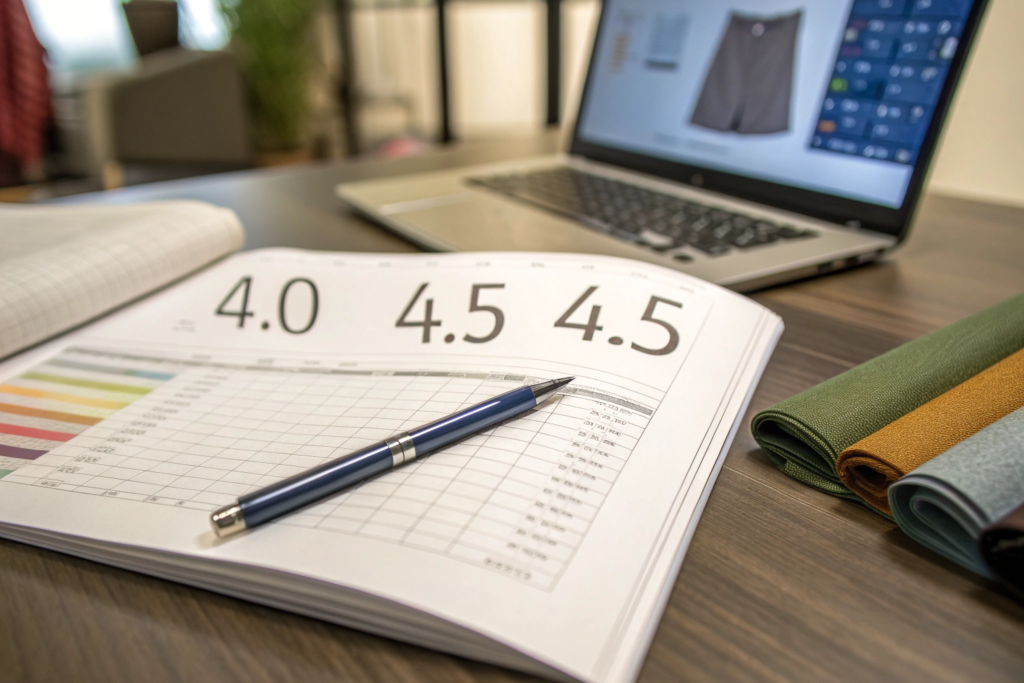
You’ve seen a technical data sheet listing numbers like “4.0, 4.5, 4-5” and nodded along, but you don’t actually know what specific tortures those numbers represent. This knowledge gap is risky. Without understanding the test methods, you can’t ask the right questions, and a supplier can cherry-pick the one test that passes while hiding the ones that fail. A linen that scores a 4.5 on dry rubbing might collapse to a 2.0 on wet rubbing, which is exactly the condition that destroys a garment—sweat, rain, or a spilled drink. The fastness rating is not a single number; it’s a profile of performance across multiple real-world abuse scenarios.
The “Big Three” fastness tests for linen are: color fastness to washing (ISO 105-C06), color fastness to rubbing (ISO 105-X12), and color fastness to light (ISO 105-B02). Washing fastness measures how much color bleeds into the wash water and transfers to an adjacent white fabric during a standardized laundry cycle at 40°C with detergent and steel balls for mechanical agitation. Rubbing fastness uses a Crockmeter—a robotic finger that rubs a dry or wet white cotton cloth against the dyed linen under a fixed pressure of 9 Newtons for 10 cycles. Light fastness exposes the linen to a Xenon arc lamp that simulates intense sunlight, and we compare the fading to a set of Blue Wool standards numbered 1 (worst) to 8 (best). At Shanghai Fumao, we test all three for every dye lot and report the results transparently. A 4.0+ rating on washing means the color change on the linen itself is negligible and the stain on the adjacent white fabric is minimal—barely visible to the untrained eye.
Beyond the Big Three, there are specialized tests for specific end-uses. Color fastness to perspiration (ISO 105-E04) simulates the alkaline and acidic conditions of human sweat—critical for linen shirting and activewear. Color fastness to water (ISO 105-E01) tests the bleeding when the fabric is soaked in distilled water under pressure, which matters for table linens that encounter spills. We also run a “color fastness to chlorinated pool water” test (ISO 105-E03) for our swimwear linen blends. The point is: a real 4.0+ guarantee covers the tests relevant to your product, not just the easiest one to pass.
How Does the Wet Rub Test Predict Real-World Color Transfer?
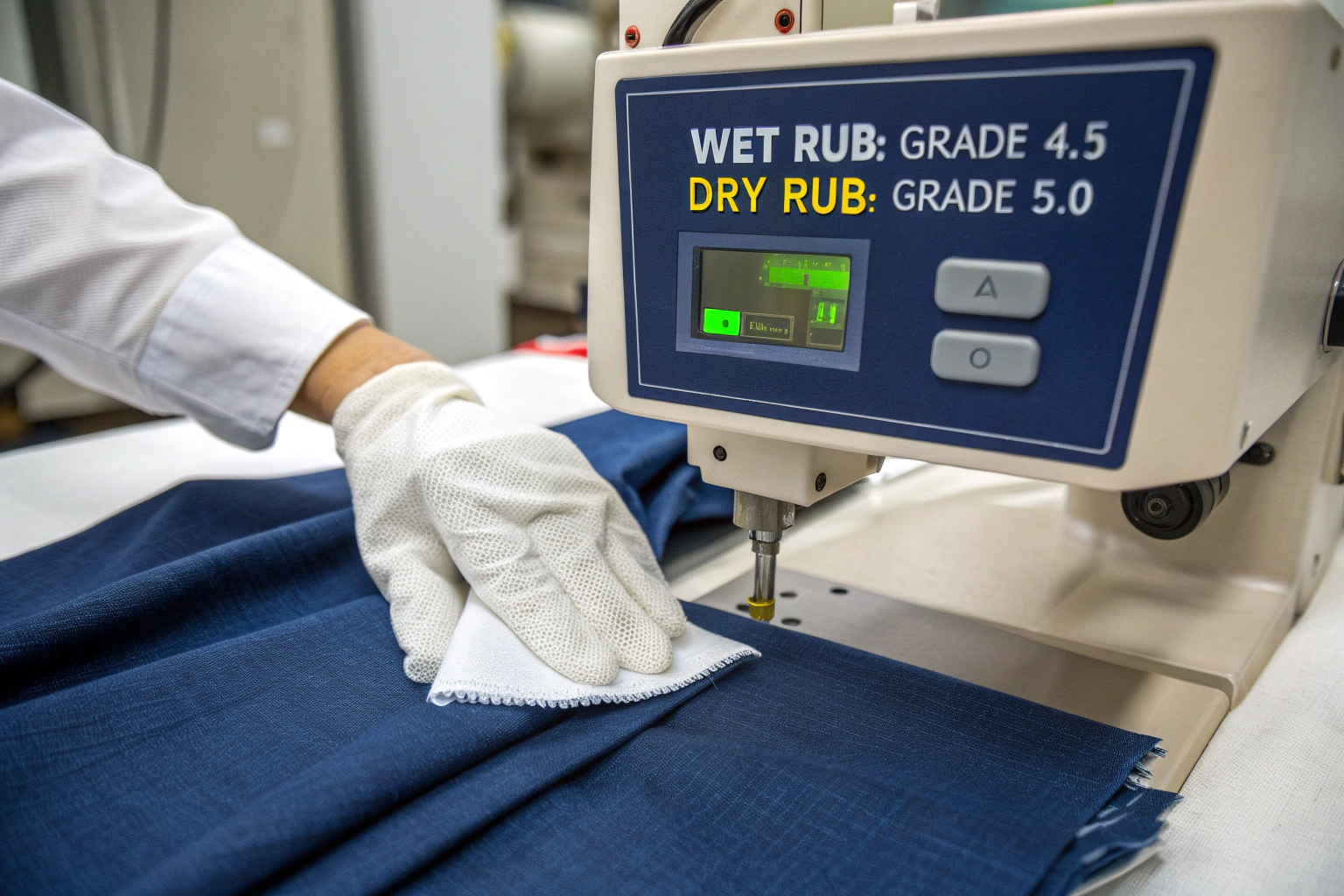
The wet rub test is the most brutal and honest of the fastness tests because it simulates the exact scenario that generates customer complaints: a damp white cloth rubbing against a colored fabric under pressure. Imagine a customer spilling water on a navy linen napkin and blotting it with a white paper towel. If the towel turns blue, your brand looks cheap. The Crockmeter replicates this with mechanical precision, eliminating human variability.
The test uses a cylindrical rubbing finger wrapped in a standard white cotton cloth, wetted to exactly 95-100% moisture pickup, and rubbed back and forth 10 times across the dyed linen in a straight line. After drying, the white cloth is compared against the ISO 105-A03 grey scale for staining. A Grade 4.0 means the stain is equivalent to Step 4 on the 5-step grey scale—a very faint discoloration that most consumers would not notice. A Grade 4.5 is nearly invisible. Our linens consistently achieve 4.0-4.5 on wet rub because we aggressively soap-off the unfixed dye. We don’t rush the post-dye wash; we run it until the final rinse water is crystal clear.
Why Is Light Fastness Crucial for Linen Upholstery and Apparel?
Linen is the fabric of summer, which means it lives in direct sunlight—draped on a chair near a window, worn on a beach boardwalk, or displayed in a sun-drenched boutique. Light fastness measures the fabric’s resistance to photodegradation of the dye. Sunlight is high-energy ultraviolet radiation that breaks chemical bonds, and certain dye colors—especially bright reds, turquoises, and yellows—are notoriously susceptible to fading.
We test this using a Xenon arc lamp in a Q-SUN chamber, exposing the linen to a controlled spectrum that matches summer noon sunlight. The exposure continues until a Blue Wool Standard 4 shows a specific degree of fading, which typically takes about 80-100 hours. We then compare the linen sample’s fade to the Blue Wool scale. A rating of 4.0 means the linen faded at a rate equivalent to the Blue Wool Standard 4, which is acceptable for apparel worn outdoors occasionally. For contract upholstery, we recommend a 5.0+ rating, which we achieve by using high-lightfastness reactive dyes specifically formulated for linen. This is an upcharge, but it’s mandatory for any furniture that sits near a window.
How Does Fiber Preparation Affect Linen’s Dye Uptake?
Dyeing linen is like trying to stain a polished glass window—the dye just wants to slide off. This is because raw flax fiber has a dense, crystalline cellulose structure with a waxy outer cuticle that repels water-based dye solutions. If you throw greige linen directly into a dye bath, you get a pale, blotchy, uneven mess that washes out in the first laundry cycle. The dye hasn’t penetrated; it’s just clinging weakly to the surface. The secret to a 4.0+ rating starts long before the dye is mixed—it starts in the pretreatment and scouring stage.
At Shanghai Fumao, we run a multi-stage pretreatment protocol specifically designed to open up the linen’s fiber structure without damaging its natural strength. First, we scour the greige fabric in a high-temperature bath at 95°C with a biodegradable surfactant and caustic soda. This strips away the natural waxes, pectins, and hemicellulose that block dye access. Second, we run a bio-polishing step with a cellulase enzyme that selectively etches away the surface fibrils, creating micro-pores that increase the fiber’s surface area for dye bonding. Third, we apply a “cationization” pre-treatment—a positively charged polymer that coats the cellulose fibers. Reactive dyes are negatively charged (anionic), so they electrostatically attract to the cationized linen like magnets. This increases the “dye exhaustion” rate—the percentage of dye that actually leaves the bath and attaches to the fiber—from a typical 60-70% up to 90-95%. More dye exhaustion means less unfixed dye floating around to cause poor wet-rub fastness later.
This scouring-biopolishing-cationization sequence takes an extra three hours per batch compared to a cheap shortcut scour, but it’s the foundation of every 4.0+ rating we issue. You can’t fix a bad pretreatment with extra dye; you just create a thick, unstable layer of surface color that looks great on day one and fails on day thirty. We’ve tested this in our lab repeatedly: the same navy reactive dye recipe on un-scoured linen yields a wet-rub fastness of Grade 2.0; on our fully pretreated linen, the same dye yields Grade 4.5.
What Is the Role of Scouring in Removing Linen’s Natural Waxes?
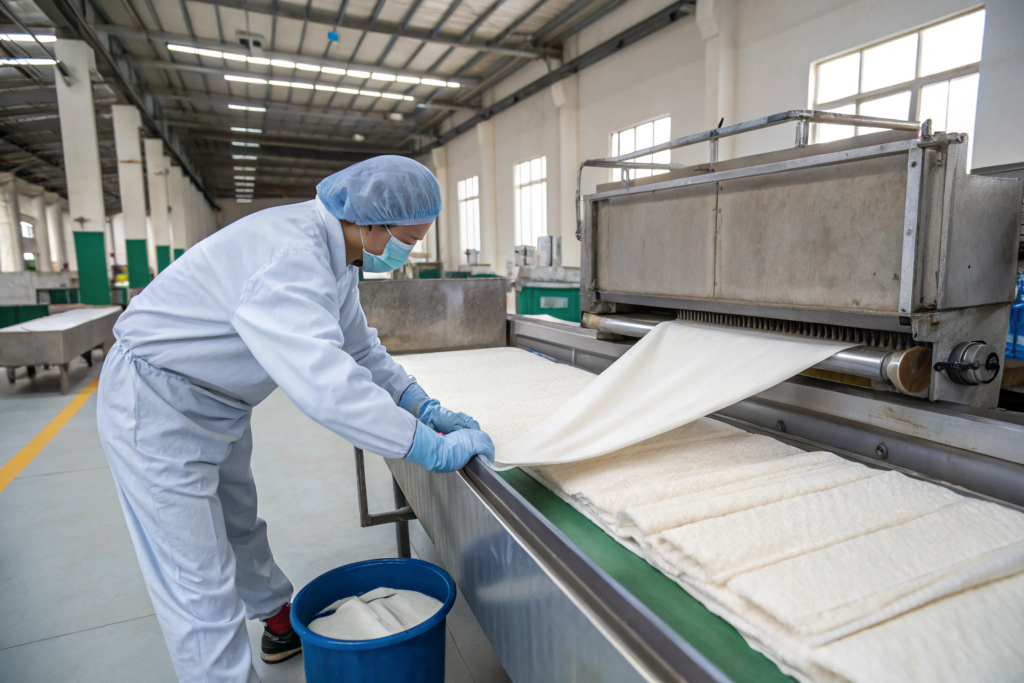
Raw flax fiber contains up to 30% non-cellulosic material by weight—waxes, pectins, lignins, and hemicelluloses. These are the fiber’s natural protective coatings, but to a dye molecule, they are impenetrable walls. Scouring is the chemical demolition of these walls. We use a combination of sodium hydroxide (caustic soda) at a concentration of about 3-5% on weight of fabric, plus a wetting agent that reduces the surface tension so the solution penetrates deep into the yarn core.
The caustic soda saponifies the waxes, converting them from water-repellent fats into water-soluble soaps that rinse away. It also swells the cellulose, breaking hydrogen bonds and making the fiber structure more amorphous and accessible. This swelling is critical because it creates internal voids where dye molecules can penetrate and anchor. The scouring step is run for 60-90 minutes at near-boiling temperatures, and we check completeness by measuring the fabric’s absorbency: a drop of water placed on a properly scoured linen must absorb in under 3 seconds. If it beads up, the scour was insufficient, and the dye fastness will suffer.
How Does Cationization Improve Reactive Dye Bonding?
Cationization is a relatively modern pretreatment that flips the electrical charge of the linen surface. Normal cellulose in water carries a slight negative charge (it’s anionic). Reactive dyes are also anionic—they have negative sulfonate groups that make them water-soluble. Like-charged particles repel, so a lot of dye stays in the water instead of migrating to the fiber. This wastes dye and creates a polluted waste bath.
Cationization applies a cationic polymer—usually a quaternary ammonium compound—that bonds to the cellulose and gives the fiber surface a permanent positive charge. Now, when the anionic reactive dye is added, it electrostatically “snaps” onto the fiber like a magnet. This attraction happens at room temperature, before any chemical fixation, so the dye is evenly distributed across the fiber surface. When we then add the alkali and raise the temperature, the dye is already in position to form the covalent bond. The result is much higher dye utilization, a deeper color with less dye, and dramatically less unfixed dye to wash off. This is a direct contributor to our 4.0+ wet-rub performance.
What Dyeing Techniques Produce the Best Linen Colorfastness?
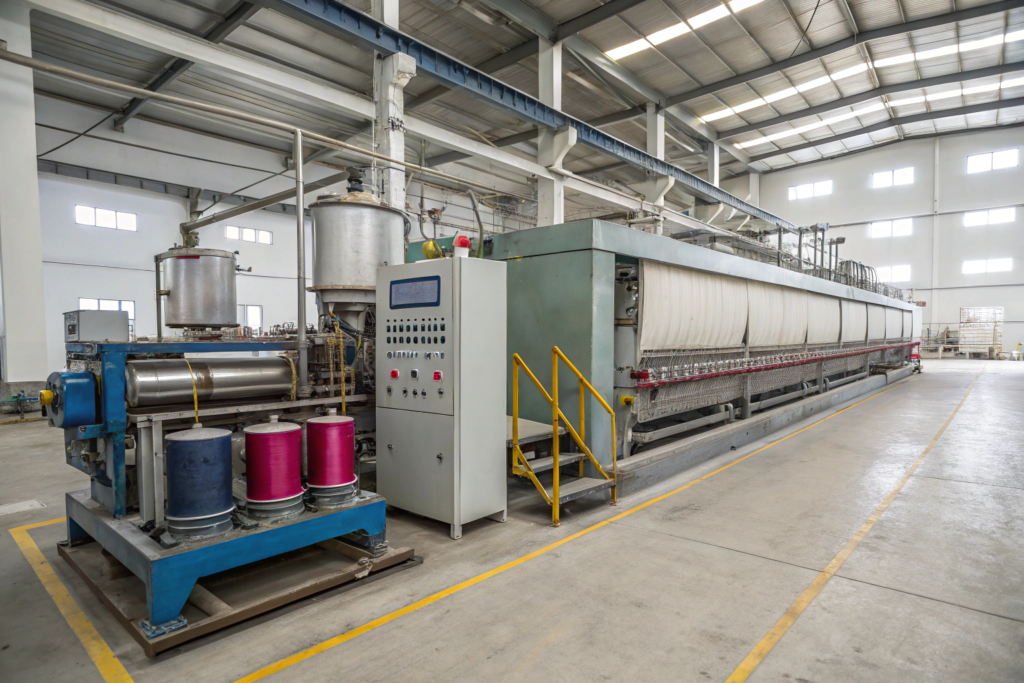
The dyeing machine and the recipe profile are just as important as the pretreatment. A poorly designed dye cycle can take a perfectly prepared linen and ruin its fastness potential. The core problem is heat management and alkali dosing. Reactive dyes form their permanent bond with cellulose in the presence of alkali at temperatures between 60°C and 80°C. If you dump all the alkali in at once, the dye fixes too quickly and unevenly, creating a surface “rush” of color that looks deep but is mechanically weak. This is the “ring dyeing” defect, where the dye only penetrates the outer surface of the yarn, leaving the core undyed. When you rub that fabric, the thin colored layer shears off.
At Shanghai Fumao, we use a “progressive alkali dosing” profile on our computer-controlled dyeing machines. The dye bath starts at 30°C with the reactive dye and the pretreated linen. We circulate for 15 minutes to allow even dye distribution (the migration phase). Then, we begin injecting the alkali—soda ash solution—not all at once, but in a linear ramp over 30-45 minutes. This slowly raises the pH from neutral to around 11.0, and we simultaneously raise the temperature to 60°C at a controlled rate of 1°C per minute. This gradual fixation allows the dye molecules to migrate deep into the fiber’s amorphous regions and form covalent bonds uniformly throughout the cross-section. The result is a “through-dyed” fiber where the color persists even if the surface is abraded.
After fixation, we don’t just rinse. We run a “high-temperature soaping” at 95°C with a specific detergent designed to strip unfixed hydrolyzed dye. This step runs for 20-30 minutes and is repeated until the rinse water is visually clear. Many mills cut this step short to save energy and time, but those saved 20 minutes are the exact reason their linen bleeds color. Our approach is simple: if the water isn’t clear, the fabric isn’t done.
Why Is a Two-Bath Dyeing Method Better Than All-in-One?
Some dyes—especially fiber-reactive dyes in deep shades like burgundy, navy, and black—require a two-bath process to achieve maximum fastness. The first bath applies the main dye color and fixes it with alkali. After the soaping-off, a second bath applies a “cationic fixative” or a “reactive reserve” treatment that further locks in any remaining loose dye molecules.
We use the two-bath method for all our dark-shade linens. The second bath is not more dye; it’s a clear chemical finish that cross-links the dye-fiber bonds and creates a protective, invisible barrier against water and friction. This adds about 45 minutes to the processing time and costs about $0.15 per meter in chemicals, but it bumps the wet-rub fastness from a borderline 3.5 to a solid 4.5. For a brand selling a $200 navy linen blazer, that $0.15 investment is the cheapest warranty insurance available.
How Do You Prevent “Crocking” with a Post-Dye Fixative?
Crocking—the transfer of dry dye powder from the fabric surface—is different from wet bleed. It happens when the dyed fabric is rubbed while dry, and loose, unfixed dye particles physically detach like dust. This is especially problematic for black and dark indigo shades. The post-dye fixative that addresses this is a cationic film-forming polymer. It wraps each fiber in a thin, flexible, transparent coating that physically glues down any residual surface dye particles.
We apply this fixative in the final bath after soaping, typically at 40°C for 15 minutes. The chemical is formaldehyde-free and OEKO-TEX certified, so it doesn’t compromise the fabric’s skin safety. It slightly stiffens the fabric, so we follow with a final pass through a mechanical softener to restore the natural linen hand-feel. The combination of thorough soaping plus cationic fixation is what allows us to guarantee a 4.0+ dry-rub rating, even on the most problematic dark colors.
Can You Test Linen Fastness at Home Before Production?
You’ve received a lab dip swatch from a supplier, and it looks beautiful. But you want to test it yourself before committing to a 2,000-meter order. You don’t have a Crockmeter or a Xenon arc lamp in your studio, but you do have a washing machine, a white towel, and a sunny windowsill. At-home testing won’t give you a certified grade number, but it will absolutely catch a catastrophic fastness failure before it becomes a financial disaster. The key is to replicate the mechanical action, moisture, and heat of the standardized tests as closely as possible with household items.
At Shanghai Fumao, we actually encourage our clients to do these “abuse tests” on our lab dip samples. We know our dyeing will pass, so it builds trust. For washing fastness, cut a 10cm square of the dyed linen and sew or safety-pin it to a same-sized square of white cotton poplin. Wash them together in a hot cycle (40-60°C) with a standard laundry detergent and a couple of old white towels for mechanical agitation. After the full cycle, separate the two fabrics and let them dry. Look at the white cotton: any pink, blue, or brown staining is a fail. Also, compare the washed linen to an unwashed swatch of the same fabric. Any obvious fading or color change is a warning sign. For rubbing fastness, take a clean white cotton cloth, dampen it with water, and rub it firmly back and forth 20 times on the dyed linen surface. If the white cloth picks up significant color, the wet-rub fastness is likely below Grade 3.0.
For light fastness, the windowsill test is a decent proxy. Tape half of the linen swatch covered with opaque cardboard, and leave the other half exposed in a south-facing window for two weeks. Remove the cardboard and compare the exposed vs. unexposed halves. Visible fading indicates a light fastness likely below Grade 4.0. These home tests are not laboratory-accurate, but they are brutally effective at identifying the bottom 20% of dye jobs that will generate customer complaints.
What Does the “White Towel Rub Test” Reveal About Dye Quality?
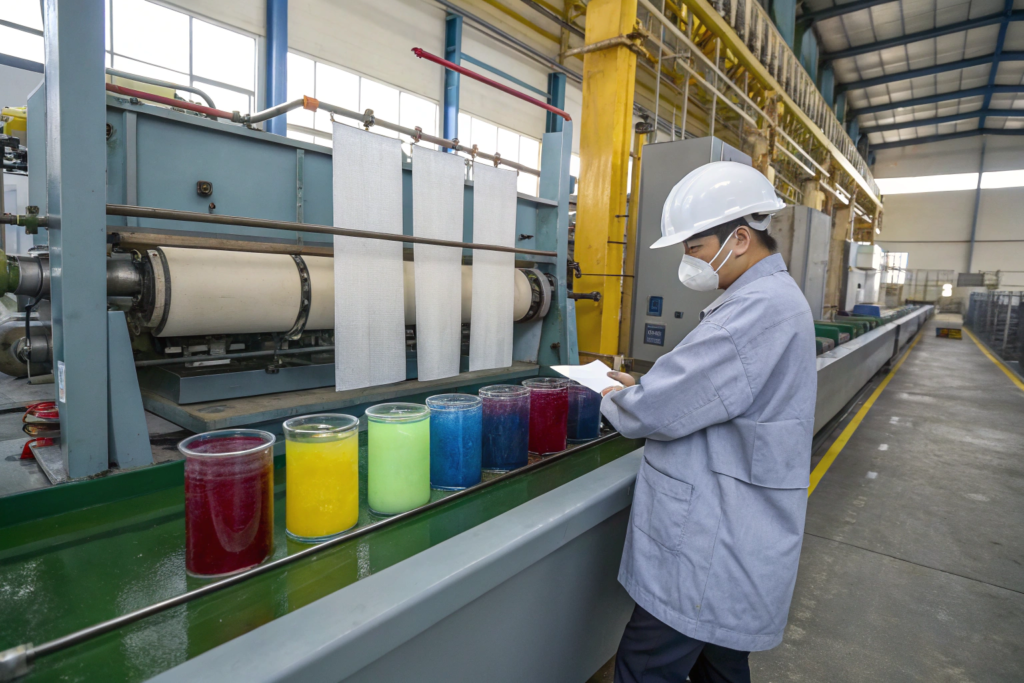
The humble white towel is actually a decent Crockmeter substitute. The key is to use consistent pressure. Fold the towel into a pad, press it firmly against the linen with your thumb, and drag it in one direction (not back and forth) for about 15 centimeters. Lift, fold to a clean section, and repeat five times.
What you’re looking at is the “off-loading” of surface dye. A well-dyed linen will transfer almost nothing—maybe a ghost of color on the first pass, and nothing on subsequent passes. A poorly dyed linen will leave a vivid colored streak on every pass. This test is particularly revealing for dark colors like black, navy, and chocolate brown, which are the hardest shades to fix. If the towel shows a dark mark after the third pass, the fabric will absolutely stain a customer’s white sofa or light-colored handbag.
How Can You Simulate a Wash Fastness Test Without a Lab?
A home washing machine is an excellent fastness laboratory, provided you control the variables. Use the “hot” setting and a standard dose of a mainstream detergent (Tide, Persil, or equivalent). Add two white bath towels as “ballast” to create the mechanical rubbing action that simulates the steel balls in the ISO test.
The critical addition is the “multifiber witness strip.” You can buy these online for about $5—a small woven ribbon containing bands of different fiber types (wool, acrylic, polyester, nylon, cotton, acetate). Sew this strip to your linen swatch and run the wash. The strip will show exactly which fibers pick up the dye, which is useful information for your care label. If the nylon or acetate bands stain heavily, you know the dye will transfer onto synthetic linings or trim. A 4.0+ rated linen should leave only a very faint discoloration on the cotton and wool bands.
Conclusion
A 4.0+ color fastness rating isn’t just a number on a certificate—it’s a commercial promise that your linen will survive sun, sweat, spills, and spin cycles without betraying your customer. We’ve walked through the brutal mechanical tests—the Crockmeter’s robotic rubbing, the Xenon lamp’s artificial sun, the steel balls tumbling in a hot wash bath—that define this standard. We’ve exposed the pretreatment secrets—scouring away nature’s waxy armor, bio-polishing the surface, and cationizing the fiber to attract dye like a magnet—that make the difference between a surface coating that fails and a covalent bond that lasts. And we’ve laid out the dyeing protocols, the progressive alkali dosing, the two-bath fixation, and the relentless soaping, that turn chemistry into consistency.
In two decades of dyeing linen in Keqiao, I’ve learned that fastness failures are never accidents; they’re choices. A mill chooses to skip the hot rinse to save steam. A buyer chooses a cheaper lab dip without asking for the wet-rub report. Every 4.0+ rating we issue is backed by those choices made correctly, every single day.
If you’re developing a linen collection where color integrity is non-negotiable—whether it’s a bridal line, a hospitality contract, or a luxury ready-to-wear label—let’s put our lab between you and a costly failure. We’ll send you a finished lab dip with the complete fastness test report, including washing, rubbing, and light, so you can approve both the color and the chemistry. For a direct consultation on your specific shade range and the fastness performance you need, reach out to our Business Director, Elaine, at elaine@fumaoclothing.com. She’ll coordinate with our dyeing lab to get you answers, swatches, and guarantees.