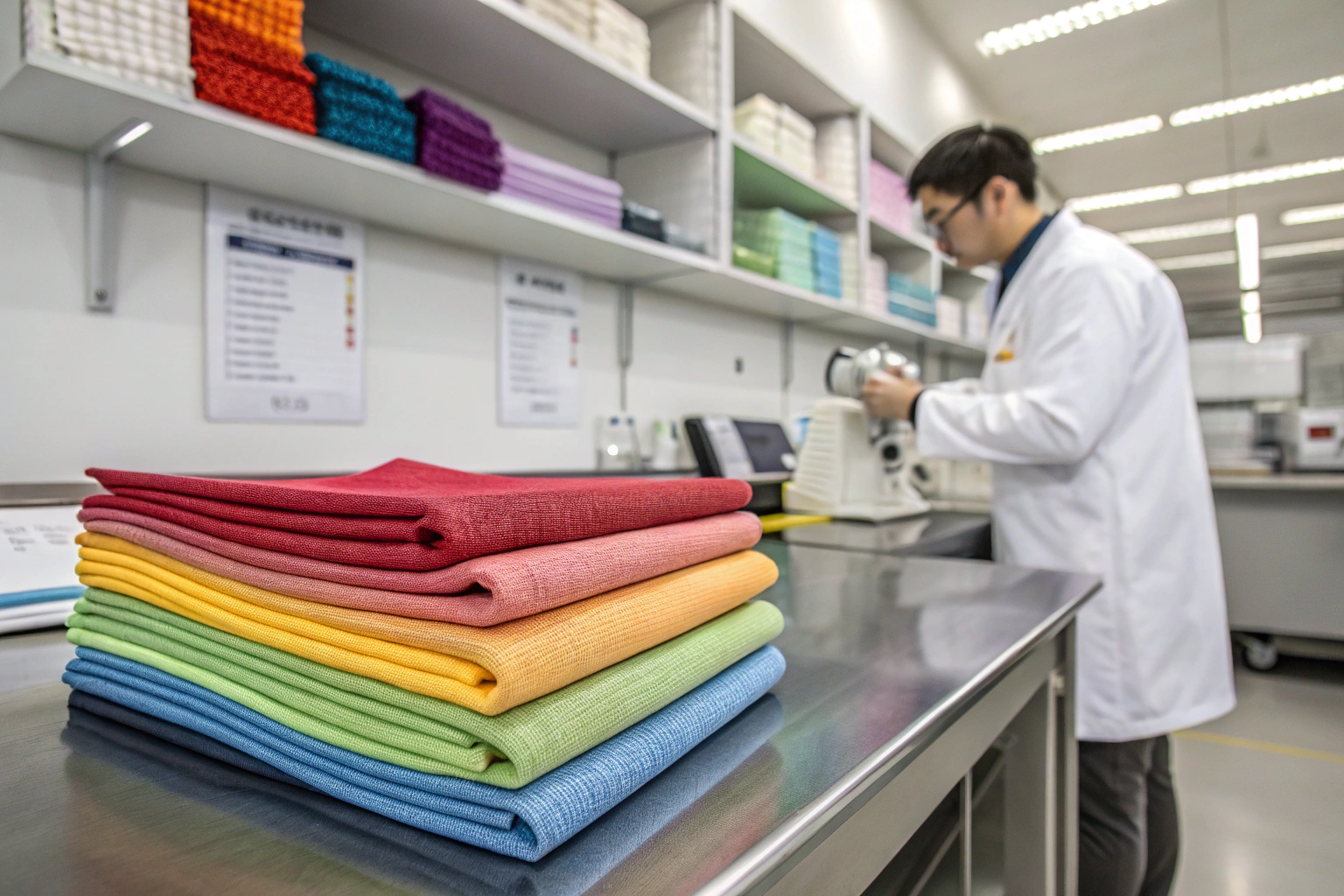
Let me be straight with you. I’ve been in the textile game for over two decades, right here in Keqiao. And if there’s one question that keeps me up at night, it’s this: how do I prove to a buyer in New York or a brand in Berlin that my fabric isn’t just beautiful, but also safe and reliable? I see it all the time. A customer falls in love with a satin’s drape or a denim’s wash, but then the hesitation kicks in. "What if it shrinks?" "What if the color bleeds?" "Will it pass customs with those new EU regulations?" That hesitation can kill a deal. It used to be a real pain point for us, too.
At Shanghai Fumao, we’ve turned that pain point into our strongest selling point. We offer a comprehensive suite of certifications that cover the entire lifecycle of our woven fabrics, from the raw fiber to the finished roll. This isn’t just a piece of paper to us; it’s our promise. Our CNAS-accredited lab doesn’t just test fabrics; we certify them against the most rigorous international standards, including OEKO-TEX® STANDARD 100, GOTS, and a host of ISO quality management and environmental standards. We provide the proof that your supply chain demands, ensuring your products are compliant, sustainable, and ready for any market, whether it’s the EU, the US, or beyond.
You might be thinking, "Every supplier says they have certifications." I get it. But there’s a big difference between having a dusty certificate on a shelf and integrating that certification into every step of production. For us, it’s about the process. It’s about the 40+ dedicated professionals in our team who understand that a certification is a tool for your business, not just a marketing bullet point. It’s the reason a European brand trusts us with their organic cotton line, and why we can confidently ship to 100+ countries without customs hiccups. So, let’s peel back the layers. Let’s get specific about what we can actually certify for you, and why it matters for your bottom line.
Which OEKO-TEX® Certifications Do Your Woven Fabrics Hold?
Have you ever had a shipment held up at the border because a customer’s lab flagged a trace amount of a restricted chemical? It’s a nightmare. The costs pile up, the timeline gets blown, and the trust starts to erode. For our clients in the EU and US, this is a constant fear. They’re under pressure from their own customers, the end consumers, to guarantee that the clothing is free from harmful substances. That’s where OEKO-TEX® comes in. It’s the gold standard for consumer safety in textiles.
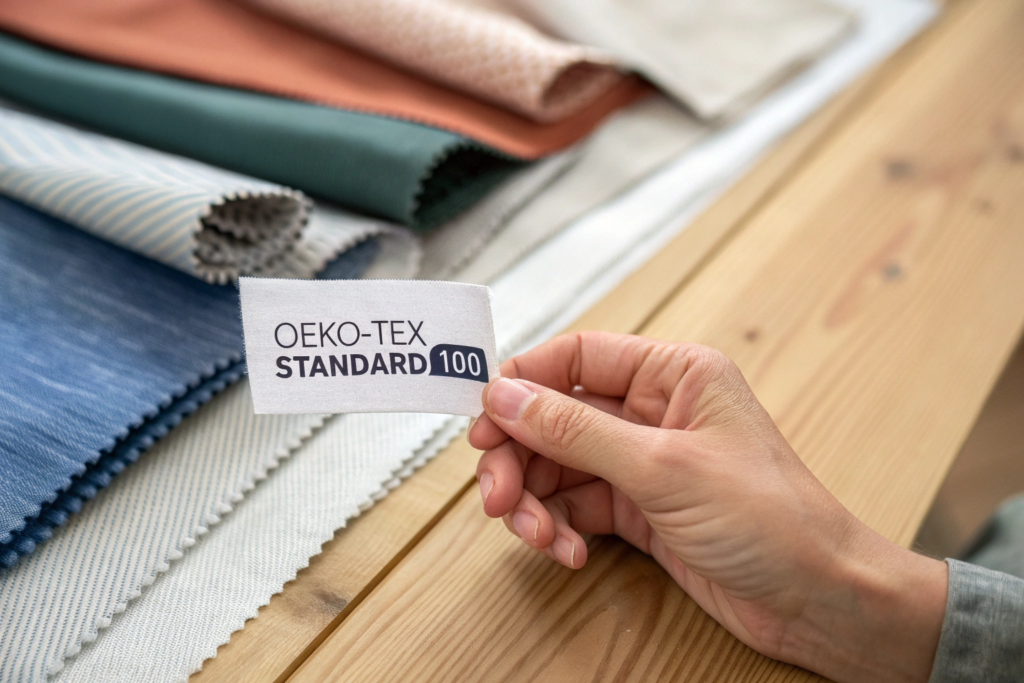
Our woven fabrics hold the OEKO-TEX® STANDARD 100 certification across all our product categories, from our eco-friendly recycled polyester and organic cotton to our performance fabrics and fashion essentials like jacquards and velvets. This isn’t just for one batch; it’s a process we maintain for every single order. We have our own CNAS-accredited testing center where we test for over 100 harmful substances, from formaldehyde to heavy metals, ensuring every meter that leaves our factory in Keqiao is safe for direct skin contact. We test all product classes, with a specific focus on Class I (for babies) and Class II (for clothing worn directly on the skin), which are the most stringent.
I’ll be honest, not every supplier can do this. Maintaining OEKO-TEX® certification requires total control over your supply chain. You can’t just buy any yarn or use any dye. That’s why our end-to-end model is so critical. We control the process from weaving to finishing.
What’s the Difference Between STANDARD 100 and LEATHER STANDARD for a Fabric Supplier?
That’s a great question I get from buyers often. While our primary focus is on woven fabrics, we do work with leather and fur as well, especially for clients making accessories or high-fashion garments. The OEKO-TEX® LEATHER STANDARD is a separate certification tailored specifically for natural and artificial leather materials. For our woven fabrics, it’s all about STANDARD 100. For example, in early 2024, a Russian buyer was concerned about a batch of our recycled polyester satin for a children’s wear line. We provided the STANDARD 100 certificate for Class I, which shows it’s safe for babies, and the shipment sailed through customs without a single delay. The key takeaway is: if it’s a woven textile, you want STANDARD 100. If it’s a hide or a leather-look coated fabric from our coating factory, you’d look for the LEATHER STANDARD. We handle both.
How Often Are Your OEKO-TEX® Certificates Renewed and Audited?
It’s not a one-and-done deal. Our certificates are renewed annually, but the surveillance is ongoing. Every year, a third-party auditor from an OEKO-TEX® institute comes to our facilities in Keqiao. They don’t just check the paperwork; they walk our dyeing factory and our printing factories. They sample raw materials, in-process goods, and finished rolls. In fact, during our last audit in November 2023, they spent three days with our QC team, cross-referencing our QR code tracking system with their own random samples. It’s rigorous. But for you, that annual renewal means you can trust that the fabric you buy in March is just as safe and compliant as the fabric you bought last year. We maintain this certification across our entire product portfolio, including our performance and functional textiles.
What Sustainable Certifications (GOTS, GRS) Can You Provide?
It’s 2024. If you’re a European brand, or selling to one, sustainability isn’t a nice-to-have anymore; it’s a requirement. I’ve seen the shift happen in real-time. Five years ago, a few of our clients were asking about organic cotton. Now? Over 30% of our European exports are eco-friendly fabrics, and that number is growing fast. But the word "sustainable" is thrown around so much it can lose its meaning. You need proof. You need a chain of custody that you can trace from the field to the final garment. That’s where certifications like GOTS and GRS come in.
We are a fully certified supplier for both the Global Organic Textile Standard (GOTS) and the Global Recycled Standard (GRS) . This means we can provide you with certified organic cotton, linen, and hemp, as well as fabrics made from recycled polyester (rPET), recycled nylon, and even recycled wool blends. These aren’t just empty claims. With GOTS, we can trace the organic fibers from the farm, through our spinning, weaving, and dyeing processes, to the final finished fabric, ensuring environmental and social responsibility at every step. With GRS, we provide verified recycled content claims, which is crucial for meeting your own corporate sustainability goals. We’ve even invested ¥550 million in our green initiatives to ensure our facilities can support these rigorous standards at scale.
These certifications are about more than just the material. They require audits of our entire facility. For GOTS, they check our chemical inputs, our water treatment, and even our social compliance. For GRS, they track the recycled material from the moment it arrives as chips to the moment the finished fabric is rolled. It’s a huge undertaking, but it’s how we can serve our clients in the EU and beyond with complete transparency.
Can You Certify Organic Cotton Woven Fabrics with GOTS?
Absolutely. In fact, we just finished a large order for a European fashion brand in Q2 of this year. They needed a GOTS-certified organic cotton canvas for a line of tote bags. We sourced the certified organic cotton yarn, wove it in our own weaving factory, and used GOTS-approved dyes in our cooperative dyeing factory. The entire process was audited. We provided them with a transaction certificate (TC) for every batch, which is the document that proves the chain of custody. If you are looking for how to source GOTS certified organic cotton from China, we are one of the few suppliers in Keqiao who can offer a one-stop solution for it.
What Is the Process for Obtaining a GRS Certificate for Recycled Polyester Fabrics?
The GRS process starts with the raw material. We source our recycled polyester from verified suppliers who take post-consumer plastic bottles and turn them into chips and then yarn. Once that yarn arrives at our facility, we track it through every step. The GRS certification requires that we have a management system that separates recycled materials from conventional ones, preventing contamination. Our coating factory even applies GRS-certified coatings. In 2023, we helped a client in the US athleisure market get their entire line GRS-certified. We provided them with the TCs for the fabric, and they were able to use that to get their final product certified. It’s a lot of paperwork, but our team of 40+ professionals handles it all for you, so you don’t have to. We can even help with documentation for recycled synthetic fabrics to ensure a smooth process.
How Do You Ensure Quality and Compliance with ISO Standards?
Let’s talk about the stuff you don’t see. Certifications like OEKO-TEX® and GOTS are about what’s in the fabric. But what about the fabric itself? Will it tear? Will the color fade after a few washes? Will the seams hold up? For a brand, these aren’t just quality issues; they’re reputation issues. If a shirt falls apart, the customer doesn’t blame the fabric supplier. They blame the brand. That’s why we’ve built our entire operation around a foundation of ISO standards. It’s our way of saying, "We’ve got your back on the performance, too."
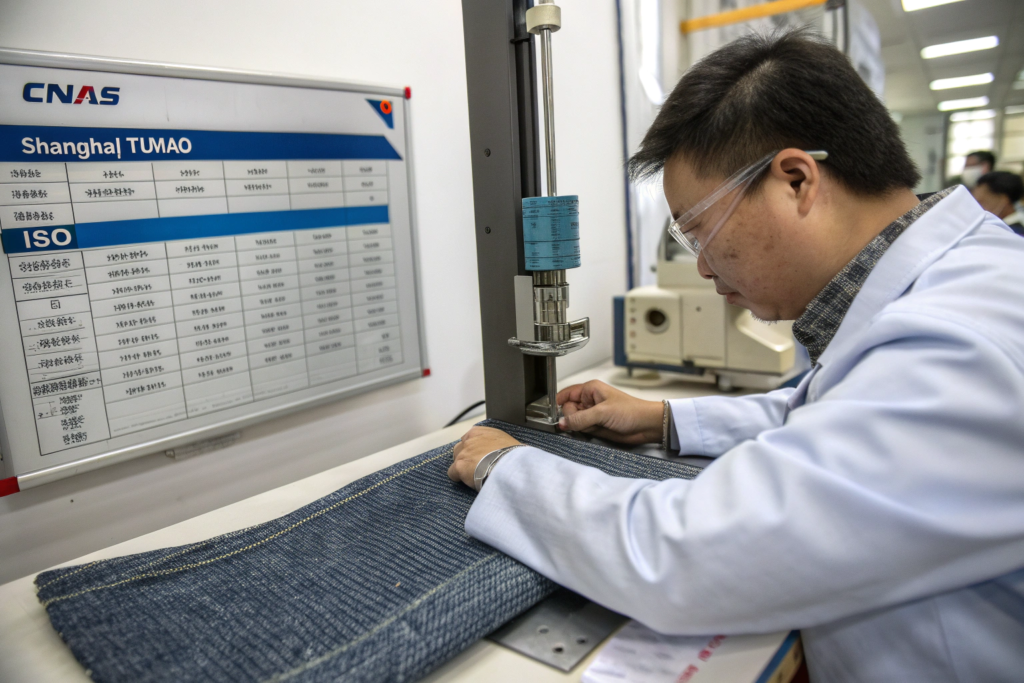
Our operations are guided by a suite of ISO certifications, including ISO 9001 for Quality Management, ISO 14001 for Environmental Management, and ISO 45001 for Occupational Health and Safety. These aren’t just certificates on our wall. They represent a systematic approach to how we run our business. Our CNAS-accredited testing center operates under ISO/IEC 17025, which is the international standard for testing and calibration laboratories. This means when our lab gives you a test report for shrinkage, colorfastness, or tensile strength, that report is recognized and accepted globally, by the SGSs and ITSs of the world. We don’t just claim quality; we have a globally recognized system to prove it.
Implementing these standards has fundamentally changed how we work. For instance, ISO 9001 forces us to document every process. From the moment an order comes in to the moment it’s loaded onto a truck for the port of Ningbo-Zhoushan, every step is recorded and reviewed. This might sound like a hassle, but for you, it means consistency. It means the fabric you get in a rush order in October will have the same specs as the one you ordered in a slower period in July.
How Does ISO 9001 Improve Your Production Consistency for Woven Fabrics?
ISO 9001 is all about the process, not just the product. It’s our management playbook. We use it to manage our supply chain, from the yarn suppliers we choose to the way our QC team uses the QR code tracking system. In practice, it means we have standard operating procedures for everything. For example, when we run a batch of cotton twill for a client, the parameters—temperature in the dyeing factory, speed on the loom, tension in the coating factory—are recorded and replicated. A few years back, we had a buyer from a major US brand visit. They wanted to see how we ensured consistency. We showed them our ISO 9001 documentation for a linen blend they had ordered 6 months prior. We had the exact specs, the exact machine settings, and the test results. We replicated the order perfectly. That’s the power of a system. You can read more about implementing quality management in textile manufacturing from industry experts.
What Specific Tests Does Your CNAS-Accredited Lab Perform Under ISO 17025?
This is where we get into the nitty-gritty. Our lab is equipped to perform all the physical and chemical tests required for woven fabrics. Under ISO 17025, we can test for:
- Physical Properties: Tensile strength (how hard you can pull before it rips), tear strength (how easily it tears), seam slippage (will the seams pucker or pull apart?), abrasion resistance (will it pill?), and dimensional stability (shrinkage after washing).
- Colorfastness: To washing, to light (will it fade in the sun?), to perspiration, to rubbing (crocking).
- Chemical Analysis: As part of our OEKO-TEX® compliance, we test for restricted substances like phthalates, heavy metals, and formaldehyde in-house.
We have a dedicated team of technicians. In one instance in Q4 of last year, a client’s final garment failed a random spot-check at the US border for a specific chemical. They were facing a massive penalty. We were able to pull the QR code data for their batch, show them the lab reports from our CNAS-accredited facility, and prove that the issue didn’t originate from our fabric. The speed and accuracy of our in-house testing saved them weeks of delays and thousands of dollars. We make sure fabric testing standards are met for international shipments every single time.
Do You Offer Certifications for Functional or Specialty Fabrics?
We’ve talked a lot about safety and sustainability. But what if your product needs to do something? Maybe it needs to keep water out, stop a fire, or block the sun. In my experience, these functional fabrics are where things can get really tricky for buyers. You can’t just trust a supplier who says "this is waterproof." You need data. You need a test standard that proves it. And you often need a certification that the treatment used to make it waterproof is also safe and durable. This is where our expertise and our lab really shine.
Yes, we provide certifications and test reports for a wide range of functional and specialty woven fabrics. Our in-house R&D team and CNAS-accredited lab can test and certify against international performance standards. For waterproof and breathable fabrics, we test against AATCC and ISO standards for water resistance and moisture vapor transmission. For flame-retardant (FR) fabrics, we can provide reports based on standards like NFPA 701 or EN 11612. We also have a coating factory that applies these finishes, so we can control the quality from the very start. We provide the test data so you can confidently market your product’s performance claims.
These aren’t just "certifications" in the same way that a GOTS label is. They are test results against a recognized international standard. When a client asks us for a waterproof fabric, we don’t just say "yes." We ask, "What is your target water column pressure? What standard do you need to meet? Is it for a rain jacket, a tent, or an umbrella?" Then we engineer the fabric, apply the coating, and test it in our lab.
What Test Standards Do You Use for Waterproof and Breathable Fabrics?
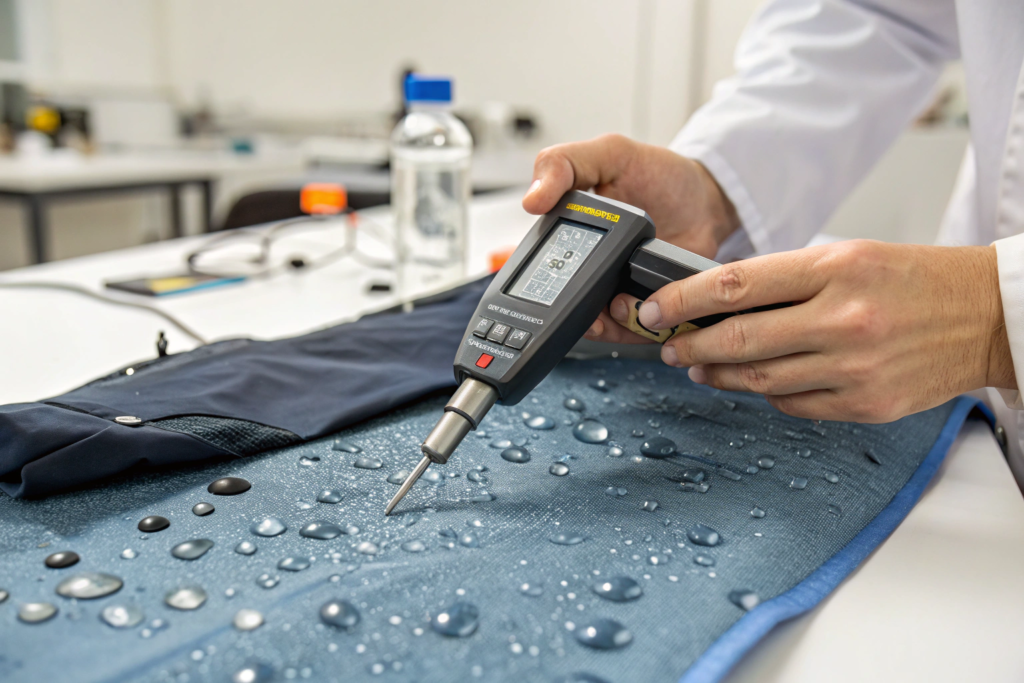
We rely on the global standards. For water resistance, we often use the AATCC 127 (Water Resistance: Hydrostatic Pressure Test) or ISO 811. This measures how much water pressure a fabric can withstand before it leaks. For breathability, we use the JIS L 1099 or ASTM E96 (Water Vapor Transmission) tests. In 2022, we had a client from Scandinavia who needed a highly breathable, waterproof fabric for an outdoor brand. We developed a new laminated fabric in our coating factory, tested it in our CNAS lab, and achieved a result of 10,000mm water column and 5,000 g/m²/24hrs MVTR, which is top-tier performance. We provided them with a full report, which they used to market their final product. If you are looking to understand how to choose a reliable functional fabric supplier, these are the kind of verifiable metrics you should demand.
Can You Certify Flame-Retardant and UV-Protective Woven Fabrics?
Absolutely. For flame-retardant (FR) fabrics, we test according to the relevant end-use. For drapery and interior fabrics, we use NFPA 701. For protective clothing, we use EN 11612 or ASTM D6413. We develop these fabrics using inherently FR fibers like aramids (like Kevlar) or with FR finishes applied in our coating factory. For UV-protective fabrics, we use the AS/NZS 4399 or AATCC 183 standards to determine the Ultraviolet Protection Factor (UPF). We can achieve UPF 50+ ratings on many of our woven fabrics, from lightweight poplins to heavier canvas. A client from Australia, where UV protection is a huge market, came to us needing a certified UPF 50+ fabric for a children’s swimwear line. We developed a how to source certified UV protective fabrics from China solution by using a specially treated nylon in our weaving factory, testing it to the Australian standard, and provided the full certification package. They were able to hit their market with a proven, safe product, and their sales grew 20% in that category the following season.
Conclusion
So, there you have it. From the moment a fiber enters our weaving factory in Keqiao to the moment it’s inspected, packed, and shipped to your door, we are building in safety, quality, and performance. The certifications we’ve discussed—OEKO-TEX®, GOTS, GRS, and the full suite of ISO standards—aren’t just marketing tools. They are the result of a 20-year commitment to doing things the right way. They represent the investment we’ve made in our people, our CNAS-accredited lab, and our facilities like our coating and printing factories.
I built this business on one simple idea: to be the partner I would want to work with if I were in your shoes. A partner who doesn’t just say "yes," but can prove it. A partner who understands that a delay in customs or a failed quality test isn’t just a problem for the factory; it’s a problem for your brand, your customers, and your bottom line. Whether you’re a large European brand needing certified organic cotton, a US entrepreneur launching a line of waterproof jackets, or a buyer looking to navigate the complexities of Chinese manufacturing, we have the infrastructure, the expertise, and the certifications to make it happen.
Now, I know that managing all these certifications and testing requirements can feel like a full-time job on its own. But it doesn’t have to be. That’s exactly why Shanghai Fumao exists. We’re here to take that weight off your shoulders. We co-create value by integrating these complex requirements into a seamless, end-to-end process, so you can focus on what you do best: building your brand.
If you’re ready to stop worrying about your supply chain and start creating great products, let’s talk. I’d like to invite you to reach out to our Business Director, Elaine. She and her team of 40+ professionals live and breathe this stuff every day. They can walk you through our process, help you understand which certifications are right for your project, and give you a clear timeline from design to delivery.
Contact us today to start your order.
Email Elaine directly at: elaine@fumaoclothing.com
Let’s weave your success story together, starting right here in Keqiao, the heart of the world’s textile industry.