I’ve been in this industry for over two decades, and I still remember the confusion I felt when I first encountered the term "warp knitting." I knew weft knitting—jersey, rib, interlock—the fabrics that stretch and curl. But warp knitting was different. The fabrics didn’t behave the same way. They were more stable, less stretchy, almost woven-like in their behavior. It took me years to fully understand the difference, and once I did, it transformed how I selected fabrics for different applications.
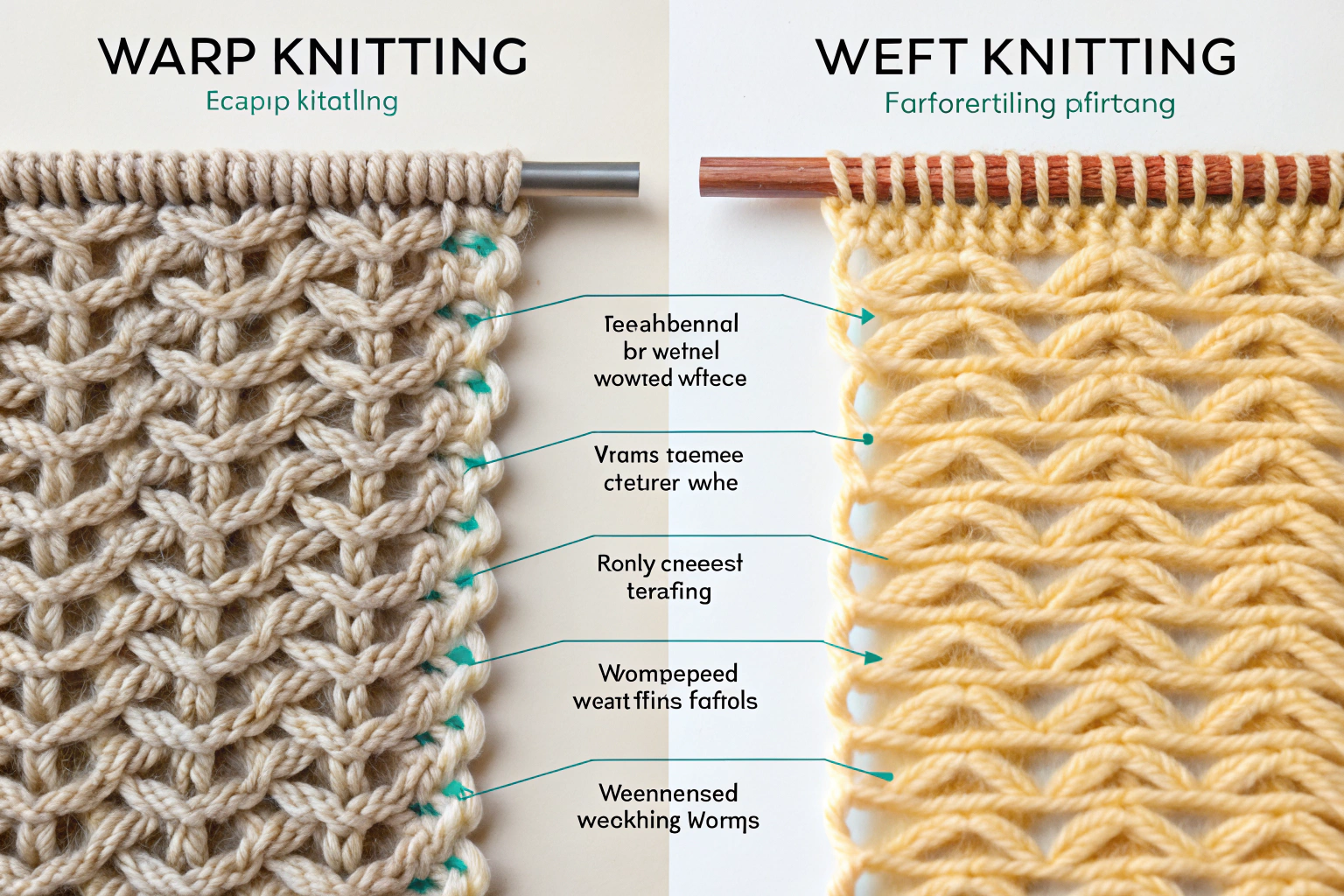
Here’s the straightforward answer: the difference between warp knitting and weft knitting lies in how the yarns are oriented and looped. In weft knitting, a single yarn runs horizontally (in the weft direction), forming loops in rows. In warp knitting, multiple yarns run vertically (in the warp direction), forming loops in columns. This fundamental difference creates fabrics with completely different properties—stretch, drape, durability, and stability.
Let me walk you through exactly how these two knitting systems differ, what fabrics each produces, and how to choose between them for your applications.
What Is Weft Knitting and How Does It Work?
Weft knitting is what most people think of when they hear "knitted fabric." It’s the construction of t-shirts, sweaters, socks, and most everyday knitwear.
In weft knitting, a single yarn (or multiple yarns fed separately) moves back and forth across the width of the fabric, forming rows of loops called courses. Each course is built from one continuous yarn that loops across the fabric. The loops interlock with the courses above and below, creating a structure that stretches easily in the width direction and has moderate stretch in the length.
The machines used for weft knitting range from simple flatbed machines for small production to large circular knitting machines that produce fabric in tubes. The circular machines are workhorses of the industry, producing jersey, interlock, rib, and many other weft knit constructions at high speed.
The properties of weft knits follow from this construction:
- High stretch in the width direction (across the courses)
- Moderate stretch in the length direction (along the courses)
- Good drape and conformability
- Tendency to curl at edges
- Stretch recovery varies by construction
A Portuguese factory manager once described weft knitting to me as "knitting like your grandmother, but much faster." The principle is the same—one yarn, rows of loops—just scaled to industrial speed.

What Are the Main Weft Knit Constructions?
Weft knitting encompasses several distinct constructions, each with different properties.
Single jersey is the most common weft knit. It has a smooth face and looped back. It stretches easily, drapes well, and is used for t-shirts, dresses, and lightweight apparel. Single jersey curls at the edges and has moderate recovery.
Rib knit alternates knit and purl stitches, creating vertical ribs. It has exceptional stretch and recovery, making it ideal for cuffs, collars, and fitted garments. Rib knits don’t curl at the edges like single jersey.
Interlock is essentially two single jersey fabrics knitted together. It’s heavier, more stable, and doesn’t curl. Interlock has good recovery and a smooth surface on both sides. It’s used for premium t-shirts, dresses, and structured knits.
Purl knit creates a fabric that looks the same on both sides. It has good stretch in both directions and is used for sweater-like fabrics and children’s wear.
A Swedish brand uses single jersey for their basics, rib for cuffs and trim, and interlock for their premium collection. Each construction serves a distinct purpose within their line.
What Are the Properties of Weft Knits?
Understanding weft knit properties helps you select the right fabric.
Stretch: Weft knits have excellent stretch, typically 20-100% depending on construction and fiber. Single jersey stretches most in the width; ribs stretch in both directions.
Drape: Weft knits drape well, conforming to body shapes. This makes them ideal for fitted garments and flowing styles.
Recovery: Recovery varies. Single jersey has moderate recovery; rib and interlock have better recovery. Spandex blends improve recovery significantly.
Durability: Weft knits are generally less durable than wovens or warp knits. They can pill, bag out, and show wear faster. Higher quality yarns and construction improve durability.
Edge behavior: Weft knits curl at cut edges, requiring careful handling during cutting and sewing. This is a feature of the construction, not a defect.
A German activewear brand selects weft knits for their yoga collection precisely because of the stretch and drape. They accept the durability trade-off for the comfort benefits.
What Is Warp Knitting and How Does It Work?
Warp knitting is less familiar to most people but produces fabrics you encounter every day—swimwear, athletic wear, lingerie, and many technical textiles.
In warp knitting, many yarns (often hundreds) feed into the knitting machine simultaneously from a warp beam. Each yarn runs vertically, forming loops in its own column (wale). The yarns interlock with neighboring columns to create a stable fabric structure. Unlike weft knitting, which builds rows across the fabric, warp knitting builds columns down the fabric.
The machines used for warp knitting—tricot, raschel, and others—are complex and specialized. They can produce fabric at high speed, with precise control over loop structure, pattern, and density.
The properties of warp knits follow from this construction:
- Low stretch (or stretch engineered in specific directions)
- Excellent dimensional stability
- No edge curl
- Smooth, flat surface
- Run-resistant (will not ladder like weft knits)
A Japanese technical textile expert once told me: "Weft knitting is for comfort; warp knitting is for performance." That captures the distinction well.

What Are the Main Warp Knit Constructions?
Warp knitting has two primary sub-categories: tricot and raschel.
Tricot warp knits are characterized by fine, lightweight fabrics with a smooth surface. They’re made on machines with fine gauges (28-40 needles per inch). Tricot fabrics have good stretch in the length direction (wales) and limited stretch in the width. They’re used for lingerie, linings, sleepwear, and lightweight activewear. The fabric doesn’t run—a hole will not ladder.
Raschel warp knits are more versatile, capable of producing a wider range of structures from lightweight mesh to heavy pile fabrics. Raschel machines can use multiple yarn types and create complex patterns. Applications include swimwear, athletic wear, lace, netting, and industrial fabrics.
Within these categories, specific constructions serve different needs:
- Jersey warp knits (tricot) have a smooth face and are used for lingerie and linings
- Mesh warp knits (raschel) have open structures for breathability
- Pile warp knits (raschel) have raised surfaces for warmth or texture
- Elastic warp knits incorporate spandex for stretch and recovery
A US swimwear brand uses raschel warp knits for their high-end collection. The stability and run resistance are essential for garments that face chlorine and salt water.
What Are the Properties of Warp Knits?
Warp knits have properties that make them ideal for specific applications.
Stretch: Warp knits have controlled stretch, typically engineered in the length direction. Some warp knits have little stretch; others (with spandex) have significant stretch. Stretch is predictable and doesn’t vary with construction.
Stability: Warp knits are dimensionally stable. They don’t curl, don’t stretch out of shape, and maintain their dimensions through wear and washing. This makes them ideal for garments that need to hold their shape.
Durability: Warp knits generally outlast weft knits. They resist pilling, don’t ladder, and maintain appearance longer. The multiple yarns and stable structure distribute stress more evenly.
Surface: Warp knits have smooth, flat surfaces that accept printing and finishing well. They can be engineered with texture, but the default is stable and smooth.
Edge behavior: Warp knits don’t curl at cut edges, making them easier to cut and sew. This is a significant advantage in garment production.
A French lingerie brand chooses warp knits for their bras and shapewear precisely for the stability and durability. The fabrics hold their shape through years of wear and washing.
How Do the Two Knitting Systems Compare?
Understanding the differences helps you select the right fabric for your application.
Construction: Weft knitting uses one yarn (or multiple yarns fed separately) moving horizontally across the fabric, forming rows of loops. Warp knitting uses many parallel yarns moving vertically, forming columns of loops. This fundamental difference drives all other properties.
Stretch: Weft knits stretch easily in the width direction; some also stretch lengthwise. Warp knits have controlled stretch, typically in the length direction. For applications requiring maximum stretch and recovery, weft knits (especially with spandex) are usually chosen.
Stability: Warp knits are much more stable. They resist stretching out of shape, don’t curl, and maintain dimensions. Weft knits can stretch, curl, and bag out over time.
Durability: Warp knits generally last longer. They resist pilling, don’t ladder, and maintain appearance through repeated wear and washing. Weft knits are more prone to wear, especially in high-friction areas.
Production speed: Both can be produced at high speed, but warp knitting machines often run faster and can produce wider fabric.
Cost: Weft knitting machines are generally less expensive, and weft knits often cost less to produce. Warp knitting requires more complex, expensive machines and more skilled operators.
A German textile engineer summarized it: "Weft knitting is the workhorse of the industry—efficient, versatile, and comfortable. Warp knitting is the specialist—precise, stable, and durable."

Which Has Better Stretch and Recovery?
This depends on what you need.
For maximum stretch and recovery, weft knits with spandex are the answer. A single jersey with 5-10% spandex can stretch 50-100% and recover almost completely. This combination is used for activewear, leggings, and fitted garments.
For controlled stretch with excellent stability, warp knits with spandex are superior. The stretch is engineered in specific directions, and the fabric returns to its exact dimensions consistently. This is essential for swimwear and shapewear.
For no stretch applications, warp knits without spandex provide stability with minimal give. Weft knits without spandex always have some stretch.
A Swedish activewear brand uses weft knits for their yoga leggings (maximum stretch needed) and warp knits for their swimwear (controlled stretch, chlorine resistance). Both are right for their applications.
How Does Edge Behavior Differ?
Edge behavior is a practical production consideration.
Weft knits curl at cut edges. The direction of curl tells you which side is the face. This requires careful handling during cutting and sewing. Experienced cutters know how to manage curl.
Warp knits don’t curl. They lie flat when cut, making them easier to cut and sew. This is a significant advantage in production, especially for complex patterns.
The difference comes from the loop structure. Weft knits have tension built into the loops that releases when cut. Warp knits have more balanced tension that doesn’t create curl.
A US garment manufacturer told me their cutting room prefers warp knits for complex styles because curl management on weft knits adds time and waste. For simple styles, weft knits are fine.
Which Is More Run-Resistant?
Run resistance matters for garment durability.
Weft knits can ladder (run) when a loop breaks. A single broken loop can travel along a course, creating a visible line. Higher-quality weft knits and tighter constructions resist running, but the risk remains.
Warp knits are inherently run-resistant. Each yarn forms loops in its own column, so a broken yarn creates a localized issue that doesn’t propagate. A hole in a warp knit stays a hole; it doesn’t run into a ladder.
This difference is critical for applications where a run would ruin the garment—swimwear, hosiery, high-end lingerie. Warp knits are the preferred choice.
A French hosiery manufacturer uses only warp knits for their premium tights. A run in weft knit tights can ruin the garment; warp knit tights resist runs and last longer.
What Are the Applications for Each Type?
Understanding applications helps you choose the right fabric for your product.
Weft knits excel in applications where comfort, drape, and stretch matter most:
- T-shirts and casual tops (single jersey)
- Leggings and activewear (with spandex)
- Sweaters and cardigans (various constructions)
- Dresses (jersey, interlock)
- Underwear and basics
- Children’s wear
- Loungewear and sleepwear
Warp knits excel where stability, durability, and controlled stretch matter:
- Swimwear (raschel with spandex)
- Lingerie and bras (tricot)
- Athletic wear (performance applications)
- Lining fabrics (tricot)
- Technical textiles (industrial, medical)
- Shapewear and compression garments
- Lace and decorative fabrics (raschel)
A brand might use both: weft knits for their casual collection, warp knits for their performance line. Each serves its purpose.

When Should You Choose Weft Knits?
Weft knits are the right choice for most everyday apparel.
Choose weft knits when comfort is the priority. The stretch and drape of weft knits conform to the body without restricting movement. T-shirts, casual dresses, and loungewear are ideal.
Choose weft knits when cost is a consideration. Weft knits are generally less expensive to produce than warp knits, making them economical for basics.
Choose weft knits when you need maximum stretch. For activewear, yoga, and fitted garments, weft knits with spandex provide the stretch and recovery you need.
Choose weft knits when you want a wide variety of constructions. Single jersey, interlock, rib, and other weft knits offer different properties within the same production framework.
A Portuguese basics brand built their entire line on weft knits. The versatility, cost, and comfort meet their customers’ needs perfectly.
When Should You Choose Warp Knits?
Warp knits are the right choice for specialized applications.
Choose warp knits when stability matters more than stretch. For garments that must hold their shape—bras, swimwear, shapewear—warp knits provide the necessary stability.
Choose warp knits when durability is critical. Warp knits resist runs, pilling, and wear better than weft knits. For swimwear, lingerie, and performance wear, this matters.
Choose warp knits when edge curl is a production problem. For complex patterns or automated cutting, the flat, stable nature of warp knits simplifies production.
Choose warp knits for technical applications. Medical textiles, industrial fabrics, and specialized performance fabrics often require the precision and stability of warp knitting.
A German medical textile company uses warp knits for compression garments. The controlled stretch, stability, and durability are essential for therapeutic applications.

How Do You Identify Which Is Which?
Even experienced professionals can confuse warp and weft knits. Simple tests reveal the difference.
The stretch test is most reliable. Weft knits stretch easily in the width direction (across the fabric). Warp knits either have little stretch or stretch in the length direction (down the fabric). Try stretching in both directions—the direction of maximum stretch tells the story.
The edge test confirms. Cut a sample and observe. Weft knits curl at the edges, with the face side curling toward the back. Warp knits lie flat, with no curl.
The pull test reveals run resistance. Try to start a run by pulling a loop. Weft knits will ladder easily, especially in the length direction. Warp knits resist laddering—a pulled loop creates a hole, not a run.
The surface test can help. Weft knits often have a distinct face and back (smooth vs looped). Warp knits often have a more uniform appearance on both sides.
A Canadian quality inspector uses these four tests on every knit sample. In seconds, she knows what she’s working with.
Conclusion
The difference between warp knitting and weft knitting is fundamental to fabric performance. Weft knitting, with its horizontal yarn movement and looped structure, produces fabrics that are comfortable, stretchy, and drape well—ideal for most apparel. Warp knitting, with its vertical yarns and interlocking columns, produces fabrics that are stable, durable, and run-resistant—ideal for specialized applications.
The key takeaways:
- Weft knitting: single yarn, horizontal loops, high stretch, edge curl, laddering risk
- Warp knitting: multiple yarns, vertical loops, controlled stretch, no curl, run-resistant
- Choose weft knits for comfort, cost, and maximum stretch
- Choose warp knits for stability, durability, and precision
At Shanghai Fumao, we produce both weft and warp knits. Our weft knit capabilities include single jersey, interlock, rib, and custom constructions in cotton, blends, and performance fibers. Our warp knit capabilities include tricot and raschel constructions for lingerie, swimwear, and technical applications.
We help clients understand the differences and choose the right construction for their needs. Whether you need the comfort of a weft knit or the performance of a warp knit, we have the expertise and production to deliver.
Contact our Business Director, Elaine, today to discuss your knitting needs. She and her team will help you understand which construction is right for your application and guide you through the selection process. Email her directly at: elaine@fumaoclothing.com. Let’s knit something great together.