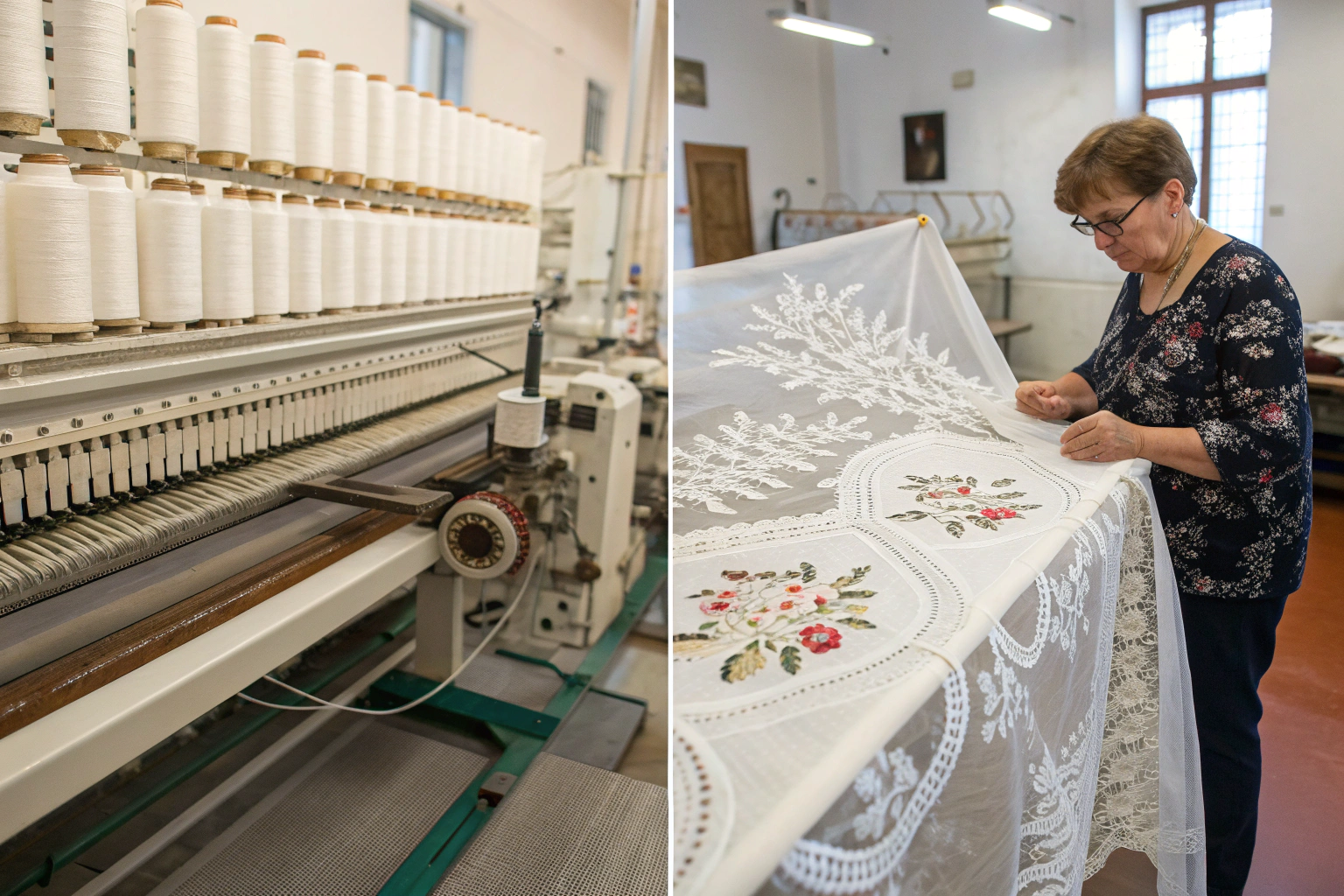
You see two stunning lace fabrics. One carries a whisper of 19th-century French luxury, the other boasts bold, contemporary dimension. Both are called "lace," but their price tags tell wildly different stories. So, what’s the real difference between Leavers lace and Embroidery lace? Is one objectively better, or are they simply tools for different jobs? As a buyer, confusing them can lead to catastrophic costing errors, mismatched quality expectations, and products that fail to resonate with your brand’s identity.
The fundamental difference lies in their manufacturing origin: Leavers lace is created through a complex weaving process on historic Leavers looms, resulting in a single, unified fabric. Embroidery lace, however, is a multi-step embellishment process where a pattern is stitched onto an existing base fabric (like tulle or mesh). This core distinction creates a cascade of differences in texture, durability, design flexibility, cost, and production scale. For high-fashion couture or heirloom lingerie, the choice often leans towards Leavers. For elaborate eveningwear, bridal overlays, or cost-sensitive ready-to-wear with dramatic effects, embroidery lace frequently wins.
Understanding this split is not academic—it’s financial and creative. Your choice dictates your fabric budget, minimum order quantities, lead times, and the very tactile language of your final garment. Let’s unravel the threads of these two iconic lace types.
What is Leavers Lace and How is it Made?
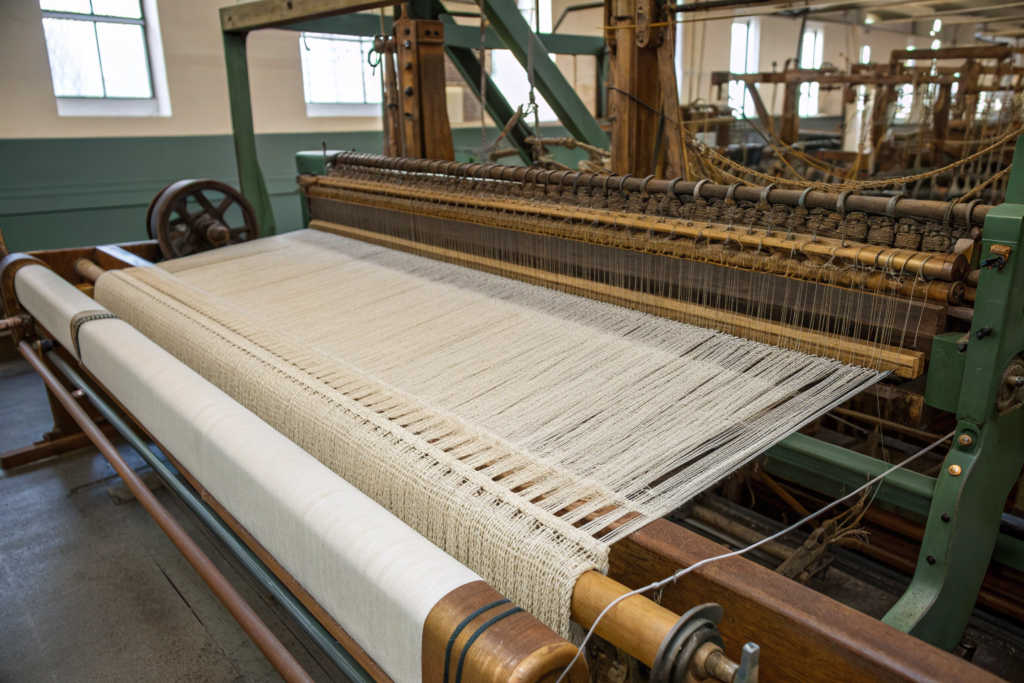
Leavers lace is often called the "Queen of Laces." Its name comes from the Leavers loom, a sophisticated machine invented in Nottingham, England, but perfected in Calais, France, in the 19th century. These looms are not just equipment; they are mechanical marvels, some stories tall, requiring immense skill to operate and program. The process is one of integrated creation, not addition.
The magic happens through a system of tens of thousands of fine threads—warp threads held vertically and bobbin threads carried horizontally in brass bobbins. The machine, guided by a intricate pattern chain (historically) or modern Jacquard cards, moves these threads with incredible precision to weave, twist, and interlace them into the lace design and its net background simultaneously. This results in a fabric that is one cohesive unit. There is no separate base cloth; the pattern and the ground are born together. This is why true Leavers lace feels so light, fluid, and has no backing—it’s a single, sheer skin of thread.
What are the Defining Characteristics of Leavers Lace?
The production method imparts unique, often unrivaled qualities:
- Unbacked and Lightweight: Because it’s woven in one piece, it has no glued or stitched backing. It’s ethereally light and boasts exceptional drape.
- Fine, Continuous Threads: The threads are continuous, not cut and secured like in embroidery. This gives the lace a smooth, refined look on both the front and back (the reverse is a negative of the front).
- Superior Drape and Handfeel: The lack of backing and integrated construction allows it to flow and conform to the body like a second skin. The "hand" is soft, supple, and luxurious.
- Historic and Complex Designs: Leavers looms excel at producing intricate, delicate, and often symmetrical patterns with a classic, timeless feel. Reproducing a true Leavers lace design on other machines is notoriously difficult.
This craftsmanship comes at a cost. Operating and maintaining these looms is highly specialized. A single design requires extensive setup time to "punch" the pattern instructions. Consequently, Leavers lace is a high-cost, lower-volume product. It’s the choice for brands where heritage, luxury, and unparalleled quality are non-negotiable. For those interested in sourcing authentic Calais Leavers lace, the history and rarity are part of its value proposition, detailed in resources like The Lace Guild’s archives on machine laces.
What are the Modern Applications and Limitations?
Today, Leavers lace is the gold standard for:
- Haute Couture: Found in the ateliers of major European fashion houses.
- Luxury Lingerie: For its softness against the skin and beautiful drape.
- High-End Bridal: Used for veils and delicate gown overlays.
However, its limitations are clear: high minimums (though lower than historical norms due to some consolidation), longer lead times, and extremely high cost per meter. It is generally not used for heavy embellishment or dense, raised patterns, as that is not the strength of the weaving process.
What is Embroidery Lace and How is it Made?
Embroidery lace, often called Schiffli lace (after the type of machine) or simply embroidered lace/net, is a process of addition. It starts with a pre-made ground fabric, typically a plain or patterned net (tulle), mesh, or even a solid fabric like satin. High-speed, multi-needle embroidery machines then stitch the decorative pattern onto this base.
Think of it as drawing with thread. The design is digitized, and the machine, which can have dozens or even hundreds of heads working in parallel, rapidly stitches the pattern. To create density or a raised effect, the machine will stitch over areas multiple times. A key feature of much embroidery lace is the use of a water-soluble or heat-away backing. This stabilizer holds the fabric taut during stitching and is washed or melted away after embroidery, leaving just the stitched pattern on the net—creating a "lace" effect with empty spaces. However, many commercial embroidery laces retain a permanent, often softer, backing for stability.
What are the Defining Characteristics of Embroidery Lace?
This method offers a different set of advantages that have made it dominant in modern fashion:
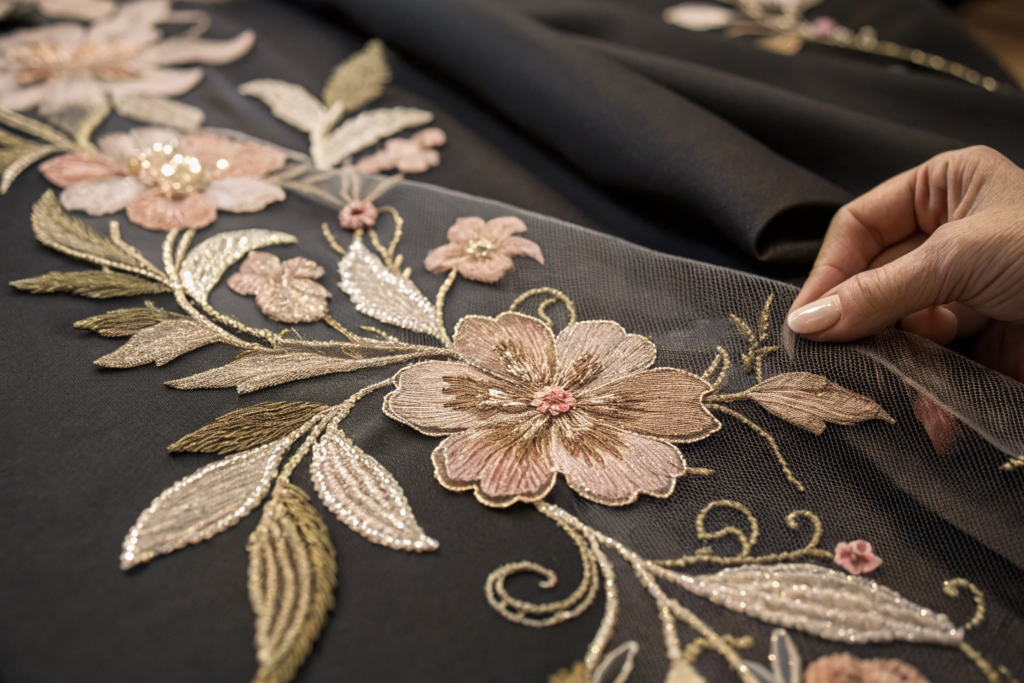
- Dimensional and Textural: Embroidery excels at creating dramatic 3D effects. You can have heavily raised motifs, incorporate different thread types (shiny, matte, thick, thin), and even add beads or sequins in-line.
- Design Freedom and Speed: Changing a digital file is fast. This allows for immense creativity, seasonal adaptability, and relatively quick sampling compared to Leavers.
- Cost-Effectiveness at Scale: Modern embroidery machines are highly efficient. While the initial digitizing and setup have a cost, the per-meter price for production runs is significantly lower than Leavers, and Minimum Order Quantities (MOQs) can be more flexible, especially from major hubs like our partners in Keqiao.
- Versatile Base Fabrics: You can embroider on stretch mesh for bodysuits, on dense satin for couture, or on eco-friendly recycled nets. This versatility is huge for performance and fashion markets.
A practical example from our work at Shanghai Fumao: In 2023, a US contemporary brand needed a custom floral lace for a capsule collection with a 10-week lead time. The design had large, dense flowers. Leavers was impossible due to time and cost. We developed an embroidered lace on a polyester tulle, using a mix of rayon and metallic threads to create shine and dimension. The MOQ was 500 meters, the cost was manageable, and the fast turnaround from our partnered embroidery factories hit their critical deadline.
What are the Trade-offs with Embroidery Lace?
The main trade-off is often in the hand and drape. Because it involves stitching onto a base, the fabric can be stiffer, especially with dense patterns. The reverse side will show the stitching and backing. While advanced techniques can mimic a "clean back," it is not the same as the reversible, integral back of Leavers. Durability can also be a nuanced point; a well-made embroidered lace is very strong, but the individual stitches are subject to snagging if a raised thread is caught.
How to Choose: Leavers Lace vs. Embroidery Lace for Your Project?
This isn’t about good vs. bad; it’s about matching the material to the mission. Your design vision, budget, timeline, and volume requirements will point you to the right answer. Asking the right questions will save you time and money.
Use this as a decision framework:
-
What is the Garment’s Purpose and Desired Handfeel?
- Choose Leavers if: You need ultimate softness, fluid drape, and a second-skin feel (lingerie, delicate blouses, heirloom pieces). The fabric itself is the luxury.
- Choose Embroidery if: You want bold texture, structural embellishment, or are applying lace as an accent on a heavier fabric (eveningwear bodices, overlay on gown skirts, structured jackets).
-
What is Your Budget and Order Volume?
- Leavers Lace: High cost per meter. Traditional MOQs can be high, but some suppliers now offer smaller minimums on stock designs. It’s a premium investment.
- Embroidery Lace: Generally more cost-effective, especially for complex designs at scale. MOQs can be as low as 100-300 meters for custom work from agile suppliers.
-
How Complex and Unique is Your Design?
- Leavers Lace: Ideal for intricate, classic, and fine continuous patterns. Major design changes are slow and expensive.
- Embroidery Lace: Unbeatable for large, graphic, or highly dimensional designs. Digital file changes allow for rapid iteration.
Can You Visually and Physically Tell Them Apart?
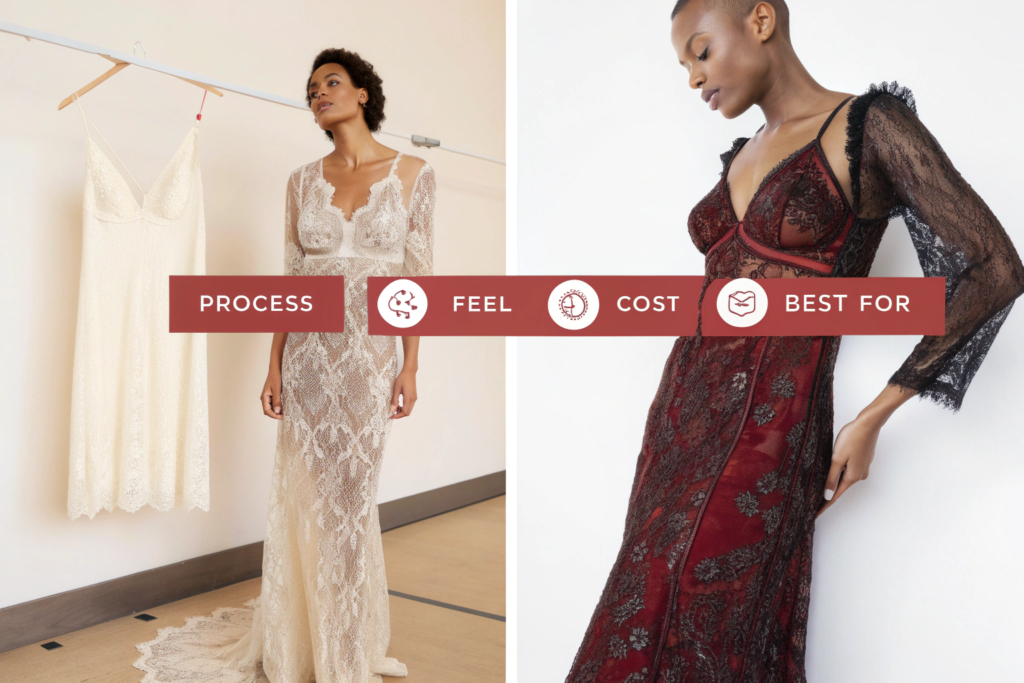
Yes, with practice. Here’s a quick guide:
| Inspection Point | Leavers Lace | Embroidery Lace |
|---|---|---|
| Back Side | Clean, a negative mirror image of the front. No added backing. | Shows stitching, knots, or a permanent backing fabric (often a soft mesh). |
| Edge of Motifs | Threads are continuous, woven into the ground. Edges are integrated. | Threads are cut and secured. You can often see where stitching starts and ends. |
| Hand/Drape | Exceptionally soft, lightweight, and fluid. Can feel almost fragile. | Can range from soft to very stiff, depending on stitch density. Has more body. |
| Price Point | Very High. | Moderate to High, but generally lower than equivalent Leavers. |
A Tip: Gently stretch the lace. Leavers lace, being one woven piece, will stretch slightly and evenly in a way that feels organic. Embroidery lace on a stable net will have less give, or if on stretch mesh, the base will stretch but the embroidered motif may pucker slightly.
For brands navigating this choice, a resource like Sewport’s guide to lace types can provide additional visual references and context.
What is the Future and Are There Hybrid Alternatives?
The landscape isn’t static. Technology is blurring the lines and creating new possibilities. While traditional Leavers lace maintains its niche, new machines like textile Jacquard looms with electronic controls can produce lace-like fabrics with more efficiency and flexibility, though purists argue they lack the soul of true Leavers. Conversely, ultra-fine embroidery machines are achieving levels of detail once reserved for weaving.
The exciting development is the rise of hybrid laces. At Shanghai Fumao, we’re working on solutions that leverage the strengths of both. For example:
- Using a raschel knitted lace as a high-drape, cost-effective base that mimics some qualities of Leavers, then adding minimal, precise embroidery for key decorative highlights.
- Developing sustainable base nets from recycled polyester for embroidery, meeting eco-demands without sacrificing the dramatic effect.
- Utilizing our CNAS-certified lab to test new blends and constructions, ensuring these hybrids meet performance standards for colorfastness and durability.
The future belongs to suppliers who understand both traditions and can navigate the technical space in between. For a client seeking a "Leavers look" with an "embroidery budget," we might propose a high-quality embroidered lace on a super-soft, fine net with a clean-back finish—a strategic compromise that delivers 90% of the aesthetic at a fraction of the cost and time.
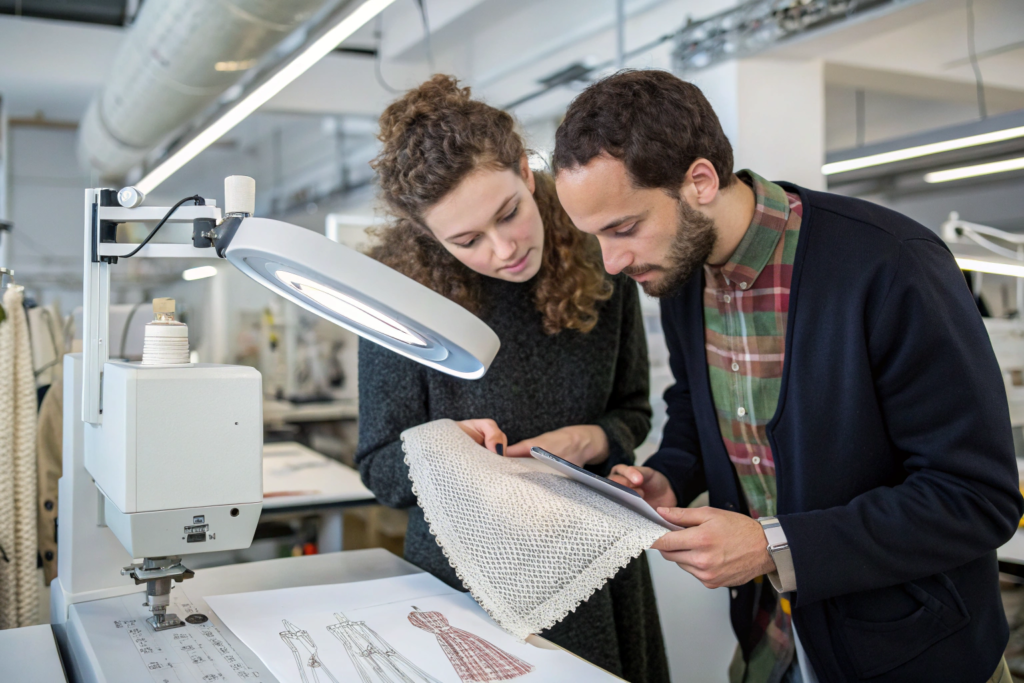
How Should You Source and Specify Your Lace?
Clarity is king. When requesting quotes or samples:
- Be Specific with Terminology: Use "Leavers lace" or "embroidered lace" deliberately. Avoid just saying "French lace," which is ambiguous.
- Provide Clear Visuals and Specs: Share your design. Specify if you need a backing or prefer it removed, the desired stretch or rigidity, and the target weight (gsm).
- Ask Direct Questions: "Is this a woven Leavers lace or an embroidered lace?" "What is the base fabric?" "Can I see the reverse side?"
- Partner with a Knowledgeable Supplier: Work with a partner like Shanghai Fumao who can explain the options, show you physical samples of both types, and guide you to the most commercially and creatively viable solution for your project. We bridge the gap between the atelier and the assembly line.
Conclusion
Leavers lace and embroidery lace are two distinct languages of luxury. Leavers speaks in whispers of history, with unparalleled drape and integrated craftsmanship. Embroidery lace declares itself with bold texture, dimensional artistry, and modern efficiency. One is not a substitute for the other; they are complementary tools in a designer’s kit.
Your choice ultimately boils down to the story you want your garment to tell and the realities of bringing it to market. By understanding the DNA of each type—how they are made, how they feel, and what they cost—you move from guesswork to strategic decision-making. This knowledge empowers you to allocate your budget wisely, set accurate timelines, and achieve the precise aesthetic your brand deserves.
In the complex world of textile sourcing, this distinction is fundamental. At Shanghai Fumao, rooted in the world’s largest textile cluster, we provide not just lace, but clarity. We help you navigate these choices with samples, technical data, and honest advice—whether you seek the heirloom quality of fine Leavers-style lace or the dramatic impact of custom embroidery. Let’s ensure the lace you choose is perfectly woven into the success of your collection. To discuss your specific lace needs and explore our vast library of both embroidered and woven lace samples, contact our Business Director, Elaine. She’ll ensure you get the right fabric for your vision. Reach her at: elaine@fumaoclothing.com.