You have a breathtaking lace design in mind—a unique pattern that will define your next collection. The excitement is real. Then you contact a supplier and ask about custom development. The answer comes back: "MOQ is 5,000 meters." Your heart sinks. Your startup brand or limited-edition line only needs 500 meters. Game over? Not necessarily. The "one-size-fits-all" MOQ is the single biggest dream-killer in textile sourcing, but it’s also one of the most misunderstood numbers.
Here’s the truth from inside the factory: MOQ isn’t a wall; it’s a conversation. At Shanghai Fumao, we’ve spent 20 years in Keqiao navigating these very conversations. The magic number depends on a delicate balance between your design’s complexity and our production machinery’s economics. This guide will decode what really drives MOQ for custom lace, reveal where flexibility exists, and show you proven strategies to access custom designs without committing to warehouse-crushing quantities. You can get your unique lace—you just need to know how to ask for it.
Think of MOQ not as a barrier, but as a key that unlocks different levels of customization. By understanding the mechanics behind it, you transform from a price-quote receiver into a strategic partner who can negotiate win-win solutions. Let’s dive into the real factors that determine how much lace you really need to order.
What Factors Actually Determine the MOQ for Custom Lace?
The MOQ isn’t pulled from thin air. It’s a calculated figure that ensures the factory can cover its fixed costs and make a reasonable profit. The biggest cost driver is the machine setup. For Raschel or Leavers lace machines, creating a new design requires programming a new "jacquard" pattern chain or a digital file. This setup is time-intensive and halts regular production. Whether we run 100 meters or 10,000 meters afterward, that setup cost remains the same. Spreading it over a larger order brings the cost per meter down.
Beyond setup, three other pillars define the MOQ:
- Yarn Type and Availability: Standard polyester or nylon yarns are stocked in bulk. If your design requires a specialty yarn—like GOTS-certified organic cotton, recycled silver thread, or a specific dye-to-match color—suppliers have minimum purchase requirements for that yarn itself.
- Production Technique: As mentioned in our previous guide, a simple Raschel lace generally has a lower MOQ than a complex Leavers or embroidered (Schiffli) lace, which involves more steps and potentially a dissolvable base fabric.
- Sampling and Development Costs: The journey to your final lace involves lab dips, strike-offs, and sample revisions. These costs are typically amortized into the bulk MOQ.
We had a case with an emerging Australian resort wear brand in 2022. They wanted a custom lace with a tropical leaf motif using a bamboo-blend yarn for sustainability. The initial MOQ from a standard factory was 3,000 meters. By working with them to simplify the leaf motif’s connecting points (making it more Raschel-friendly) and agreeing to use a stock bamboo blend we already sourced for other projects, we brought the feasible MOQ down to 800 meters for their first season. It’s about smart co-design.
How Do Different Lace Machines (Raschel vs. Leavers) Affect MOQ?
This is the most critical technical distinction. Raschel machine MOQs are generally more flexible. Modern electronic Raschel machines can switch patterns with digital files, reducing physical setup time. We can often batch smaller, similar-width designs together on one machine run. This allows us at Shanghai Fumao to offer MOQs as low as 300-500 meters for relatively simple custom Raschel laces, especially for our trusted repeat clients.
Leavers lace machines, the classics for haute couture styles, are a different story. They require a physical jacquard chain to be punched or assembled for each new pattern—a craft in itself. Setting up a chain can take weeks. Therefore, the MOQ to justify this is significantly higher, often starting at 2,000 meters and above. For a true Leavers lace, the investment is in the pattern itself, which becomes a durable asset. For brands, understanding this distinction is crucial when researching how to choose between Raschel and Leavers lace for fashion design, where resources from institutions like the Victoria and Albert Museum can provide foundational knowledge.
Can You Share a Real Case Where MOQ Was Successfully Negotiated?
Absolutely. In Q3 2023, a boutique Swiss lingerie brand approached us. They had a technically complex design for a stretch lace with a 22% Lycra content and a precise, small-scale geometric pattern. Their forecast was only 350 meters across four colors. A straight custom run was uneconomical. Our solution was a "platform development" approach. We identified an existing base geometric mesh structure in our library that was 85% similar. We then developed only the new, unique motif elements as an embroidered appliqué that could be heat-transferred onto the base mesh in our coating factory. The MOQ for the custom appliqué was 200 meters, and the base mesh was from stock. They got a unique product, and we kept production efficient. The key was transparent conversation about their real needs versus perceived ones.
What Are Practical Strategies to Lower Your Effective MOQ?
You don’t always need to move the supplier’s official MOQ number. Often, you can achieve your goal by working creatively within their system. The first and most powerful strategy is to explore existing pattern libraries. Most reputable suppliers, including us, have a catalog of hundreds of existing lace designs. Modifying an existing pattern’s color or making a minor tweak (like changing a flower’s center) often carries a tiny fraction of the MOQ and cost of a ground-up design. It’s the fastest path to "semi-custom."
Another proven tactic is consolidating orders across seasons or colorways. If you need two colors, ordering them together in a single production run can meet the meterage MOQ. Similarly, if you have a lace you’ll use across multiple styles or seasons, committing to a forecast and placing a single larger order with phased delivery can unlock the pricing and feasibility of a true custom design. We can warehouse and ship according to your schedule.
Is Group Buying or Crowdsourcing a Viable Option for Startups?
This is an increasingly popular model, especially in the digital age. Group buying involves several small brands or designers pooling their orders for the same custom lace design. The combined volume meets the MOQ, and each brand gets their share. The challenges are logistical: finding compatible partners, agreeing on specifications, and managing split shipments and payments. Platforms exist that facilitate this, but they require relinquishing some exclusivity.
A more controlled approach we sometimes facilitate is internal batching. If we have two clients with similar design aesthetics and timing needs, we might propose a base custom design with slight variations for each. This shares the core development cost. For example, we once produced a custom floral vine lace where one client received it with a scalloped edge and another with a straight edge. Both were happy with their "unique" product. For entrepreneurs, joining forums like The Fashion Business Coach community can be a way to network with potential collaboration partners.
How Does Sample Development Work Before Committing to MOQ?
This is the essential "try before you buy" phase, and it’s a critical investment. The process typically involves:
- Tech Pack & Quote: You provide a detailed design. We give a preliminary quote and MOQ.
- Sample Development Fee: You pay a non-refundable fee to cover the cost of creating the first physical sample (a "strike-off"). This fee is usually credited against your future bulk order.
- Revisions: You receive the sample, request changes (e.g., "make the pattern 10% larger," "use a softer yarn"), and we revise. 1-2 revisions are often included; more may incur additional fees.
- Approval & Bulk Order: Once you approve the final sample, we proceed with the bulk production at the agreed MOQ.
This process de-risks the large order. In early 2024, a US sustainable brand paid a sample fee for a lace made from recycled ocean plastic. The first sample was too stiff. We revised the yarn blend, adding a touch of modal. The second sample was perfect, and they placed their 700-meter bulk order with complete confidence. Understanding what to include in a professional fabric tech pack is the first step to a smooth sampling process.
How Do MOQs Compare Across Different Lace Types (Chantilly, Guipure, etc.)?
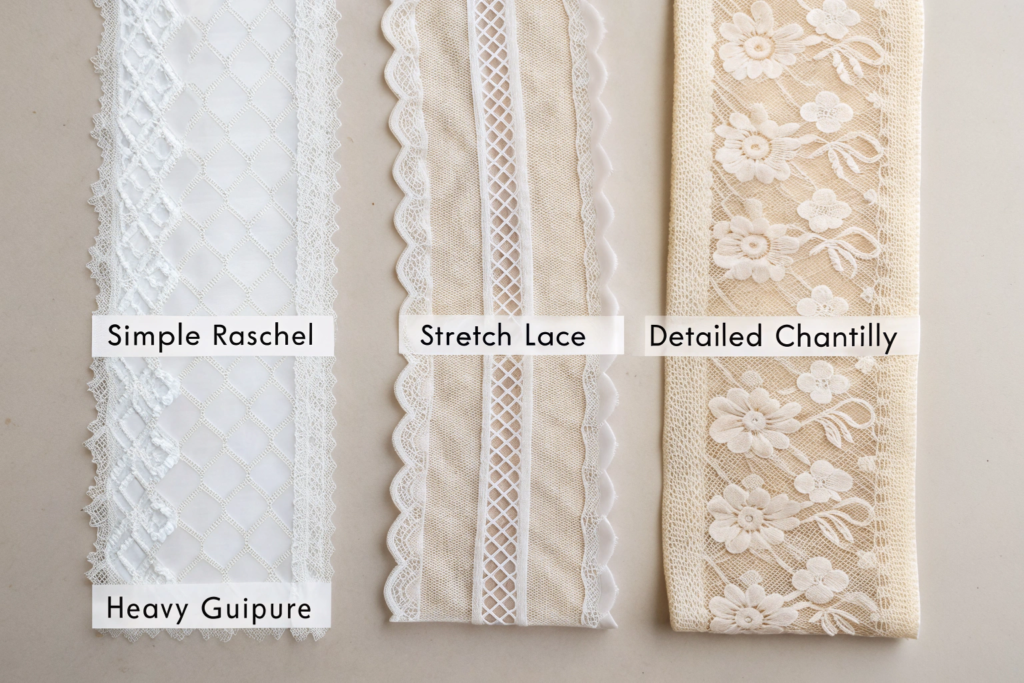
Not all laces are created equal in the eyes of production economics. As a rule of thumb, MOQ increases with complexity, weight, and the specialization of the machinery required. Here’s a generalized hierarchy:
| Lace Type | Typical Production Method | Key MOQ Drivers | Estimated Custom MOQ Range* |
|---|---|---|---|
| Simple Raschel Lace | Electronic Raschel Knitting | Digital pattern setup, yarn | 300 – 1,000 meters |
| Stretch Lace (Lycra) | Raschel with Elastane | Yarn complexity, tension control | 500 – 1,500 meters |
| Chantilly-Style Lace | Often Leavers or fine Raschel | Fine yarn, intricate pattern detail | 1,000 – 3,000+ meters |
| Embroidered (Schiffli) Lace | Embroidery on dissolvable base | Stitch count, stabilizer, digitization | 800 – 2,000 meters |
| Guipure / Venise Lace | Heavy Raschel or embroidery | High yarn consumption, dense structure | 1,000 – 2,500 meters |
*Ranges are indicative and vary widely by supplier capability and design specifics.
Guipure lace, being dense and yarn-heavy, has a high material cost per meter, which can influence MOQ as the factory needs to purchase significant yarn quantities. Embroidered lace MOQ is heavily dependent on the number of stitches—a densely embroidered design will cost more per meter and may have a higher MOQ than a sparser one on the same base.
Why Does Embroidered Lace Often Have a Variable MOQ?
As mentioned, stitch count is king. But there’s another lever: fabric base width. Our embroidery machines have a fixed working width, say 160 cm. If your lace pattern is 10 cm wide, we can embroider multiple parallel strands across the 160 cm base fabric. This dramatically reduces the effective cost per meter and can lower the feasible MOQ. If your pattern is 150 cm wide, it must run singly down the length of the base. Therefore, a narrower repeat pattern is one of the most effective ways to reduce the MOQ for custom embroidered lace. It’s a classic design-for-manufacturability principle.
What is the Real Cost Breakdown Behind a Custom Lace MOQ?
Let’s demystify this with a simplified example for a 1,000-meter MOQ custom Raschel lace:
- Design & Setup (20-30%): CAD pattern creation, machine programming, technician time.
- Sampling (5-10%): Yarn for samples, labor for sample loom setup, shipping.
- Raw Material Yarn (40-50%): The actual thread used.
- Production Labor & Overhead (20-30%): Machine operation, electricity, quality control.
- Finishing & Shipping (5%): Dyeing (if not yarn-dyed), softening, inspection, packing.
When you order only 300 meters, the Design & Setup cost becomes a much larger percentage, making the per-meter price skyrocket or the project unviable for the factory. The 1,000-meter MOQ brings that percentage down to an acceptable level. For startups, reading about the hidden costs of small-batch clothing production can provide full-picture financial planning context.
Conclusion
The conversation about MOQ should never be your first question. It should be the culmination of a dialogue. Start by presenting a clear vision (your tech pack), demonstrating professionalism, and expressing a desire for a long-term partnership. Ask open-ended questions: "What drives the MOQ for this particular design?" and "Are there modifications we could make that would improve production efficiency?"
Remember, suppliers want to say yes to good projects. They want reliable clients who will grow. By showing you understand the constraints and are willing to collaborate—whether through flexible timing, design adjustments, or consolidated ordering—you position yourself not as a problem, but as a partner. The most successful clients we have at Shanghai Fumao are those who see us as an extension of their own team.
Ready to turn your custom lace vision into a tangible, affordable reality? The journey starts with a conversation grounded in mutual understanding. Contact our Business Director, Elaine, at elaine@fumaoclothing.com with your design ideas. Let’s explore the art of the possible together, finding the most efficient and creative path to produce the lace that will make your next collection unforgettable. We’re here to make custom achievable.