You have a vision for the perfect wedding dress—romantic, ethereal, and exquisitely detailed. The lace you choose will define it. But navigating the world of Chinese lace sourcing feels like walking through a maze: endless Alibaba listings, confusing terms like "Leavers" vs. "Raschel," and a fear that the stunning sample will arrive as a stiff, shiny disappointment. How do you cut through the noise and secure the exquisite, high-quality lace your design deserves without blowing your budget or timeline?
Sourcing high-quality wedding dress lace from China is a strategic process that combines aesthetic discernment with technical due diligence. The key is to target the right production methods (primarily Leavers lace and high-end embroidered lace), partner with specialized suppliers in the right industrial clusters, and implement a rigorous sampling and verification protocol. Success hinges on understanding that "quality" for bridal means specific attributes: a soft, luxurious hand; intricate, well-defined patterns; excellent drape; and color purity (ivory, champagne, white). This isn’t just buying fabric; it’s curating the centerpiece of a bride’s most important garment.
Forget the generic suppliers. You need to engage with experts who speak the language of bridal couture and understand the non-negotiable standards of the wedding dress industry. As a supplier embedded in Zhejiang’s textile heartland, I’ve guided countless designers through this journey, from initial swatch selection to the arrival of flawless bulk rolls. Let’s map out the precise steps to turn your vision into a tangible, breathtaking reality.
Why is "Leavers Lace" Considered the Gold Standard for Bridal?
In the hierarchy of lace, Leavers sits at the throne for bridal. Its name isn’t just a brand; it’s a specific, centuries-old manufacturing process that yields an unparalleled result. When a bride says she wants "real lace," this is often what she imagines—the lace of vintage heirlooms and haute couture.
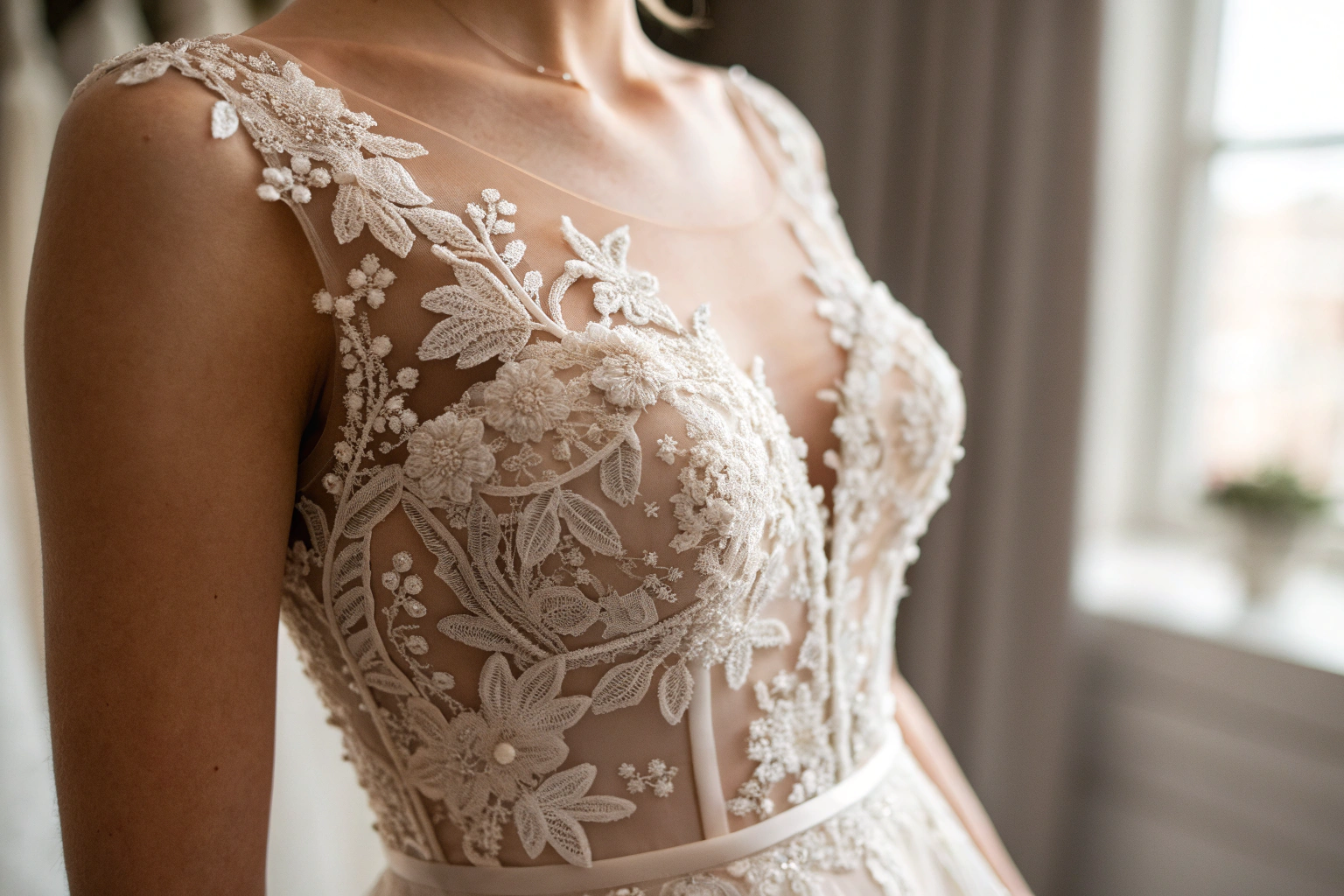
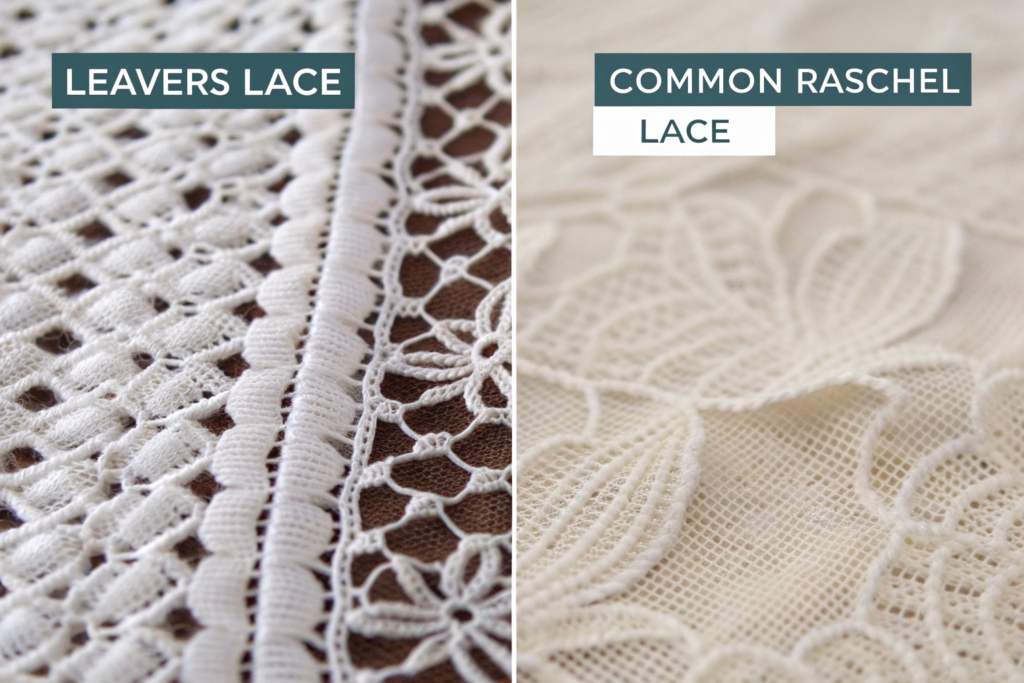
Leavers lace is produced on incredibly complex, often antique, Jacquard looms. The process is slow and artisanal, even when mechanized. Yarns (traditionally fine cotton, silk, or linen, now often high-quality polyester) are individually guided to create the pattern and the ground net simultaneously. This results in a fabric with exceptional detail, a non-stretchy, stable structure, and a beautiful, slightly irregular texture that looks handcrafted. The patterns are deep and well-defined, often outlined with a glossy "cordé" thread that adds dimension and prevents fraying. Most importantly, it has a drape and hand feel that cheaper laces cannot replicate—it moves with the body, not against it.
What specific visual and tactile markers distinguish true Leavers lace?
You must train your eye and hands. When evaluating a sample:
- Examine the Back: Turn it over. A true Leavers lace will have a back that is almost as neat as the front, with carried threads that are part of the structure. Cheap lace will have a messy back with many cut, floating threads or a glued-on feel from an embroidered appliqué on net.
- Check the Ground Net: The net background (réseau) should be fine, regular, and soft. It shouldn’t be stiff or scratchy.
- Feel the Weight and Drape: It should have a substantial but soft hand. Crush it in your fist—it should recover well without permanent creasing. Drape it over your hand; it should fall in soft folds, not stand away stiffly.
- Look at the Pattern Definition: Motifs should be crisp, not blurry. The outlining cordé (if present) should be smooth and integrated, not like a thick, plasticky thread laid on top.
Always request a physical swatch of at least A4 size. Digital photos lie. In 2023, a UK designer sent us a photo asking for a "Leavers lace match." We sent our sample alongside the one she was considering. Ours was a true cotton Leavers; hers was a polyester Raschel imitation. The difference in hand and drape was immediate and decisive—she switched suppliers on the spot. Resources like guides to identifying antique and quality contemporary lace can help sharpen your evaluation skills.
Are there viable high-quality alternatives to Leavers lace for bridal?
Yes, absolutely. While Leavers is the benchmark, other techniques produce stunning bridal-quality lace:
- High-End Embroidered Lace (Schiffli): This involves embroidering a pattern onto a temporary backing or a fine base fabric (like tulle or organza), then dissolving the backing. The result is incredibly delicate, with limitless design possibilities and often a lighter weight. It’s perfect for overlays, sleeves, and ethereal looks. The key is the quality of the embroidery thread and the fineness of the stitch.
- French Alençon-style Lace: This is often a type of embroidered lace where a fine cord outlines the pattern on a tulle ground, mimicking the look of the classic French needle lace. It’s elegant and structured.
- Premium Raschel Lace: Technological advances mean some high-end Raschel laces, especially those using fine natural fiber yarns, can approach the aesthetic of Leavers for certain applications at a lower cost and with the benefit of slight stretch, which can be advantageous for fit.
The choice depends on your design, budget, and the specific drape you need. We often advise clients to use Leavers for the main body and a matching embroidered lace for the sleeves or skirt overlay for consistency and cost efficiency.
Where and How to Find Specialized Bridal Lace Suppliers in China?
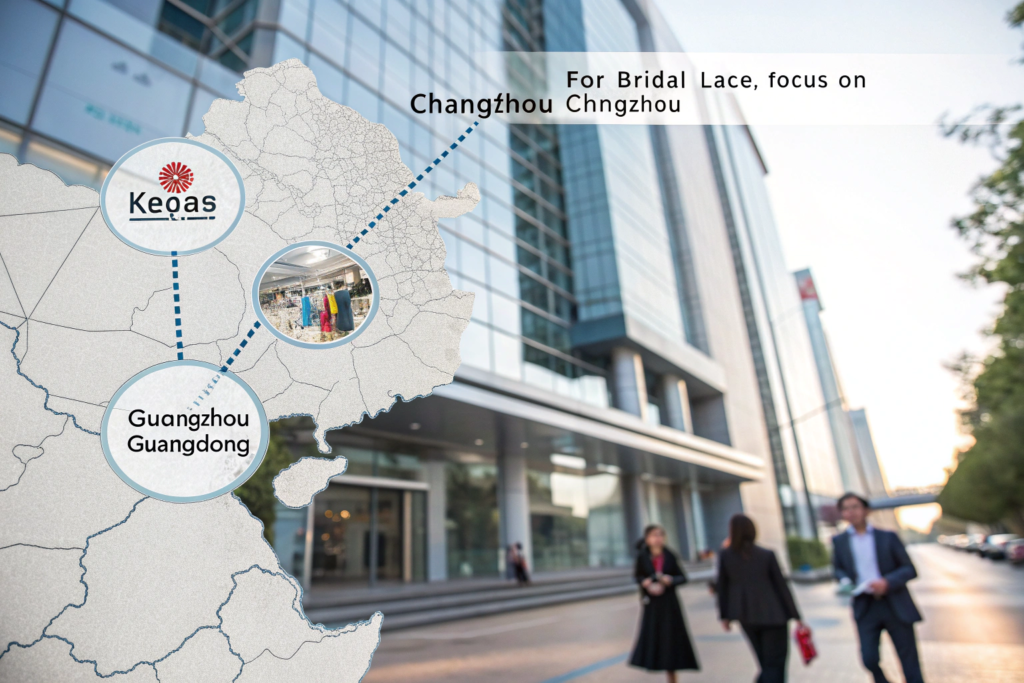
You won’t find true bridal lace specialists by searching generically. You need to go to the source. The epicenter for high-end lace production in China is Changzhou, Jiangsu Province, and certain specialized factories in Guangdong and Zhejiang. These regions have clusters of factories with the legacy Leavers looms and advanced embroidery capabilities.
Start by targeting suppliers who explicitly list "bridal lace," "wedding dress lace," or "Leavers lace" as a core specialty. Their portfolio should show close-up, high-resolution images of lace, not just generic garment shots. Look for suppliers who are exhibitors at international bridal fairs like Shanghai Bridal or who are featured on B2B platforms with verified transaction records in the wedding category. A serious supplier will have an English-speaking account manager who understands bridal terminology (e.g., "ivory vs. diamond white," "scalloped edge," "all-over pattern vs. border").
What are the red flags and green flags when vetting a potential supplier?
Red Flags:
- Vague Terminology: Supplier calls everything "Leavers lace" or "French lace" without distinction.
- No Physical Address or Factory Photos: They are likely a trading company with no quality control.
- Unwillingness to Send Large Swatches: They may only have small cuttings that hide flaws.
- Prices Too Good to Be True: True Leavers lace has a significant base cost due to slow production.
- No Discussion of Fiber Content: They should readily state if it’s 100% cotton, polyester, or a blend.
Green Flags:
- Specialized Catalog: They have a dedicated bridal lace lookbook.
- Proactive Technical Questions: They ask about the dress silhouette, lining fabric, and application method.
- Transparent About Process: They explain if it’s stock or custom, and the lead time implications.
- Offers Comprehensive Services: Like Shanghai Fumao, they can provide fabric mounting services for lace appliqué or connect you with compatible lining suppliers.
- Provides Certificates: They can provide Oeko-Tex Standard 100 certificates ensuring the lace is free from harmful substances—a critical point for garments worn close to the skin for long periods.
How should I approach the initial inquiry to get serious attention?
Your first contact sets the tone. Write a professional, detailed inquiry:
- Introduce Your Brand: Briefly state you are a wedding dress designer/manufacturer.
- Describe Your Project: "Seeking all-over floral Leavers lace for a fitted mermaid gown bodice and skirt overlay."
- Specify Key Requirements: Mention desired color (provide Pantone if possible), approximate width, and required meterage (even if an estimate).
- Request Specific Actions: "Please send 30x30cm swatches of your 5 best-selling ivory bridal Leavers laces with technical specs and FOB prices. We are ready to order samples for a Fall 2024 collection."
This demonstrates you are a knowledgeable, serious buyer, not just browsing. It will prompt a more serious response from quality suppliers.
What Does a Robust Sampling and Quality Assurance Process Look Like?
Sampling is not a cost; it’s your most important insurance policy. For bridal lace, a multi-stage sampling process is non-negotiable to avoid catastrophic bulk order failures.
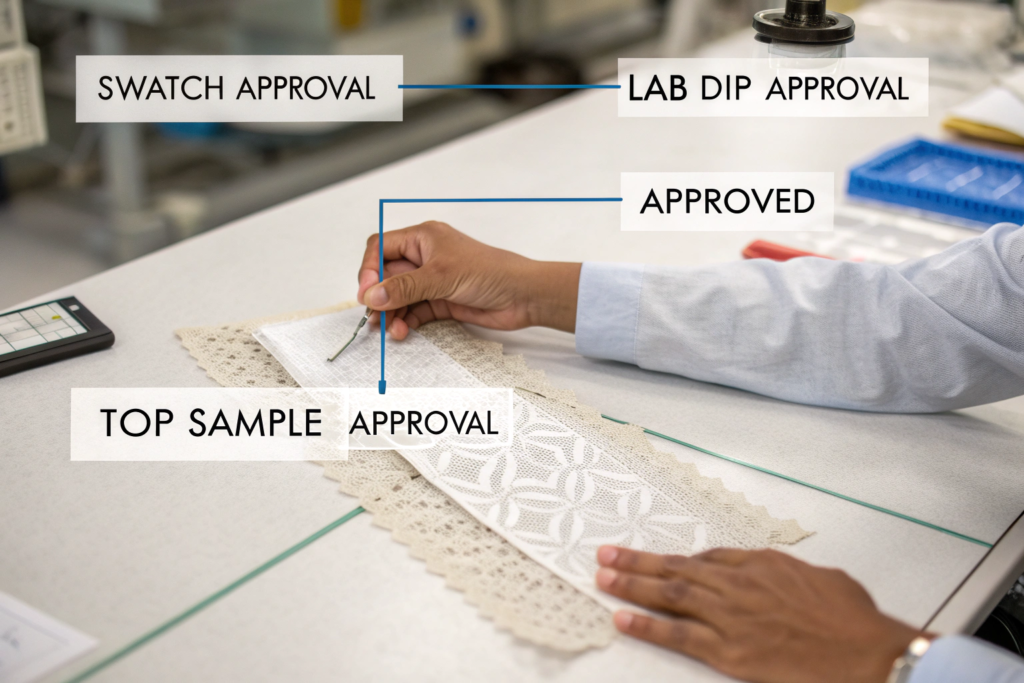
The process should have at least three gates:
- Swatch Approval: Evaluate large (30x30cm) swatches for hand, drape, and color.
- Lab Dip/Strike-Off Approval: For custom colors, the supplier dyes a small batch (1-2 meters) to match your standard. You must approve this under both natural and artificial light to check for metamerism (color shift).
- Bulk Yardage Sample (TOP Sample): Before the full order is cut and packed, insist on receiving 3-5 meters cut from the beginning of the bulk production run. This is your final check for consistency with the approved swatch in terms of weight, hand, pattern alignment, and color.
What technical tests should I require for bridal lace?
Do not skip independent lab testing. The minimum test report for bridal lace should include:
- Composition: Verifying fiber content (e.g., 100% Polyester, 92% Cotton/8% Polyester).
- Colorfastness: To washing (ISO 105-C06), perspiration (ISO 105-E04), and light (ISO 105-B02). A rating of 4-5 (on a 1-5 scale) is excellent.
- Dimensional Stability (Shrinkage): After washing or steam pressing. Bridal lace may be dry-cleaned, but testing for steam pressing shrinkage is crucial for dress construction.
- pH Value: Should be neutral (4.0-7.5) to be skin-safe.
Reputable suppliers will have these tests done at third-party labs like SGS or Intertek and provide the reports. We include these as standard for all our bridal lace orders. For designers concerned about sustainability, asking for a Global Recycled Standard (GRS) certificate for recycled polyester laces is also becoming common.
How do I manage the critical issue of color consistency?
Color is emotional in bridal. "Ivory" is not one color. You must control this meticulously.
- Provide a Physical Standard: Send a physical fabric swatch of your desired color as the master standard. Do not rely on Pantone numbers alone, as lace dyeing on different fibers yields different results.
- Use a Light Box: Approve all lab dips and TOP samples under a D65 daylight simulator light box to eliminate ambient light influence.
- Define Acceptable Tolerance: Discuss with your supplier what a commercially acceptable shade deviation is. In the bridal industry, it’s typically very tight.
A nightmarish scenario is receiving a bulk order where the lace is a yellowish ivory against a pinkish ivory lining. In 2024, we managed a project for a US brand where we dyed the lace, the tulle underlay, and the silk satin lining all in the same dye house batch to guarantee a perfect match—this level of coordination is what defines a true sourcing partner.
How to Navigate Costs, MOQs, and Logistics for Bridal Lace?
Bridal lace is an investment. Understanding the cost drivers and planning for the associated logistics is key to managing your overall dress cost and timeline.
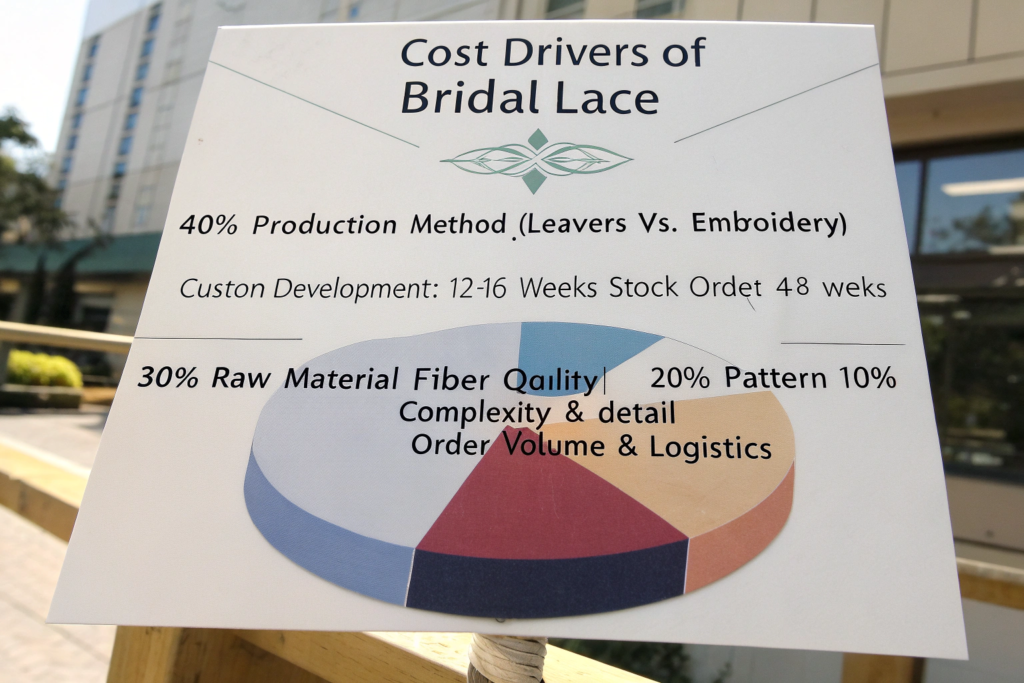
The cost is determined by: Production Method (Leavers is most expensive), Fiber (Silk > Cotton > Polyester), Pattern Complexity (denser patterns use more thread and machine time), and Order Quantity. MOQs for custom Leavers lace can be 300-1000 meters per design/color. For stock designs, MOQs can be as low as 50-100 meters. Always factor in sampling costs (which may be credited against a bulk order) and shipping costs for samples and bulk. Bridal lace is often shipped via air freight for speed, especially for smaller orders or urgent samples, which significantly impacts cost.
What are effective strategies to manage high MOQs?
If you’re a smaller designer, high MOQs can seem prohibitive. Here are strategies:
- Choose Stock Designs: Work with a supplier’s existing pattern library. The MOQ is lower, and you can often customize the color.
- Consortium Ordering: Partner with other non-competing designers to combine orders for a custom design.
- Phased Ordering: Place a bulk order for your main color (e.g., Ivory) and a much smaller sample quantity of a secondary color (e.g., Blush) to test the market.
- Strategic Use of Appliqués: Order a smaller quantity of an expensive custom lace and use it as appliqués on a less expensive base fabric (like mikado or tulle), rather than as an all-over fabric.
Discuss your constraints openly with the supplier. A good partner like Shanghai Fumao will work creatively to find a solution, perhaps suggesting a similar but stock pattern with a lower MOQ.
How do I plan for shipping and customs clearance?
Plan this early to avoid delays on the wedding aisle!
- Shipping Terms: Understand Incoterms. "FOB Shanghai" means the supplier gets the goods to the port; you handle and pay for the main shipping and insurance. "EXW" means you handle everything from their factory door.
- Documentation: Ensure the supplier provides a detailed commercial invoice, packing list, and certificate of origin. For lace, the Harmonized System (HS) code is critical for correct customs duty classification.
- Import Duties: Research the duty rate for lace fabric in your country. The US, for example, has different rates for different fiber types.
- Logistics Partner: Work with a freight forwarder experienced in textile imports. They can handle customs clearance and advise on packing (lace should be rolled on tubes, not folded, to prevent permanent creases). We often handle this for our clients, providing door-to-door DDP (Delivered Duty Paid) service for peace of mind.
Conclusion
Sourcing high-quality lace from China for wedding dresses is a journey of precision and partnership. It demands a focused search for specialized suppliers, an educated eye for true quality (championing Leavers and fine embroidery), and an unwavering commitment to a rigorous sampling and testing protocol. By understanding the cost structures, MOQ strategies, and logistical nuances, you can secure the exquisite foundation your designs deserve while maintaining control over your budget and timeline.
Remember, the right supplier is more than a vendor; they are a collaborator who understands the emotional weight and technical demands of bridal couture. They should elevate your process with expertise, transparency, and a shared commitment to beauty. If you are ready to source lace that will make brides dream, let’s begin that conversation. At Shanghai Fumao, we bridge the gap between China’s finest lace ateliers and designers worldwide, ensuring quality, consistency, and a seamless journey from loom to aisle. Contact our Business Director, Elaine, at elaine@fumaoclothing.com to request our curated bridal lace portfolio and start a partnership built on trust and exceptional craft.