If you’re sourcing fabrics in 2024, you’ve likely heard the term "PFAS" — and the rising panic around it. These "forever chemicals" are creating regulatory whirlwinds that are fundamentally reshaping global textile supply chains. For buyers and brands, ignorance isn’t just risky; it’s a direct threat to market access, reputation, and financial stability.
So, what exactly are the rules, and how can you ensure compliance without derailing your production? The regulatory landscape is fragmented but rapidly converging on a clear goal: the phased elimination of PFAS in consumer textiles, especially apparel and home textiles. This isn’t a distant future concern. Bans are already in effect in key markets, with aggressive enforcement timelines that directly impact your sourcing decisions from China and Asia.
Understanding these regulations is no longer just about corporate responsibility; it’s a core component of supply chain due diligence and a significant competitive advantage. Brands that adapt quickly will secure access to compliant factories and innovative materials, while others face costly recalls and lost shelf space.
What Are PFAS and Why Are They in My Fabrics?
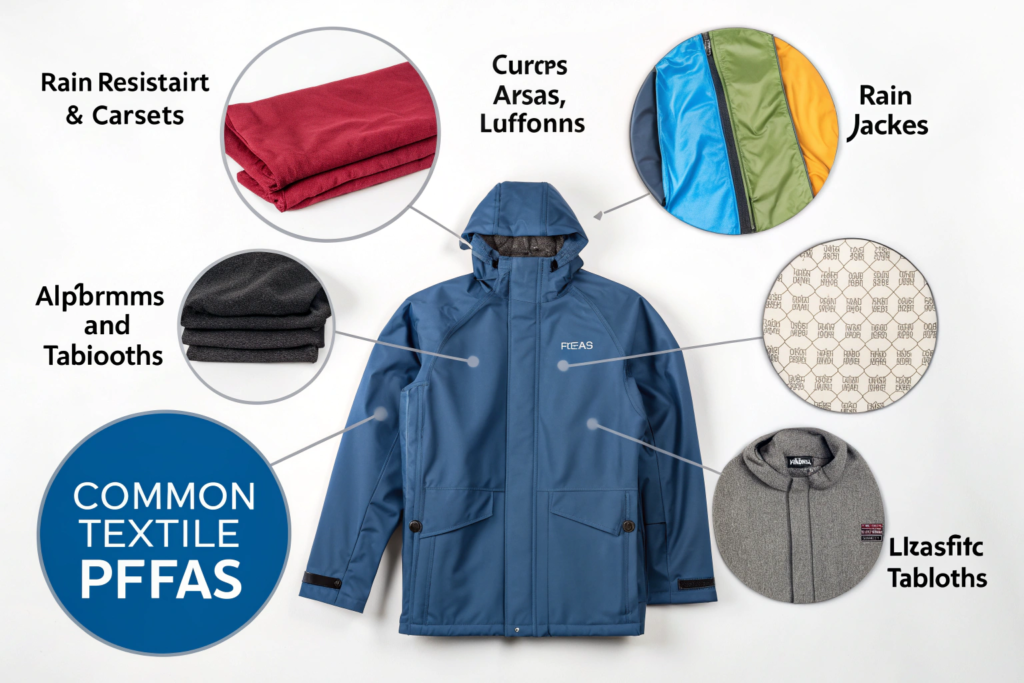
Let’s break down the basics. PFAS (Per- and Polyfluoroalkyl Substances) are a vast class of thousands of synthetic chemicals. Their superpower—and their curse—is the incredibly strong carbon-fluorine bond. This makes them resistant to oil, water, stains, and heat. In fabrics, this translated to popular "durable water repellent" (DWR) finishes on rainwear, stain-resistant treatments for upholstery and uniforms, and even some anti-wicking claims in workwear.
For decades, they were the go-to solution for performance. However, that same persistence means they don’t break down in the environment or our bodies—hence "forever chemicals." Studies link certain PFAS to serious health risks, driving the regulatory crackdown. The key for you as a buyer is that PFAS in functional textiles are now a liability, not a feature. Your customers in the EU and US are increasingly aware, and retailers are demanding proof of compliance.
The challenge in sourcing is that PFAS can be hidden. They might be in a coating, a laminate, or even in recycled materials (due to previous use). This makes supply chain transparency non-negotiable. When we at Shanghai Fumao develop high-performance fabrics now, we start with a fundamental question: "Is this performance achievable without fluorochemistry?" The answer is increasingly "yes," through newer eco-friendly innovations like PFAS-free DWR based on silicon or dendrimer technology.
How do I know if PFAS are in my sourced fabrics?
You must ask, and you must test. Don’t rely on a supplier’s verbal "no." The due diligence process should be contractual. First, request a full chemical inventory disclosure or a Manufacturing Restricted Substance List (MRSL) declaration from your mill or factory. Reputable suppliers, especially those serving the EU market, should have this. Second, for high-risk items (any fabric marketed as water-, stain-, or oil-repellent), insist on third-party testing.
Specific test standards are key. Look for testing that covers a broad range of PFAS substances, not just the old PFOA and PFOS. Standards are evolving fast. For example, the OEKO-TEX® STANDARD 100 now includes an extensive list of PFAS, and their ECO PASSPORT for chemicals is a good tool for verifying safer alternatives. A case from early 2023: A Danish workwear brand sourcing coated fabrics from China required testing to the new EU REACH PFAS restriction proposal scope. We facilitated testing at our CNAS lab, and the batch failed due to trace PFAS in a sourced coating agent. We switched to a certified PFAS-free coating supplier, and the subsequent shipment passed, avoiding a potential border rejection. This proactive testing is your best defense.
Are all "water-repellent" finishes now problematic?
Not all. The problem is specifically fluorinated water repellents. The market has shifted dramatically toward high-performance, PFAS-free DWR finishes. These alternatives, while sometimes requiring more careful laundering, meet the needs of most consumers. When sourcing, you need to specify "Non-Fluorinated DWR" or "PFAS-Free Water Repellency" explicitly in your tech pack and purchase orders.
Performance comparisons are critical. In our experience, the best PFAS-free fabric finishes can achieve a water repellency spray test rating of 80-90 (ISO 4920), which is excellent for most urban and lifestyle applications. For extreme conditions, the gap is narrowing. The trade-off for avoiding regulatory risk and contributing to a sustainable textile supply chain is well worth it for most brands. We guide our clients through this transition by providing side-by-side performance data and wash durability tests.
What Are the Key Global Regulations I Must Follow?
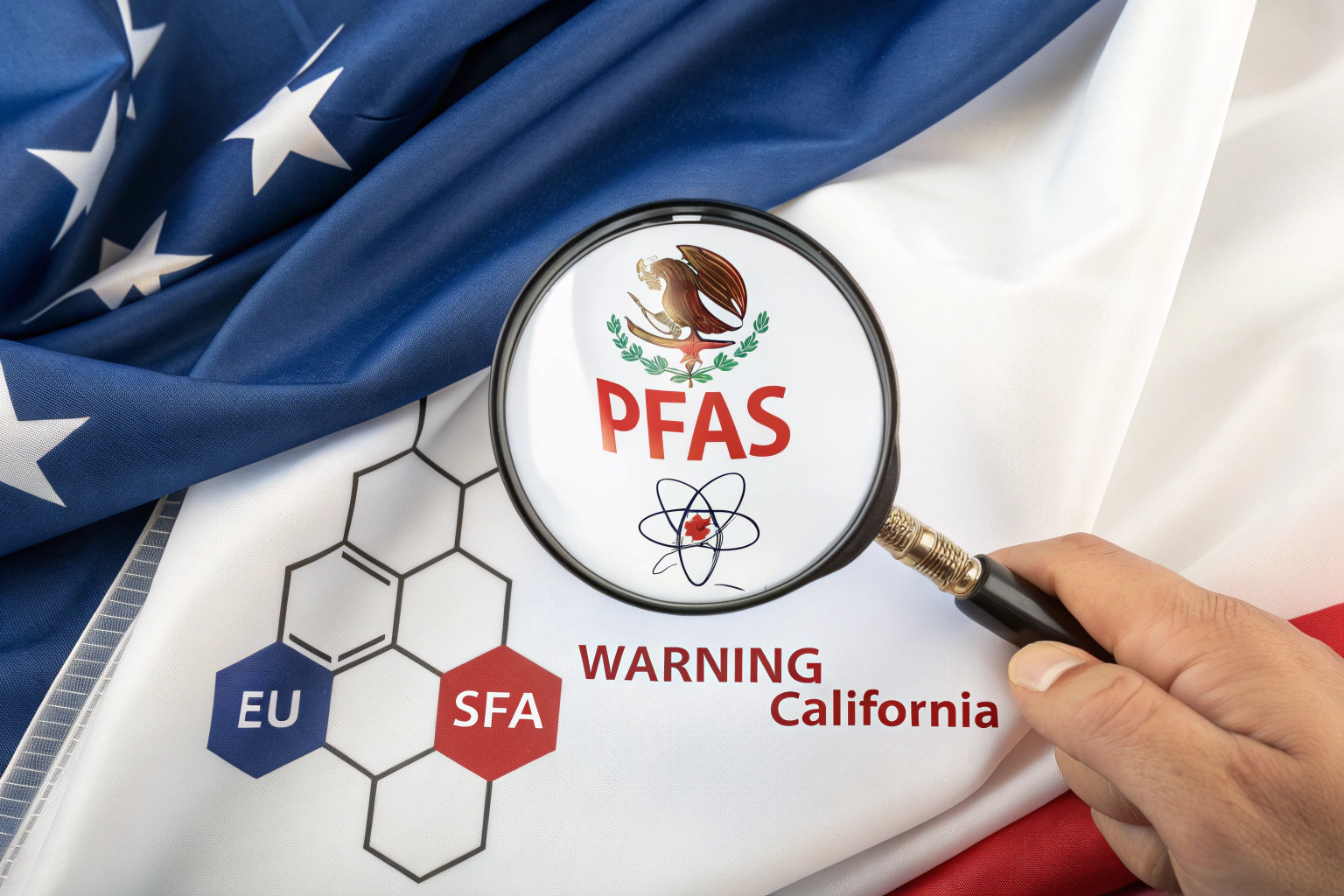
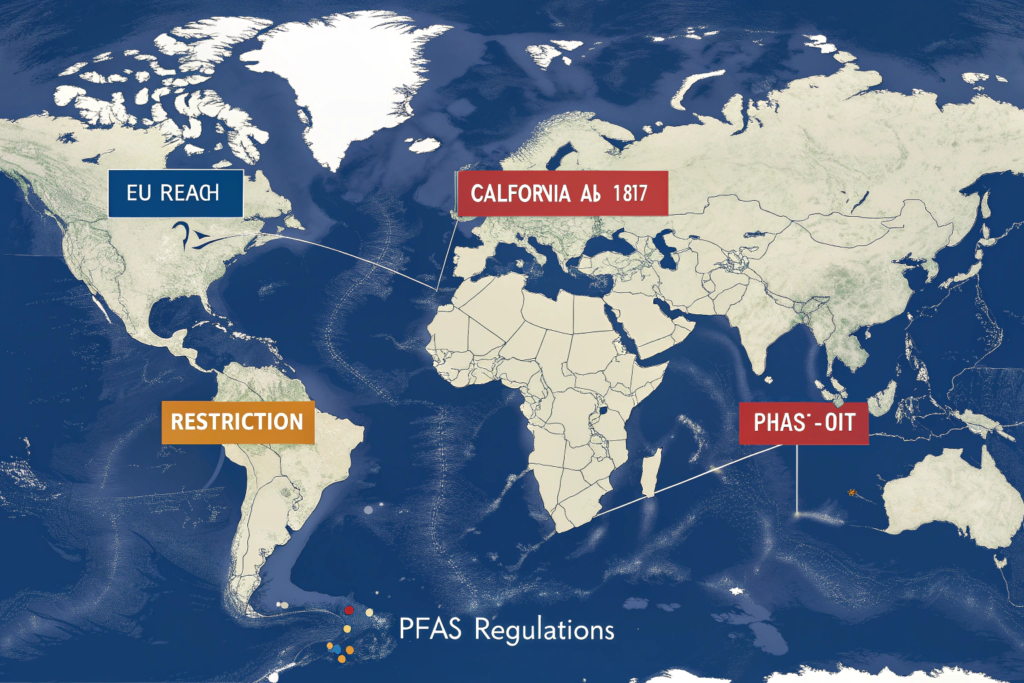
The regulatory landscape is a patchwork, but three regions are setting the de facto global standard: the European Union, the United States (particularly California), and China. Non-compliance means your goods cannot be sold in these markets—a business-ending prospect for many.
1. The European Union (EU REACH): This is the most comprehensive and influential. PFAS are regulated under the REACH (Registration, Evaluation, Authorisation and Restriction of Chemicals) framework. Key existing restrictions include:
- A ban on PFOA (and related compounds) since 2020, with a very low limit (0.025 mg/kg for textiles).
- A proposed universal restriction on all PFAS. This monumental proposal, under evaluation by the European Chemicals Agency (ECHA), aims to ban the manufacture, use, and sale of PFAS in the EU. A transition period is expected, but the direction is absolute. For textile imports into Europe, this is the single biggest compliance hurdle on the horizon.
2. United States (State-Level Leadership): Federal action is slower, but states are racing ahead.
- California (AB 1817): Effective January 1, 2025, this law prohibits the intentional use of PFAS in most apparel and textiles. It sets a strict threshold of 100 ppm for "organic fluorine" as a proxy for PFAS presence. This is the rule that has every major brand auditing its supply chain right now.
- Maine, New York, Washington: Have similar laws targeting textiles, with varying timelines and scopes.
- Federal: The EPA is moving toward designating certain PFAS as hazardous substances, which impacts waste and liability.
3. China (GB Standards): As a major producer, China’s own GB (Guobiao) standards are tightening. While historically focused on PFOA and PFOS, amendments are expected to align more closely with global trends. For factories exporting to the EU and US, compliance is already being driven by buyer demand.
How do regulations differ between apparel, home textiles, and PPE?
This is a crucial nuance. Regulations often target "apparel" and "textile furnishings" first, with broader categories to follow. However, exemptions exist, creating a complex matrix.
| Product Category | EU REACH (Current & Proposed) | California AB 1817 | Key Notes & Exemptions |
|---|---|---|---|
| Apparel | Banned/Restricted | Banned from 2025 | Includes accessories. Outdoor apparel may have a longer phase-out under EU proposal. |
| Home Textiles (e.g., upholstery, carpets) | Banned/Restricted | Banned from 2025 | Major focus due to indoor exposure. |
| Personal Protective Equipment (PPE) | Possible Exemption | Exempted | Where needed for worker safety (e.g., certain firefighter gear). Alternatives are being developed. |
| Industrial & Technical Textiles | Case-by-case assessment | Often Exempt | Must prove essential use with no alternative. Documentation is critical. |
The trend is clear: exemptions are narrow and temporary. For innovative functional fabrics, the R&D investment is now squarely in creating performance without PFAS. We’ve redirected our agile R&D team to focus on this, developing moisture-wicking and UV-resistant finishes that achieve performance through physical fabric construction and non-fluorinated chemistry.
What is the "Organic Fluorine" threshold and how is it tested?
California’s law uses a brilliant enforcement tool: it doesn’t require testing for all 10,000+ PFAS compounds individually. Instead, it sets a limit for Total Organic Fluorine (TOF) as a marker. If the TOF concentration in a product exceeds 100 parts per million (ppm), it is presumed to contain intentionally added PFAS.
The standard test method is California Modified SCAQMD Method 311. This is a combustion ion chromatography (CIC) test. You must ensure your third-party lab is using this specific or an equivalent method. For your quality control process, this means:
- Factory Audit: Verify that no PFAS-based chemicals are purchased or used in the production line.
- Material Testing: Test the final fabric, especially any layered or laminated materials.
- Component Testing: Don’t forget threads, zippers, and labels, which can be contaminated sources.
How Can I Audit My Supply Chain for PFAS Compliance?
You cannot outsource this risk. A robust, multi-layered audit strategy is your only safe path. It starts with your sourcing relationship and must be documented every step of the way. The first question to ask a potential supplier like Shanghai Fumao is not just about price, but about their chemical management system.
A credible supplier should have:
- A publicly available or shareable MRSL (like one aligned with the ZDHC Foundation’s).
- Evidence of training for their procurement and production staff on PFAS restrictions.
- A system for tracking and documenting chemical inputs from their own suppliers (a Bill of Chemicals).
- Relationships with certified chemical suppliers who provide full disclosure.
Your audit should include a document review, a factory visit (or virtual audit) to check chemical storage and application areas, and a prescribed testing protocol for finished goods. Make compliance a part of your contract, with clear liability for failures.

What documentation should I require from my fabric supplier?
Paperwork is your legal shield. Insist on receiving and archiving:
- MRSL Conformity Declaration: A signed statement that the fabric was produced in compliance with a specific MRSL that restricts all PFAS.
- Test Reports from Accredited Labs: For high-risk items, these are non-negotiable. Reports must be recent, include the test method (e.g., CA SCAQMD Method 311), and show results for each color/style.
- Chemical Supplier SDS & Certificates: Your fabric mill should obtain and provide, upon request, Safety Data Sheets and compliance certificates from their chemical suppliers, confirming PFAS-free status.
- Transaction Documentation: Keep detailed records of purchase orders, invoices, and shipping documents that specify "PFAS-Free" as a requirement.
We provide our clients with a digital QC tracking system. Each order has a QR code that links to a secure portal containing all this documentation—test reports, certificates, and even photos from our production audit. This level of transparency is what builds the trust needed for long-term partnership in this new regulatory era.
Can I trust "PFAS-Free" claims from Chinese suppliers?
Trust, but verify. The phrase "PFAS-Free" is now a major marketing point, and unfortunately, not all claims are equally rigorous. The credibility hinges on the supplier’s infrastructure and mindset.
Look for suppliers who are investing in the right capabilities. For example, a supplier with its own CNAS-certified lab has a major advantage—they can screen materials in-house before sending them for official third-party testing, catching issues early. Ask how they ensure the claim. Do they test every batch? Do they audit their chemical suppliers? Can they trace a roll of fabric back to the specific dyeing and finishing lots?
In 2023, we worked with an American outdoor brand that had received "PFAS-Free" claims from another mill. Their own spot-check testing found PFAS. They came to us, and the first thing we did was test our own recycled polyester base material and our nominated finishing agents before production started. We identified a contaminant in a softening agent, switched it, and proceeded. The brand’s subsequent independent testing passed. This proactive, verification-based approach is what separates a reliable partner from a risky one.
What Are the Viable Alternatives to PFAS Finishes?
The good news is that innovation is racing ahead of regulation. A new generation of high-performance, chemistry-based and construction-based alternatives is commercially available. The transition requires re-educating your design and product teams about performance expectations and care instructions.
The main alternative technologies fall into three categories:
- Long-Chain Polymer (e.g., Silicone-based, Dendrimer): These create a repellent surface with a different chemistry. Performance is very good for water and water-based stains, and they are widely used.
- Hydrocarbon-Based Wax Emulsions: A more natural option, often used for eco-friendly fabrics. Provides a softer hand feel but may have lower durability to washing.
- Physical Construction: This is the most sustainable path. Using ultra-fine, tightly woven microfilament yarns (like in some high-end athleisure wear) can create a fabric that is inherently water-resistant without any chemical finish—a concept known as "construction-only" performance.
At Shanghai Fumao, our R&D experts are focused on hybrid solutions. For instance, combining a tightly woven nylon face with a moisture-wicking polyester back, and applying a meticulous PFAS-free DWR, can create a functional sportswear fabric that exceeds consumer expectations and breezes through customs.

How do the performance and cost compare?
Let’s be practical. Here’s a straightforward comparison:
| Criteria | Traditional PFAS DWR | Modern PFAS-Free DWR (e.g., Silicone-based) | Construction-Only (e.g., Microfiber) |
|---|---|---|---|
| Water Repellency | Excellent, durable | Very Good to Excellent | Good to Very Good (depends on construction) |
| Oil Repellency | Excellent | Poor to Fair | None |
| Durability (Washes) | High | Moderate to High (requires proper care) | Permanent (inherent to fabric) |
| Environmental Impact | Very High (Persistent) | Low to Moderate | Very Low |
| Relative Cost | Medium (but rising due to regulation) | Medium | Higher (due to yarn and weaving tech) |
| Best For | Legacy specs, extreme conditions | Most apparel, urban outdoor, lifestyle wear | High-end athleisure, technical layers where next-to-skin comfort is key |
The cost dynamic is shifting. As PFAS chemicals face shrinking production scales and legal liability, their price is becoming volatile and likely to rise. Meanwhile, economies of scale are improving for alternatives. The total cost of non-compliance—recalls, lost orders, brand damage—is infinitely higher.
Are there certifications for PFAS-free fabrics?
Yes, and they are powerful tools for verification and marketing. Look for these labels on your supplier’s materials or insist that they certify the final product:
- OEKO-TEX® STANDARD 100: This globally recognized label includes strict limits for PFAS. A product with this label is a strong signal of safety.
- Bluesign®: The Bluesign® SYSTEM is a holistic chemical management framework. A Bluesign® APPROVED fabric ensures that all chemical inputs are assessed and safer alternatives are used, effectively excluding PFAS.
- ZDHC MRSL Conformance: Suppliers at ZDHC’s "Conformance Level" have demonstrated rigorous management of chemicals against their MRSL, which bans PFAS.
Promoting your use of fabrics with these certifications is a strong sustainability commitment message to your end consumers. We help our clients navigate this certification process, as it often requires close collaboration between the fabric mill, garment factory, and certifying body.
Conclusion
The era of PFAS in textiles is ending. The regulatory wave from the EU, California, and beyond is not a temporary swell but a permanent, rising sea level that will reshape the coastline of global textile manufacturing. For sourcing professionals and brand owners, this translates to one imperative: proactive supply chain transformation.
Compliance is now a multilayer strategy—combining deep supplier vetting, rigorous documentation, mandatory testing, and a steadfast commitment to next-generation material innovation. The brands that will thrive are those that see this not merely as a compliance cost, but as an opportunity to future-proof their supply chain, innovate their products, and strengthen their brand’s integrity with increasingly conscious consumers.
You don’t have to navigate this shift alone. Partnering with a forward-thinking supplier who has already invested in the infrastructure, expertise, and transparent systems is the most effective risk mitigation strategy. At Shanghai Fumao, we’ve built our service around this new reality—from our PFAS-free eco-friendly innovations portfolio to our integrated testing and digital traceability. We are ready to be your compliance partner.
If managing PFAS regulations feels overwhelming for your next sourcing cycle, let’s talk. Contact our Business Director, Elaine, at elaine@fumaoclothing.com. We can conduct a preliminary audit of your current fabric specifications, propose compliant alternative materials from our portfolio, and outline a clear testing and documentation pathway to ensure your goods meet all market access requirements. Secure your supply chain’s future today.