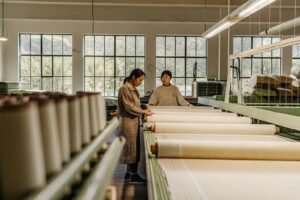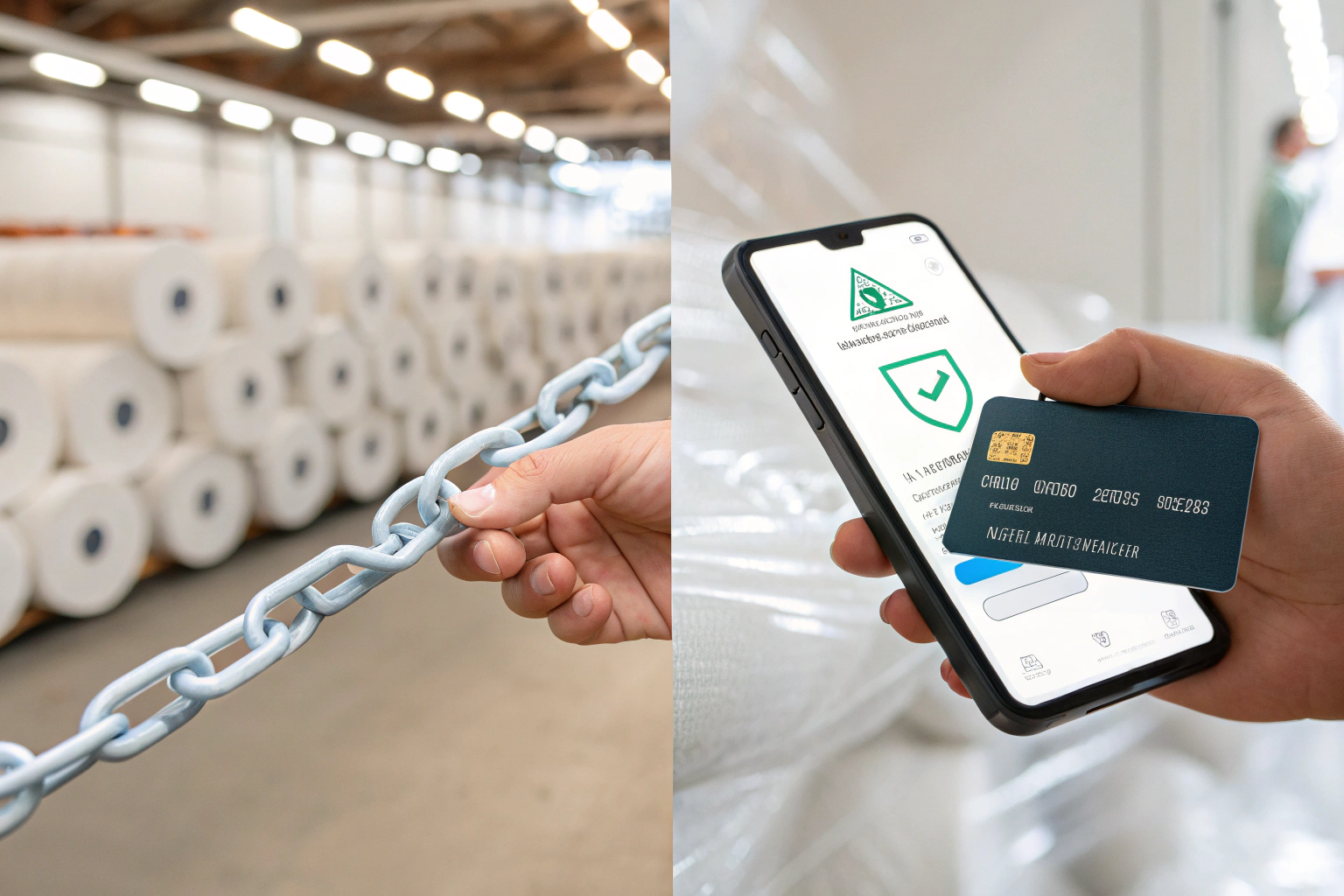
Here’s the uncomfortable truth every importer faces: you want the fabric, the supplier wants the money, and you’re 8,000 kilometers apart with zero legal leverage. The fear isn’t just about losing money—it’s about wiring $50,000 to a bank account in Zhejiang only to receive silence, substandard goods, or worse, an empty container. On the flip side, as a supplier, we’ve seen buyers disappear after we’ve committed raw materials to their order based on a PO. The core conflict is a massive trust deficit, and the payment method you choose is the single most important tool to balance that risk.
The most reliable payment methods for sourcing fabric from Asia are those that provide verified security and clear terms for both parties. There is no one-size-fits-all answer; reliability depends on your order size, relationship with the supplier, and risk tolerance. The top-tier options are Letters of Credit (L/C) for large, new supplier orders; Escrow Services (like Alibaba Trade Assurance) for mid-sized transactions; and Bank Transfer (T/T) with Milestone Payments for established relationships. Critically, "reliable" means safe and practical—a method so cumbersome it kills the deal isn’t reliable at all.
From our desk at Shanghai Fumao, where we both pay our own mills and receive payments from global clients, I’ll break down the real-world pros, cons, and hidden costs of each method. I’ll share exactly what we use, what we recommend, and the red flags that should make you walk away.
What are the Standard Payment Terms in the Asian Textile Industry?
Before you even negotiate price, you need to understand the payment landscape. Walking in demanding 100% payment after 90 days will get you laughed out of the room (or attract only the most desperate suppliers). The standard terms are shaped by high capital intensity—we buy yarn, pay for dyeing, and finance labor long before we see your money.
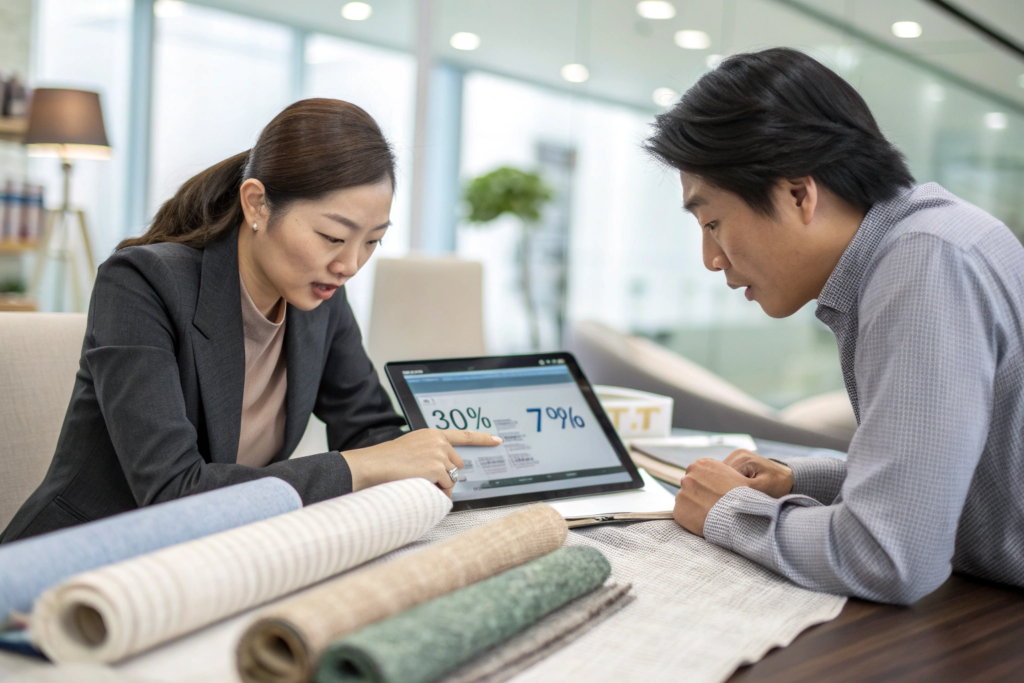
The most common framework is T/T (Telegraphic Transfer) with a deposit and balance. The typical structure is 30% deposit with order, 70% balance before shipment. This is the baseline. For long-standing trust relationships, this might shift to 30/70 against copy of Bill of Lading. For smaller, repeat orders, it could be 50/50. Letters of Credit (L/C) are standard for orders above a certain threshold (often $50,000+) or with new corporate clients requiring audit trails.
Crucially, Open Account (paying 100% after receiving goods) is extremely rare and only extended to decade-long partners with impeccable credit. If a new supplier offers it readily, be very suspicious—it’s a major red flag. Conversely, 100% advance payment is what we ask from very small, first-time buyers to mitigate our risk; it’s a tough ask for you, but common. Understanding this ecosystem is your first step to a realistic negotiation. For a broader view, the International Chamber of Commerce (ICC) guidelines on trade finance provide the global rulebook that underpins these practices.
Why Do Suppliers Insist on a 30% Deposit?
It’s not just about locking you in. That deposit is our working capital. Let me give you a real example from last month. A US client ordered a custom-developed recycled polyester jacquard. The yarn alone cost us $20,000. The 30% deposit they paid ($15,000 on a $50,000 order) went directly to the yarn supplier to secure raw material. Without it, we would be financing their entire order for 60+ days—a cash flow nightmare. That deposit is a sign of commitment. It turns your order from an email into a scheduled line in our production plan. When buyers try to skip the deposit, what they’re really asking is for us to take 100% of the financial risk before we even start. It’s a non-starter for any reputable factory with options.
How Do Payment Terms Vary Between a Trading Company and a Factory?
This is a critical distinction that affects your risk.
- Direct Factory: Terms are often less flexible but more transparent. You might pay a higher deposit because their capital is tied up in machinery and raw material inventory. The benefit is that your money goes directly into making your goods.
- Trading Company: They may offer slightly more flexible terms (like a lower deposit) because they have lighter assets and act as intermediaries. However, this adds a layer—your payment goes to them, who then pays the factory, creating a potential point of failure.
Always ask: "Are you the factory or a trading company?" We are a factory-integrated supplier at Shanghai Fumao, so we can show clients the production process their deposit is funding, which builds tremendous trust. For insights on vetting partners, look at guides on how to distinguish between manufacturers and traders in China.
How Does a Letter of Credit (L/C) Work and When Should I Use It?
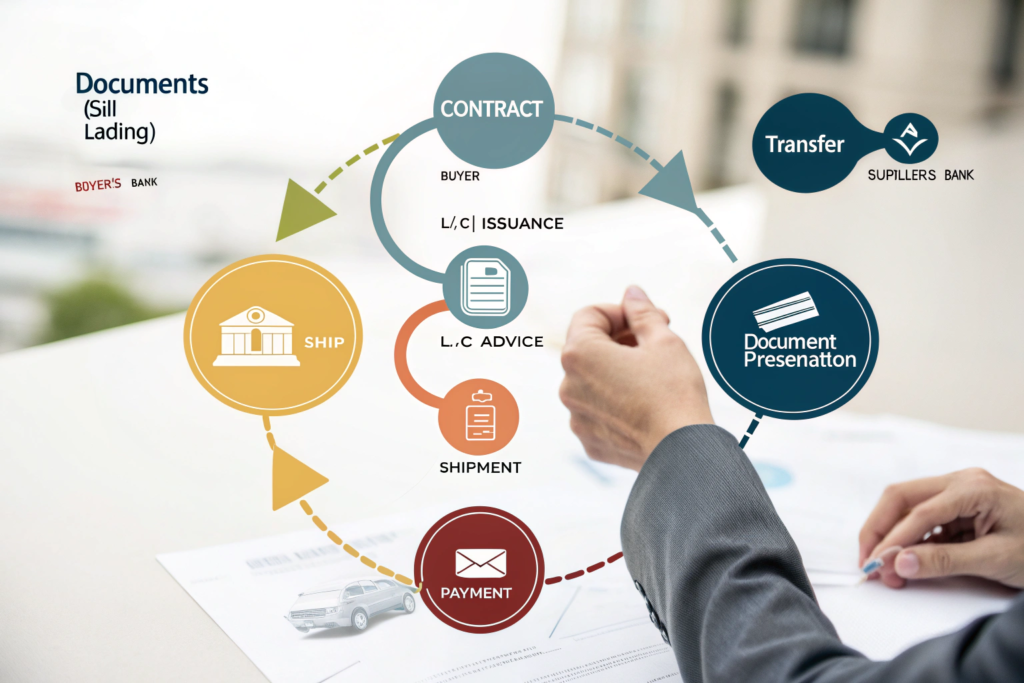
Think of an L/C as a trusted referee holding the money. It’s a bank’s promise to pay the supplier, but only after the supplier presents documents proving they have shipped exactly what you ordered. It’s the gold standard for security in large transactions, but it’s also bureaucratic and costly.
Here’s the typical flow:
- You (the buyer) and I (the supplier) agree to use an L/C.
- You go to your bank and open an L/C in my favor, with exactly specified terms (fabric description, quantity, shipment date, required documents like Bill of Lading, Inspection Certificate).
- Your bank sends the L/C to my bank in China.
- I produce and ship the fabric.
- I take the shipping documents to my bank and say, "Here’s proof I met the terms. Please pay me."
- My bank checks the documents meticulously. If they match the L/C 100%, they pay me and forward the documents to your bank.
- Your bank releases payment to my bank and gives you the documents so you can claim the goods at the port.
What are the “Devils in the Details” of an L/C?
The security comes from precise documentation, which is also its biggest pitfall. Discrepancies are common and can delay payment for weeks. For example:
- The Bill of Lading has a minor typo vs. the L/C.
- The inspection certificate is issued by a company not pre-approved in the L/C.
- The shipment date is even one day later than the L/C allows.
I once had a client’s L/C require a "Clean On Board Bill of Lading." The shipping line issued a standard Bill of Lading. That single word missing caused a 10-day delay while we got it re-issued. Banks deal only in paper, not intent. You absolutely must work with a bank or freight forwarder experienced in L/Cs. Resources like Freightos’s detailed guide on common LC discrepancies can help you avoid these costly errors.
Is an L/C Worth the Cost and Complexity?
For orders below $50,000, usually not. Bank fees can be 1-2% of the transaction value, shared between both parties. The paperwork is heavy. For a first-time order of $200,000 with a new supplier? Absolutely. It’s the cost of insurance. It protects you because you only pay if the goods are shipped as specified. It protects me because I have a bank guarantee of payment upon shipment. It’s the ultimate tool for scaling trust. For established relationships, we often move away from L/Cs to simpler T/T terms because the trust is already built.
Are Online Escrow Services Like Alibaba Trade Assurance Safe?
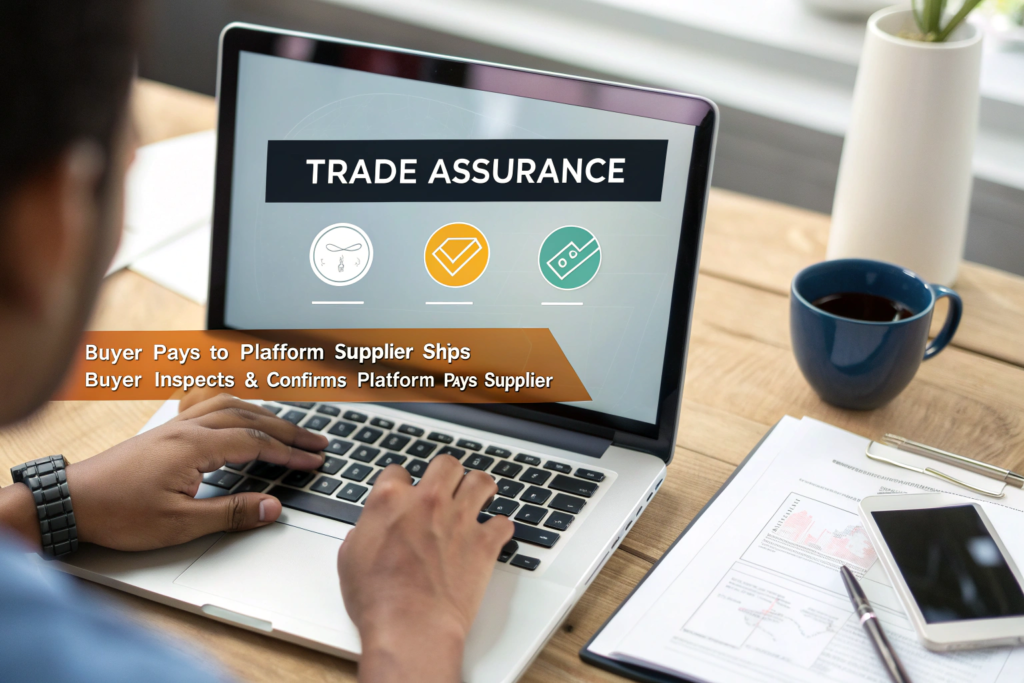
In a word: yes, for the right scenario. They’ve revolutionized mid-market sourcing. Platforms like Alibaba Trade Assurance or Global Sources’ Verified Transactions act as a neutral third party. You pay the platform, the supplier ships, you confirm receipt and quality, then the platform releases the money to the supplier.
How it works:
- You and the supplier agree on terms on the platform.
- You pay Alibaba (not the supplier).
- The supplier is notified and ships.
- You have a pre-agreed inspection period (e.g., 15 days after shipment arrival) to verify the goods.
- If you approve, Alibaba pays the supplier. If there’s a dispute, you file a claim and Alibaba mediates.
It’s excellent for orders between $3,000 and $50,000 where an L/C is too costly but a direct T/T feels too risky. It gives buyers tremendous psychological comfort. However, it’s not foolproof. The inspection period is short for thorough fabric testing. Dispute resolution can be slow and sometimes favors the buyer in ambiguous cases, which makes some top-tier suppliers hesitant. We use it on our Alibaba store for new clients, and it has dramatically increased conversion rates for them.
What Are the Limitations of Escrow Services?
- Quality Dispute Complexity: If fabric fails a lab test after the 15-day window, you’re likely out of luck. The platform’s protection is for "non-shipment" or "gross non-conformance," not subtle quality deviations.
- Supplier Tier: The very best factories, often with full order books, may not actively use these platforms because they don’t need to. You might be limiting your supplier pool.
- Transaction Caps: There are usually monetary limits.
For these reasons, while escrow is a fantastic tool for building initial trust, many businesses transition to direct T/T terms after a few successful orders. It’s a stepping stone. Understanding the scope and limitations of Alibaba Trade Assurance protection is crucial before you rely on it entirely.
What About PayPal or Credit Cards?
Almost never used for bulk fabric orders. Why? High fees (3-4%), and most importantly, the buyer can easily chargeback the payment up to 180 days later, leaving the supplier with zero recourse. We only accept these for tiny sample fees, never for bulk. If a supplier readily accepts PayPal for a $20,000 order, it’s a red flag—they might be inexperienced or planning a scam.
How Can I Structure T/T Payments to Minimize My Risk?
For most ongoing importer-supplier relationships, T/T is the workhorse. The key is to structure it in milestones that align payment with verified progress. This is where you get creative and fair.
A very secure and common structure for a new relationship is: 30% deposit, 40% against pre-shipment inspection photos/videos and copy of BL, 30% after arrival and satisfactory spot check. This drastically reduces your final risk.
Let me share a real case. A Canadian startup ordered 10,000 meters of custom-printed satin in Q1 2024. They were nervous. We agreed on:
- 30% with order (to start production).
- 40% after we sent them a video of all rolls on pallets, with their PO# visible, alongside the commercial invoice and packing list.
- 30% due 10 days after cargo arrival at their port, giving them time for a basic inspection.
This gave them control and us confidence. They paid the final 30% early because the goods were perfect. That structure built the trust that now sees them placing monthly orders on 30/70 terms. The cornerstone was the pre-shipment evidence. We made the process transparent. For more on structuring, the U.S. Department of Commerce guide on payment methods in international trade offers excellent templates.
What Are the Biggest Red Flags in Payment Requests?
- Pressure to Use Western Union or MoneyGram: These are irreversible, untraceable cash transfers. Used only by scammers.
- Requests to Pay to a Different Company/Person’s Account: This is a classic sign of a bogus trading company. Always pay to the company account that issued the proforma invoice.
- Sudden Changes in Payment Details: If bank account info changes last minute, stop everything and verify via a direct phone call to a known number.
- A Supplier Too Eager to Accept Any Terms: If they readily agree to 100% payment after shipment when you’re a new client, be wary. They might be desperate or dishonest.
Trust your gut. A reliable partner, like us at Shanghai Fumao, will be transparent, consistent, and understand your need for security because we share it.
Conclusion
There is no perfect, risk-free payment method. Reliability is a balance struck through clarity, structure, and gradual trust-building. Start with the securest method your order size justifies—Escrow for medium, L/C for large. Use structured T/T milestones to share risk fairly as the relationship grows. Always, always do your due diligence: verify the supplier, get a proforma invoice with clear terms, and never rush a wire transfer.
The right payment method is more than a financial transaction; it’s the foundation of your business relationship. It signals professionalism, respect, and a commitment to a successful outcome for both sides.
If navigating this process feels daunting, partner with a supplier who values transparency as much as you do. At Shanghai Fumao, we work with our clients to find a payment solution that secures both our interests, because we’re in this for the long haul. We’re confident enough in our quality and reliability to work within secure, structured terms. To discuss a risk-managed approach to your next fabric order, contact our Business Director, Elaine. Let’s build a partnership, not just a transaction. Email her at: elaine@fumaoclothing.com.