Here’s a scenario I know you’ve faced: you’ve designed something incredible. Maybe it’s a jacquard with metallic lurex threads for a luxury line, or a performance knit with a proprietary moisture-wicking finish. It’s not a basic cotton jersey. It’s unique, it’s your next bestseller, but it’s also a compliance nightmare waiting to happen. You send it to a factory, and they say, “Sure, we can make it.” But when you ask about OEKO-TEX certification, you get a long pause followed by, “That might be difficult for this style.” At that moment, you’re forced to choose between your vision and your safety standards. What if you didn’t have to choose?
At Fumao Clothing, this isn’t a hypothetical—it’s our daily bread. We specialize in turning “difficult” and rare styles into certified, market-ready products. The short answer is: we ensure compliance by designing it in from the molecule up, not testing it on at the end. OEKO-TEX isn’t a final checkpoint for us; it’s the blueprint that guides our entire R&D and production process for every single order, no matter how unconventional. For a rare style, compliance is about proactive engineering, not reactive filtering.
Think of it like building a race car to pass strict emissions tests. You don’t build a gas-guzzling engine and then try to bolt on a giant filter at the tailpipe. You engineer a clean, efficient powertrain from the outset. That’s our approach. When you bring us a rare style—be it a plant-based leather alternative, a deep-pile faux fur, or a fabric with a complex coating—our first question isn’t “Can we make it?” It’s “What certified components and processes will allow us to make it safely?” This article will pull back the curtain on exactly how that engineering process works.
How does the compliance process start at the design stage?
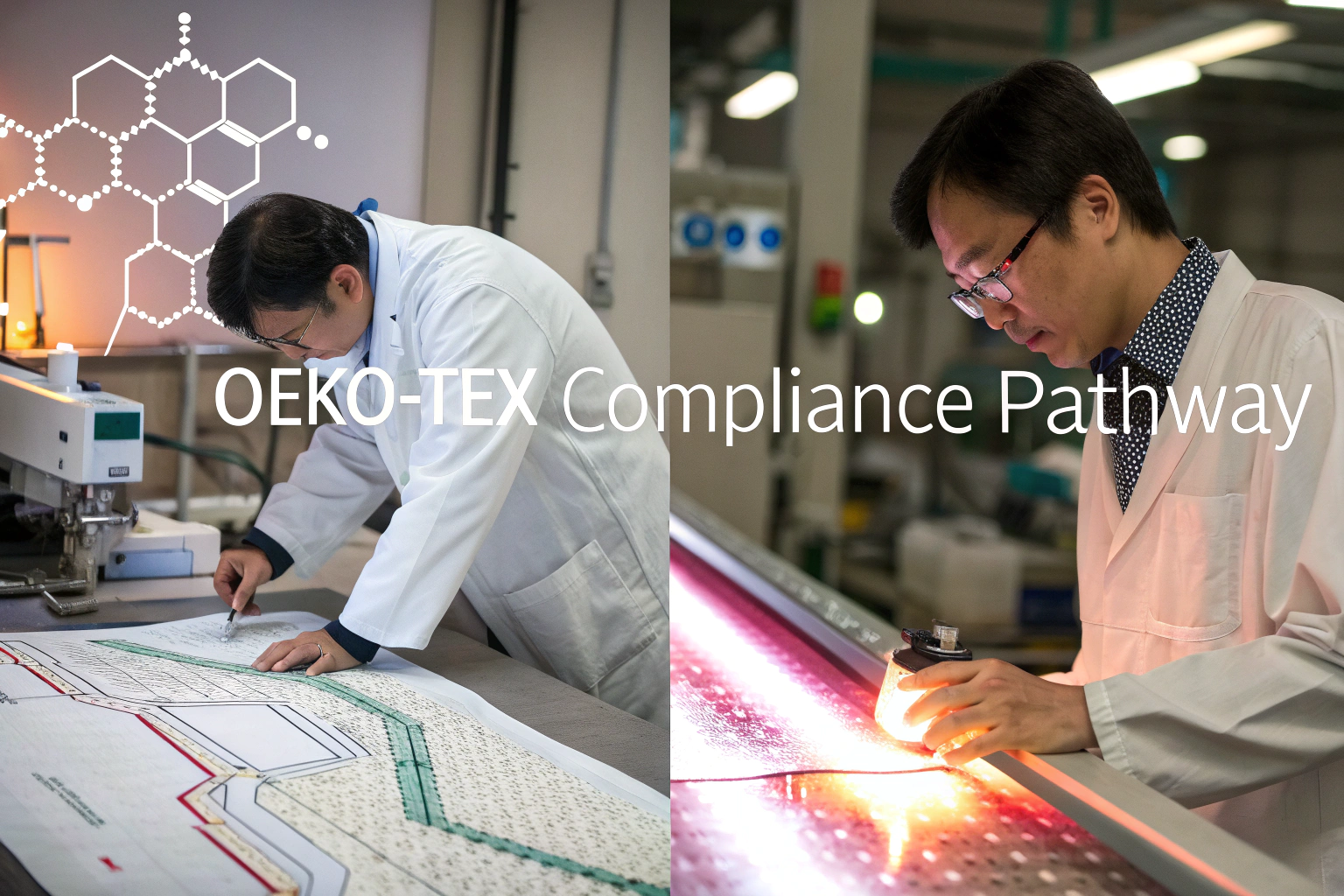
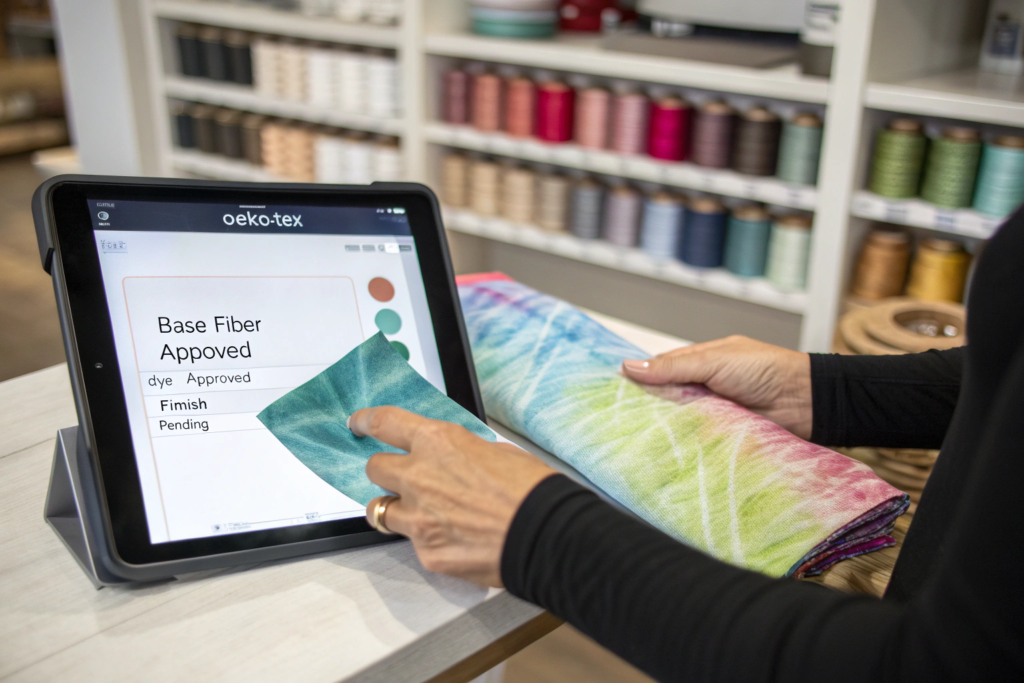
The moment you share your tech pack or sample for a rare style, our compliance engine kicks in—long before any yarn is spun or dye is mixed. We have a dedicated Material Compliance Team that sits between our sales/R&D and production departments. Their first job is a “Substance Risk Assessment.” They analyze every component of your design: the base fiber, any exotic yarns (metallic, recycled, specialty animal hair), the dyeing method, the type of prints (pigment, discharge, foil), and all functional finishes (waterproof, flame retardant, antimicrobial). They cross-reference each element against our massive, continuously updated database of OEKO-TEX restricted substances and pre-approved material sources.
Let me give you a real case. Last year, a Paris-based avant-garde brand wanted a fully biodegradable lace for a high-end collection, using a novel bamboo silk blend and an organic shrinkage control finish. It was a style most mills would avoid. Our team’s first step was to source the specific bamboo silk yarn from one of our OEKO-TEX STeP certified spinning partners—a partner whose entire chemical management system we trust. We then worked with the brand to select a shrinkage control agent from our vetted list of “green chemistry” auxiliaries that we knew had already passed comprehensive testing for harmful residues. We designed the compliance into the recipe before a single meter was produced.
What is a “Restricted Substance List (RSL) First” sourcing strategy?
For common fabrics, you can often find pre-certified materials. For rare styles, they frequently don’t exist. So, we flip the script. Instead of looking for a “certified metallic yarn,” we look for a metallic yarn supplier who can provide a full, transparent chemical composition declaration (CCD) and a history of passing our in-house RSL screening. We qualify them as a “RSL-Compliant Source.” This means we audit their factory’s chemical management (often a mini version of an OEKO-TEX STeP audit) and run our own preliminary tests on their material. Once approved, they enter our vetted supplier pool for rare projects. This proactive qualification is how we built a network for sourcing low-impact dyes for intricate digital prints that are both vibrant and safe.
How do you handle custom finishes and functional treatments?
This is where most failures occur. A factory might use a standard OEKO-TEX certified fabric, then apply an uncertified waterproof coating to meet a spec, instantly voiding the compliance. Our process is locked down:
- Isolation: We identify the exact chemical product (e.g., a specific brand of C6 DWR finish) the client’s performance requires.
- Pre-Testing: We obtain the Safety Data Sheet (SDS) and, crucially, a sample of the chemical itself. We run it through our in-house CNAS-accredited lab for a targeted screening, looking for PFAS, phthalates, heavy metals, etc.
- Integration: Only after it passes our screening do we apply it to a swatch of the rare fabric and submit the complete, finished article for official OEKO-TEX certification testing. The finish becomes part of the certified “product.”
For a client needing a flame-retardant linen blend for hotel curtains, we went through 3 different FR agents before finding one that met both performance and our pre-compliance criteria, saving weeks of back-and-forth with the external lab.
What role does your in-house CNAS lab play for rare styles?
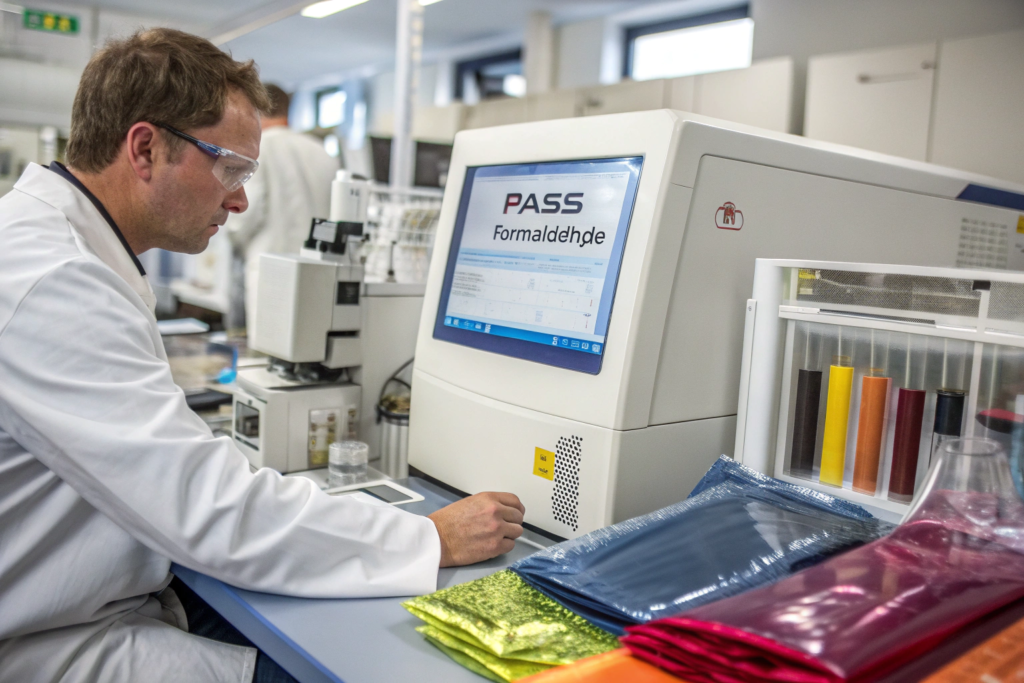
An external OEKO-TEX lab is the final judge, but our in-house CNAS (China National Accreditation Service) accredited lab is the tireless investigator and gatekeeper. For rare styles, sending every iteration to an external lab for a full OEKO-TEX test would be impossibly slow and expensive. Instead, we use our lab to de-risk the development cycle. We can test for specific parameters—formaldehyde content, pH value, extractable heavy metals, banned amines from dyes—in a matter of hours. This allows our R&D team to iterate quickly: “That coating failed for nickel. Let’s try formulation B.” We test. “Formulation B passes. Now let’s proceed to the official certification sample.”
This capability is a game-changer. In early 2024, we developed a thermo-regulating phase-change material (PCM) coating for a sportswear brand. The brand was concerned about the microcapsules’ shell chemistry. Over two weeks, our lab team worked with the coating supplier, testing 5 different shell material variants in-house until we identified one that was free of restricted substances. We then made a pilot batch, and it passed the official OEKO-TEX test on the first submission. Without our lab playing this diagnostic role, the project would have taken months and incurred massive third-party testing fees.
Can you give an example of solving a complex compliance puzzle?
Absolutely. One of our most challenging projects was for a luxury British brand that wanted a “pearlized” cotton velvet. The effect required a mica-based pigment applied in a binder. The velvet itself was fine. The pigment supplier provided an SDS claiming it was “safe.” But our initial in-house screening detected trace levels of antimony, a restricted metal often found as an impurity in mineral pigments. The brand loved the unique luster and didn’t want to change the aesthetic.
Our solution was multi-step:
- We worked back through the pigment supplier to identify the specific mica mine source.
- We sourced a batch of mica from a different mine with a known lower impurity profile.
- We had the pigment re-milled using this cleaner mica.
- We re-tested the new pigment in-house—antimony levels were now undetectable.
- Finally, we produced a new sample and it passed OEKO-TEX.
The entire process relied on our lab’s ability to pinpoint the exact contaminant and our team’s persistence in tracing the supply chain upstream—something a standard factory without these resources would never have attempted.
How does this prevent delays during peak production seasons?
Timing is everything, especially during the March-May and August-October rushes. The worst delay is a surprise failure at the final certification stage when bulk production is ready to ship. Our in-house screening acts as a “pre-flight check.” By the time we send a sample to the official OEKO-TEX institute, we have over 95% confidence it will pass. This means we can confidently schedule bulk production to run concurrently with the official certification process for rare styles, shaving 2-3 weeks off the total lead time. A client gets their unique, certified fabric faster, and we optimize our factory scheduling.
How do you manage certified production for small-batch rare styles?
OEKO-TEX certification requires testing of the final production batch. For a 50,000-meter run of a common fabric, the cost per meter is low. But what about a 500-meter luxury order? The testing fee can seem prohibitive. We solve this through two key strategies: Modular Certification and Family Approval.
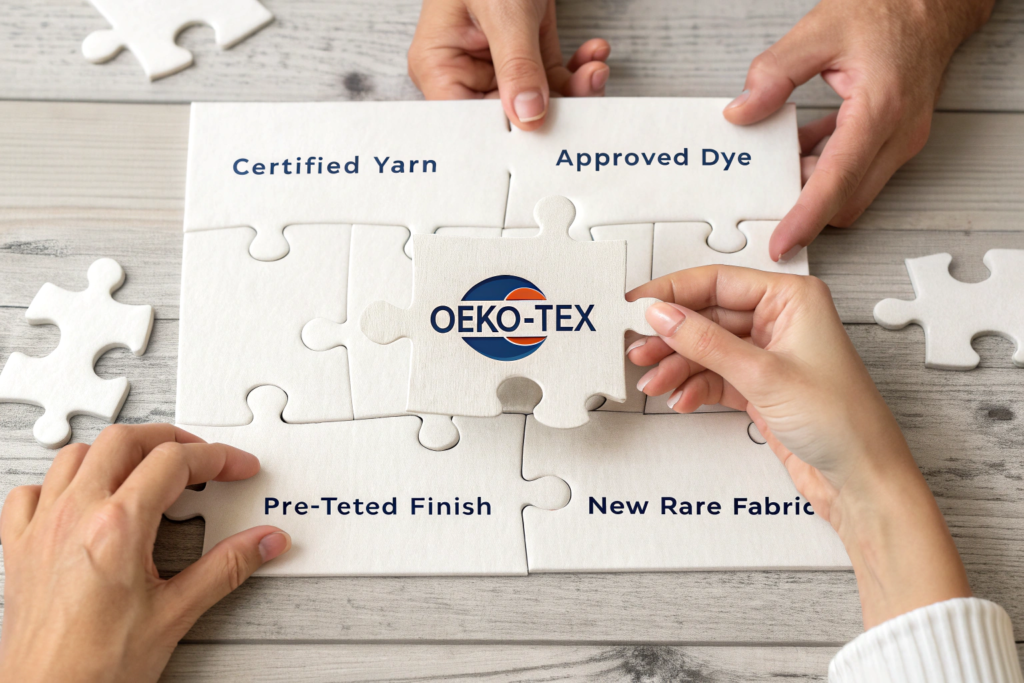
Modular Certification: If a rare style uses components that are already individually certified or pre-approved in our system, the path is shorter. For example, if your rare knit uses a GRS-certified recycled polyester yarn that we’ve already used in other OEKO-TEX certified fabrics, and a standard silicone softener from our approved list, the risk is low. We can often extend an existing certificate to cover the new construction with a simpler, faster “variation test.”
Family Approval: This is a powerful OEKO-TEX tool for innovators. When we develop a new type of finish or treatment (like our proprietary biodegradable water repellent), we can apply for certification for the “finish” itself as a material. Once that “family” of finish is approved, any fabric we apply it to falls under that umbrella, drastically reducing the testing burden for each new rare style that uses it. This is how we make small-batch customization feasible without sacrificing compliance.
What about styles with mixed materials, like bonded fabrics or trims?
Rare styles often involve lamination, bonding, or intricate trims. OEKO-TEX requires testing the entire article. We treat each layer and component as a separate module.
- For a bonded fabric (e.g., wool bonded to a tech membrane): We certify the wool face fabric, the membrane, and the adhesive separately first. Then, we test the bonded composite as the final product. This modular approach isolates any failure to a specific component.
- For trims (unique buttons, zippers, ribbons): We maintain a library of pre-certified trim suppliers. For a custom metal button, we require the button factory to provide an OEKO-TEX certificate or, at minimum, a test report for nickel release and heavy metals. We then include the trim in the final garment test submission.
The key is traceability. Every component in a rare style from Fumao Clothing has a documented chemical pedigree.
How do you handle the cost challenge for low-volume, high-complexity orders?
We are transparent: certifying a one-off, 200-meter style with completely novel materials is expensive. However, we work with clients to manage this through:
- Cost Sharing: If the style is a pilot for a potential larger order, we can amortize the testing cost over the future volume.
- Phased Approach: We might first achieve OEKO-TEX Class II (skin contact) for the launch, then upgrade to Class I (babywear) in the next season if volumes justify it.
- Value Engineering: Our R&D team often finds ways to achieve a similar aesthetic or performance using more compliance-friendly, and sometimes more cost-effective, alternative materials from our vetted pool. Our goal is to be a partner in making your vision commercially and compliantly viable.
Why is traceability the ultimate key for rare style compliance?
With a standard fabric, you might test a batch and be done. With a rare style, especially one you plan to re-order, compliance must be reproducible. This is where digital traceability is non-negotiable. For every rare style we produce, we create a unique “Digital Tech File” that lives behind a QR code. This file doesn’t just contain the OEKO-TEX certificate. It contains the recipe: the supplier codes for every yarn lot, the batch numbers of every dye and chemical used, the parameters of every finishing process, and the results of our in-house screenings.
Imagine you order a rare fabric today and re-order it in 18 months. Without traceability, it’s a new gamble. With our system, we simply pull up the Digital Tech File and replicate the exact “chemical recipe” from the original certified batch. We then run a conformity test to confirm the new batch matches the old. This guarantees consistent compliance over time and across orders, turning your rare style into a reliably recurring asset. A Swiss performance wear brand we work with relies on this system for their seasonal limited-edition technical fabrics—it’s what allows them to innovate fearlessly.

How does this system protect against supply chain changes?
Suppliers change. A dye manufacturer discontinues a product. Our traceability system provides an audit trail that is invaluable for managing change. If a component in a rare style’s recipe becomes unavailable, we don’t start from scratch. We know its exact chemical specification from the Tech File. We can task our sourcing team with finding a direct, pre-tested equivalent, massively reducing the requalification time and risk. This system transforms compliance from a one-time event into a living, manageable process.
What is the final verification step before shipment?
Even with all this front-end work, the final step is non-negotiable: the official OEKO-TEX batch test by an accredited institute. For the bulk production of your rare style, we cut a sample from the beginning, middle, and end of the production run. We submit this composite sample for the full test suite. Only when we receive the official pass report do we release the goods for shipment. This is your ultimate guarantee. The report is linked to the specific roll numbers in your shipment, and a copy is uploaded to your product’s Digital Tech File for your permanent records.
Conclusion
Ensuring OEKO-TEX compliance for rare styles isn’t about finding a factory that can make them; it’s about partnering with a system engineered for chemical safety innovation. At Fumao Clothing, compliance is not a bottleneck—it’s the framework that enables creativity. From the initial molecule-level risk assessment in our R&D lab, through modular sourcing and in-house pre-screening, to final digital traceability, we build safety into the DNA of your most unique designs.
This systematic approach de-risks your innovation. It allows you to explore new textures, performances, and aesthetics without the fear of regulatory backlash or consumer harm. It turns the complexity of a rare style from a liability into a competitive advantage—because your product will be as safe as it is stunning.
Don’t let compliance concerns limit your next breakthrough collection. Partner with a manufacturer that sees OEKO-TEX not as a limit, but as the foundation for limitless, responsible creativity.
Have a rare or complex style that you’ve been hesitant to pursue because of compliance concerns? Let’s engineer it together. At Fumao Clothing, our entire system is built to turn your most ambitious ideas into certifiably safe, market-ready realities. Contact our Business Director, Elaine, at elaine@fumaoclothing.com to start a conversation about your next groundbreaking fabric.