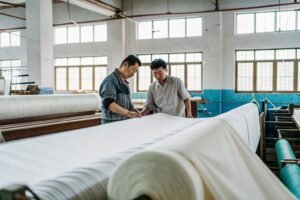
If you’re sourcing kids’ wear and feel a knot in your stomach every time a shipment clears customs, you’re not alone. The gap between a supplier’s verbal "yes, we comply" and the hard reality of chemical residues, choking hazards, and flammable materials in children’s clothing is where brands get destroyed. Compliance isn’t a checkbox; it’s a continuous, documented, and obsessive system of controls. So, how can you tell if your supplier’s commitment is real or just marketing? The answer lies not in their certificates, but in their processes, transparency, and the culture of safety built into every stage of production.
A truly committed supplier doesn’t just pass safety tests; they design for safety from the fiber up. Their commitment is visible in their investment in specialized equipment, their relentless in-process testing, and their willingness to provide granular, batch-specific data that goes beyond the basic OEKO-TEX® STANDARD 100 certificate. For kids’ wear, safety standards like CPSIA (USA), EN 14682 (EU), and AS/NZS 1249 (Australia) aren’t just export requirements—they are non-negotiable design parameters that dictate everything from button attachment strength to the pH balance of printed areas. A supplier who is genuinely committed understands this and makes it the core of their operational DNA.
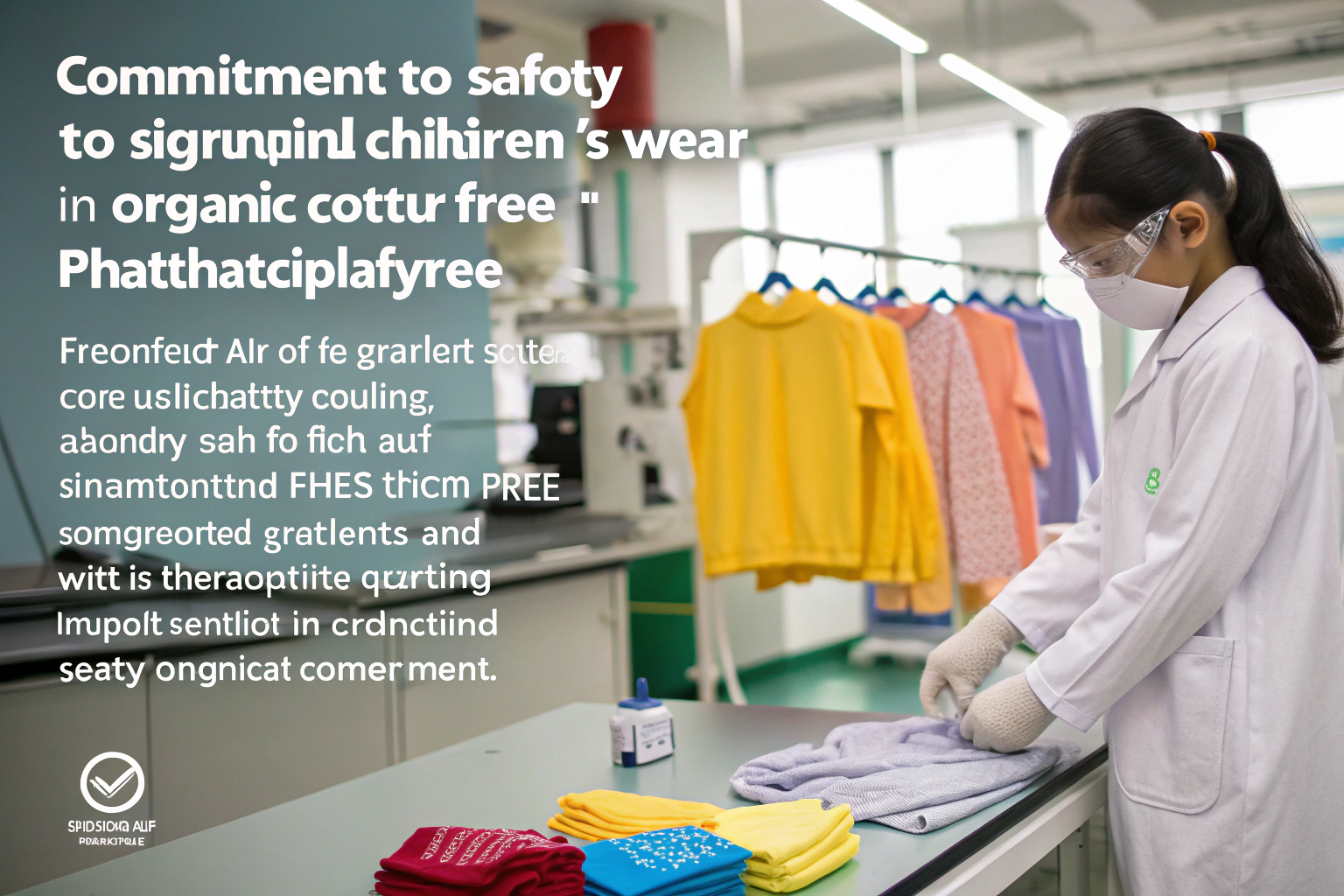
Let me be blunt: in kids’ wear, a safety failure is a brand-ending event. At Shanghai Fumao, our commitment is engineered into our vertical control. From sourcing GOTS-certified organic cotton to using AZO-free dyes and implementing phthalate-free plasticizer systems in coatings, safety isn’t an afterthought—it’s the first line in our product brief. We treat every order as if it were for our own children, because we know you do the same for your customers. This mindset shapes everything from our R&D to our final inspection, and it’s what separates a true partner from a risky vendor.
What Certifications Are Non-Negotiable for Kids’ Wear Fabrics?
Certifications are the language of compliance, but not all certificates are created equal. The presence of a certificate is a baseline; its scope, validity, and the supplier’s understanding of it are what matter. For kids’ wear, especially for ages 0-3, certain certifications are absolute prerequisites. A committed supplier will not only hold these certificates but will be able to explain the specific testing parameters and limits for each, and will provide test reports that are batch-traceable to your order.
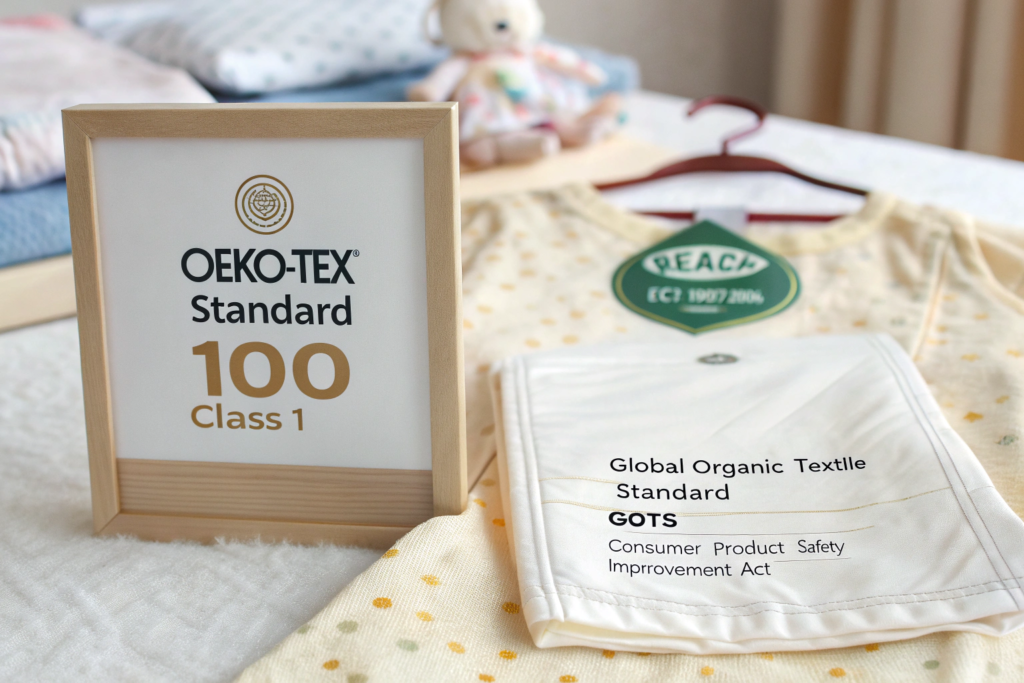
The gold standard is OEKO-TEX® STANDARD 100, Class I. This is for products for babies and toddlers. It’s the strictest class, prohibiting over 100 harmful substances. However, OEKO-TEX® is primarily a final product test. A truly safety-focused supplier will also integrate REACH (EC 1907/2006) compliance into their material sourcing, controlling substances of very high concern (SVHCs) at the chemical level. For organic claims, Global Organic Textile Standard (GOTS) is essential, as it covers the entire processing chain with ecological and social criteria. In the US, compliance with the Consumer Product Safety Improvement Act (CPSIA) for lead and phthalates is mandatory. A supplier showing you a generic, year-old OEKO-TEX® certificate for their company is not enough. You need a current, product-specific certificate for the exact fabric composition you are purchasing.
How Do You Verify the Authenticity and Scope of a Safety Certificate?
You must go beyond the logo. First, check the certificate number on the issuing body’s website (e.g., OEKO-TEX® database). Second, examine the "Tested Articles" section. It must describe your specific product (e.g., "100% cotton knitted jersey, dyed") and list the applicable product class (Class I for babies). Third, check the validity period. Finally, confirm the applicant is your actual manufacturing factory, not a trading company. We had a client in 2023 who discovered their previous supplier’s OEKO-TEX® certificate was for "polyester woven fabric," but they were buying "cotton knit." The certificate was useless. At Shanghai Fumao, we provide a digital dossier for each order, linking the lab report to the production batch QR code. For a detailed guide, resources like The Consumer Product Safety Commission’s guide to testing and certification outline these verification steps clearly.
Why is CPSIA Compliance for Lead & Phthalates Especially Critical?
CPSIA sets extremely low limits for lead (≤100 ppm in substrate) and specific phthalates (≤0.1% in plasticized components). The danger is often in the trims and decorations. A committed supplier controls the entire bill of materials (BOM). For example, the plastisol ink used in prints, the PVC in appliqués, or the plastic snaps can be high-risk points. Our process involves pre-screening all trim suppliers and conducting X-ray Fluorescence (XRF) screening on incoming components for lead, followed by wet chemistry tests for phthalates on composite samples. In mid-2024, we rejected a batch of otherwise perfect rainbow unicorn prints for a toddler’s dress because our XRF scan flagged the orange pigment. Subsequent lab analysis confirmed lead levels at 110 ppm—just over the limit, but enough for us to scrap the entire print run. Understanding how to test for regulated substances in children’s products is fundamental, and we build these controls in-house.
How is Physical Safety (Cords, Drawstrings, Small Parts) Enforced?
Chemical safety is invisible; physical safety hazards are often designed in. Standards like EN 14682 (Europe) and ASTM F1816 (USA) provide detailed, measurement-based rules for cords, drawstrings, toggles, and small parts in children’s clothing. A supplier’s commitment is proven by their technical design review process and their production line controls. It’s not enough to say "we follow the rules"; they must have a system to ensure every single garment, across thousands of units, complies with precise loop lengths, attachment strengths, and warning label placements.
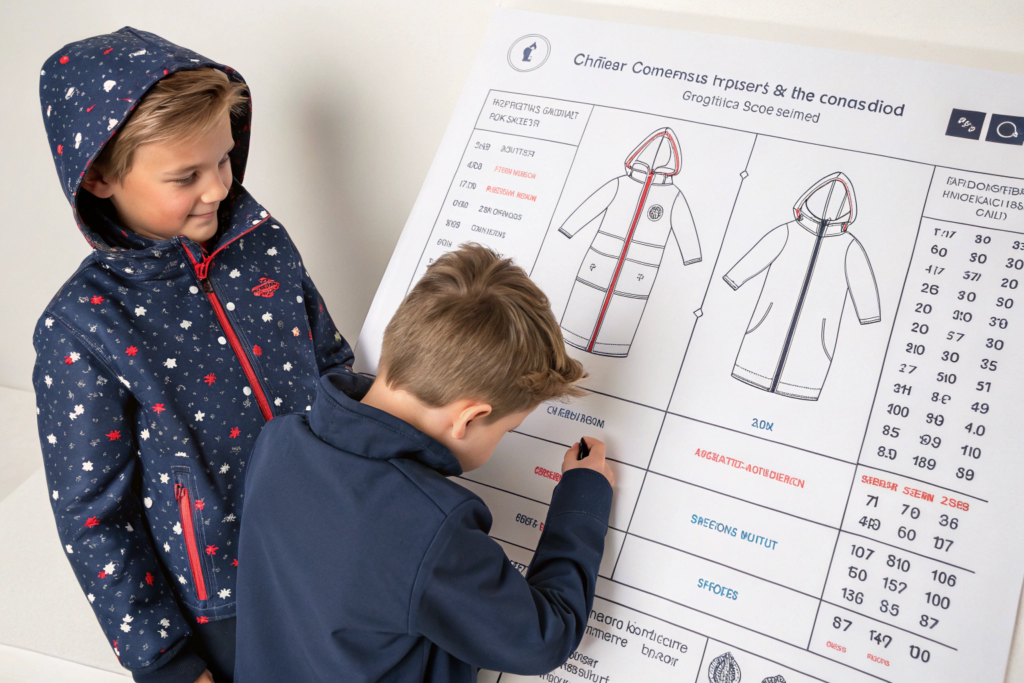
This requires deep technical understanding. For instance, EN 14682 stipulates that for children’s upper garments (size 134cm and below), functional cords in the hood are prohibited. Decorative cords are allowed but must have a maximum circumference of 75mm when drawn tight. For waist drawstrings, the free ends cannot extend more than a certain length beyond the toggle. A committed supplier will have these measurements and diagrams integrated into their QC checklists. More importantly, they will have designed the garment to be stylish and functional within these constraints from the outset, rather than trying to retrofit compliance.
What Are the Key Checkpoints for Drawstring and Cord Safety?
A rigorous supplier implements a three-stage control:
- Pre-Production (PP) Sample Approval: The tech pack must specify cord type, length, attachment points, and toggle security. The PP sample is physically tested for cord attachment strength (a minimum force, often 70N for certain ages).
- In-Line Production Checks: Supervisors audit operators to ensure cords are cut to the exact pre-measured length and that bar-tacks at cord ends are secure. For hoodies, they verify no functional drawstrings are added.
- Final Random Inspection: AQL inspection includes specific checks for cord and drawstring compliance. Tools like fixed-length gauges and spring scales are used.
We once worked with an Australian brand on a line of children’s raincoats. The design had a belt with a decorative toggle. Our pattern makers suggested moving the belt loops slightly and using a specific knot inside the toggle to ensure it could not be detached to create a small parts hazard, while still meeting the aesthetic goal. This proactive design-for-safety approach is critical. Industry guidelines, such as those from The American Apparel & Footwear Association on juvenile product safety, detail these requirements.
How is Small Parts Testing (Choking Hazard) Conducted and Documented?
For children under 3 years, any detachable component is a potential choking hazard. The test involves using a small parts cylinder (a tube with a diameter of 31.7mm). If any part of a button, snap, or decorative item fits completely inside the cylinder, it fails. A committed supplier will test not only the component but its attachment strength. We use a calibrated force gauge to perform a tension test on buttons and snaps, ensuring they withstand a pull force significantly higher than a child could exert. The results for both the cylinder test and the pull test are recorded in our inspection reports. For prints and embroideries, we conduct a wash durability test (e.g., 5 home washes) and then a scratch test to ensure no flakes or pieces can detach. This multi-layered approach is documented and provided as part of our quality dossier. Forums like The UKCA & CE Marking Forum discussions on toy safety often delve into related small parts testing protocols.
What Does In-House vs. Outsourced Testing Reveal About Commitment?
This is where the rubber meets the road. A supplier who outsources all safety testing to a third-party lab, only after bulk production is complete, is playing Russian roulette with your business. The results take weeks, and a failure means your entire finished order is toxic inventory. A truly committed supplier invests in in-house, rapid-screening capabilities to catch issues in real-time at the material and component stage, long before bulk production. They use third-party accredited labs for final certification, but the in-house lab is their first line of defense.
Our CNAS-accredited lab is equipped for this. We perform pH value checks on every dye lot, formaldehyde content tests using spectrophotometers, and colorfastness to saliva and perspiration tests specifically for infants. We screen for heavy metals using XRF. This allows us to reject a faulty dye batch within hours, not weeks. The final OEKO-TEX® or SGS report then serves as the official confirmation of what we already know is safe. This proactive investment—often costing hundreds of thousands of dollars in equipment and training—is the clearest signal of a supplier’s commitment to safety, not just compliance.

What Rapid Screening Tests Should a Supplier Perform?
Key in-house screening tests include:
- pH Test (ISO 3071): For skin-contact fabrics, pH must be neutral (4.0-7.5). We test every batch of dyed or printed fabric.
- Formaldehyde (Free and Released) Screening (ISO 14184-1): Using a quick extraction method to flag any potential over-limit batches before sending for precise analysis.
- AZO Dyes Screening: Using a chemical spot test to detect the presence of banned aromatic amines.
- Flammability Testing (16 CFR Part 1610 for USA): For children’s sleepwear (which has stricter rules, 16 CFR Part 1615/1616), or for general apparel fabrics like cotton fleece, we conduct preliminary vertical flame tests.
For a French client’s organic cotton baby rompers in 2023, our in-house pH test flagged a batch at 8.2 (too alkaline). We traced it to a neutralizing agent error at the dye house, corrected it, and re-tested—all within 48 hours—before the fabric was ever cut. This saved a 4-week delay and potential product recall. Resources like Intertek’s guide to common textile test methods explain the value of this layered testing approach.
Why is a CNAS-Accredited In-House Lab a Game-Changer?
CNAS (China National Accreditation Service) accreditation means our lab meets international standards (ISO/IEC 17025). Its test results are nationally and internationally recognized. This allows us to generate pre-shipment inspection reports that carry significant weight. It means our internal data is reliable. For you, it translates to speed and confidence. You can review our comprehensive in-house test report while the order is in production, rather than waiting for the final external certificate. This level of transparency and capability is rare and signifies a deep, operational commitment to quality and safety control. Learning about laboratory accreditation and its importance in manufacturing highlights why this is a key differentiator for suppliers like us.
How is Safety Traceability Maintained from Fiber to Garment?
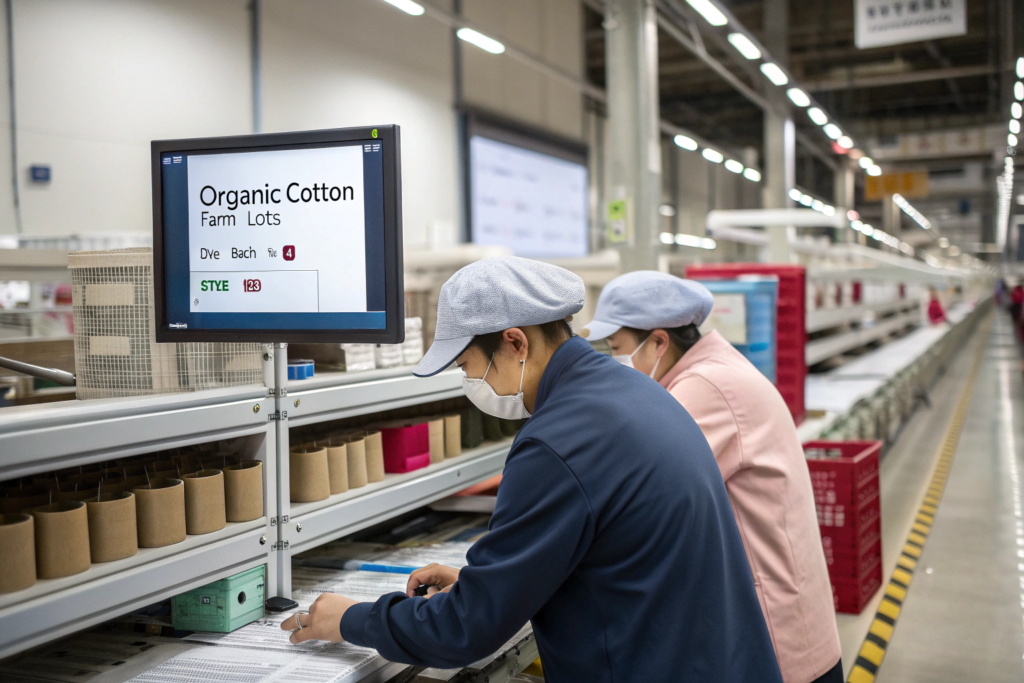
Commitment is proven by accountability, and accountability requires traceability. Can your supplier tell you which farm lot the organic cotton came from, which dye batch was used on roll #45, and which operator stitched the buttons on style #123? For kids’ wear, this is critical. In the event of a safety inquiry or recall, you need to isolate the problem to a specific batch quickly to minimize damage. A "committed" supplier has a digital or physical system that creates an unbroken chain of custody for all materials.
At Shanghai Fumao, we implement a QR Code-Based Traceability System. A unique code is assigned to each fabric batch (e.g., 10,000 meters of GOTS cotton interlock). This code is linked to our ERP system, which contains:
- Fiber Origin: GOTS transaction certificate number.
- Dye/Chemical Records: MSDS (Material Safety Data Sheets) for all dyes and auxiliaries used.
- In-Process Test Records: All in-house pH, formaldehyde, and colorfastness results.
- Final Test Reports: The scanned OEKO-TEX® or similar certificate.
When the fabric is shipped to your garment factory, they can scan the QR code on the roll header to access this dossier. This empowers your own QC and provides undeniable proof of due diligence to regulators and consumers.
What Information Should a Traceability System Provide?
A robust system should offer tiered information access:
- Basic Level (Brand/Consumer-facing): Scannable QR on garment hangtag showing fiber origin, core safety certifications, and care instructions.
- Advanced Level (Brand/QC-facing): Password-protected portal linked to the batch code, showing full test reports, mill of origin, and production date.
- Audit Level (Internal/Regulator-facing): Complete records of all material inputs, chemical inventories, and lab test raw data.
This system allowed us to swiftly support a Canadian client in early 2024. A competitor faced a recall due to high formaldehyde. Our client’s retailer asked for proof of compliance. Within an hour, we provided the retailer with a secure link to the full test reports and traceability data for the specific batch of pajama fabric we had supplied, reassuring them and strengthening their partnership. Understanding blockchain and traceability in the apparel supply chain shows the direction the industry is heading, and our system is a practical implementation of its principles.
How Does This Traceability Impact Recalls and Liability?
In a worst-case scenario, precise traceability is your best defense. Instead of recalling an entire season’s line, you can pinpoint the recall to garments made from fabric with Batch ID #FMA-2024-0456, produced between March 10-15. This limits financial loss, protects brand reputation, and demonstrates responsible governance. A supplier who cannot provide this level of traceability is exposing you to disproportionate risk. Our system is designed to make you, the brand, look proactive and in control, because you have a partner who provides the data backbone to be just that. Legal resources, such as articles on Product Liability Prevention for importers, stress the necessity of this documented supply chain control.
Conclusion
Asking if your kids’ wear supplier is committed to safety standards is the most important question you can ask. The true answer isn’t found in a folder of certificates, but in the supplier’s infrastructure, processes, and culture. It’s found in their investment in in-house screening labs, their obsessive control over physical design hazards, their granular traceability systems, and their willingness to be transparent with data at every step.
Safety in children’s products is a sacred trust. It requires a partner who views compliance as the absolute minimum and pursues safety as a moral and operational imperative. At Shanghai Fumao, this commitment defines us. We build safety into our fabrics from the first fiber, so you can build trust into your brand with every garment.
Don’t gamble with the safety of your youngest customers. Partner with a supplier whose processes are as rigorous as your standards. Contact our Business Director, Elaine, at elaine@fumaoclothing.com to request our detailed Safety Compliance Protocol and see how we engineer trust into every meter of kids’ wear fabric.