You‘re told the organic cotton in your t-shirt is “certified.“ The recycled polyester in your jacket comes from “verified“ sources. But in today‘s market, where “greenwashing“ accusations fly fast, how do you move beyond marketing claims to provable, ethical manufacturing? The answer lies not just in a shiny supplier certificate, but in a specific, often-overlooked document: the Transaction Certificate (TC). At Shanghai Fumao, we see the TC not as an administrative afterthought, but as the financial and ethical fingerprint of your order—the single piece of paper that bridges the gap between a farm or recycling plant and your finished product.
Simply having a GRS (Global Recycled Standard) or RCS (Recycled Claim Standard) certificate for your supplier is not enough. That‘s like a restaurant having a food hygiene license—it‘s necessary, but it doesn‘t prove the specific chicken in your meal was raised ethically. The Transaction Certificate does that. It‘s the auditable trail that matches a specific quantity of certified material (e.g., 5,000 kg of GRS-certified recycled polyester chips) to a specific batch of your fabric, and ultimately, to your purchase order. Without a valid TC, any claim of recycled or organic content is just a story. For brand buyers like Ron who need to answer to retailers, consumers, and their own ESG reports, mastering the TC is non-negotiable.
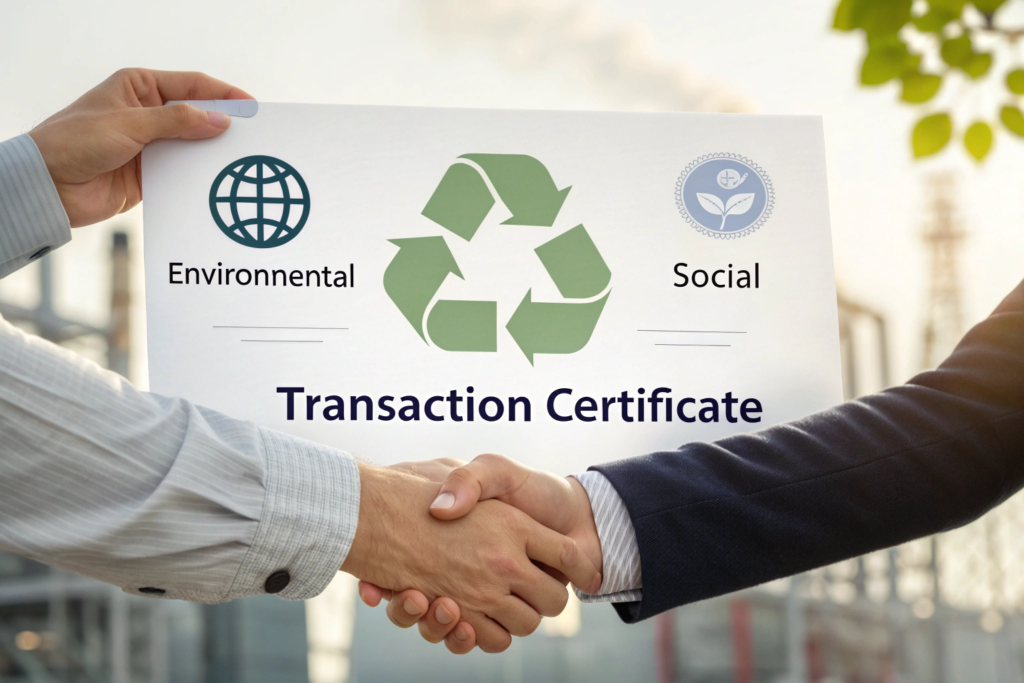
Let‘s cut through the jargon. Ethical manufacturing today is built on three pillars: Environmental Integrity (using recycled/organic materials), Social Responsibility (safe, fair labor), and Chain of Custody (proving it all actually happened). The Transaction Certificate is the gold standard for proving the Chain of Custody for materials. It turns “we think“ into “we can prove.“ This guide will show you how to use TCs not just as a receipt, but as an active tool to audit your supply chain, substantiate your marketing, and build a brand that stands up to the toughest scrutiny.
What Exactly is a Transaction Certificate and How is it Created?
A Transaction Certificate is an official document issued by an accredited certification body (like Control Union, SCS, or ICEA) that accompanies a specific shipment of certified material through the supply chain. It‘s created every time certified goods change hands—from recycler to yarn spinner, spinner to fabric mill (like us), and from us to you.
The process is rigorous. Let‘s say you order GRS-certified fabric from Shanghai Fumao. Here‘s what happens:
- Input Verification: We purchase GRS-certified recycled polyester chips. Our supplier gives us a TC for that batch of chips.
- Production & Mass Balance: In our certified facility, we weave and dye the fabric. We meticulously track the weight of certified input versus non-certified input (if any) according to strict “mass balance“ rules.
- Application: We apply to our certification body (e.g., Control Union) for a new TC for the finished fabric batch. We submit evidence: the supplier‘s TC, our production records, and invoices.
- Issuance: The certifier audits the paperwork and, if all checks out, issues a new TC in our name. This TC lists your company as the “Consignee“ and states the exact weight and percentage of certified content in the fabric you‘re buying.
This TC is unique. It has a serial number, references the prior TC in the chain, and is traceable online. It‘s the proof that the certified content claimed hasn‘t been diluted or lost along the way. A great resource to understand this flow is the Textile Exchange‘s official explanations, which detail the key differences between a scope certificate and a transaction certificate.
What Critical Information Must a Valid TC Contain?
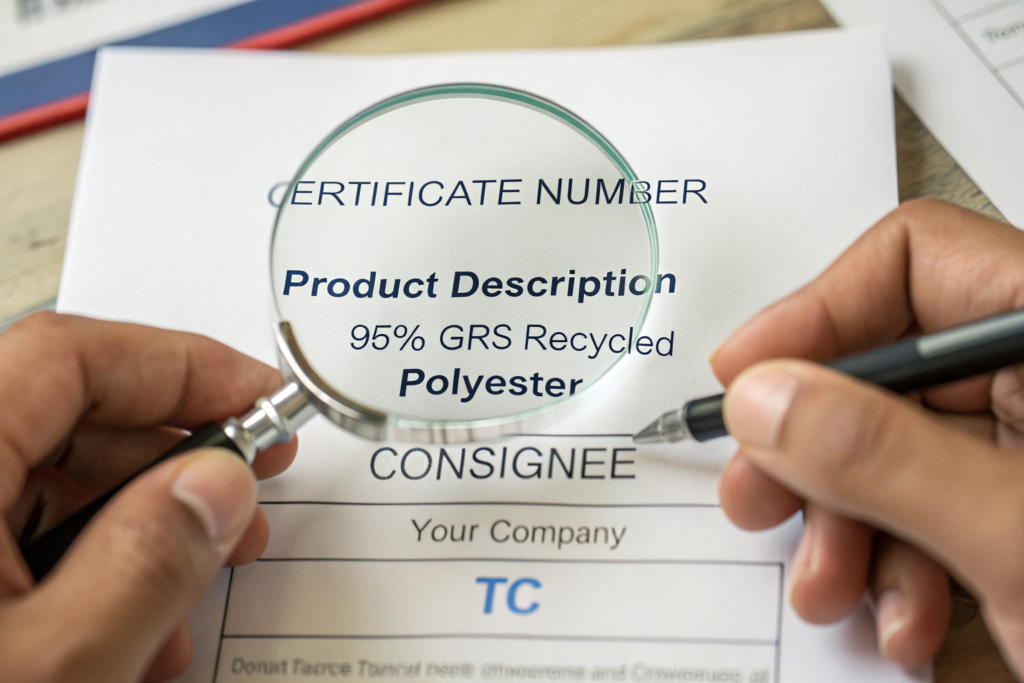
Don‘t just file it—read it. A valid TC must have:
- Issuing Body & Logo: e.g., “Control Union Certifications.“
- Certificate Number: A unique ID (e.g., CU123456).
- Standard & Version: e.g., “Global Recycled Standard (GRS) v4.0.“
- Product Description: e.g., “100% Recycled Polyester Knitted Fabric.“
- Certified Content Claim: The exact percentage (e.g., “95% Recycled Content“).
- Quantity: Net weight in kilograms.
- Supplier (Consignor): Our company details (Shanghai Fumao).
- Buyer (Consignee): Your company name and address.
- Reference to Previous TC: The certificate number of the input material TC.
- Issue Date & Authorized Signature.
If any of this is missing or doesn‘t match your order details, the TC is invalid for your claim.
Can a Factory Have a Certification But Fail to Provide a TC?
Yes, and this is a major red flag. A factory may have a “Scope Certificate“ proving it is capable of producing GRS goods, but if it doesn‘t issue a TC for your specific order, it means it did not follow the chain-of-custody procedures for your batch. The material may be blended with uncertified stock, or the paperwork trail is broken. Always demand the TC before final payment. In 2023, we helped a European outdoor brand audit a potential down supplier. The supplier had a RDS (Responsible Down Standard) certificate but could not produce TCs linking the down to certified farms. The brand walked away, avoiding a major ethical scandal. This due diligence is discussed in communities focused on sustainable sourcing best practices for apparel brands.
How to Use the TC to Verify Recycled and Organic Content Claims?
The TC is your forensic tool to back up every “made with recycled materials“ or “contains organic cotton“ claim. It moves you from vague storytelling to data-driven accountability.
First, match the TC to your order. The product description, weight, and your company name as consignee must align perfectly. Second, verify the percentage. A TC for “Blended Fabric“ might state “50% Certified Organic Cotton.“ You can only claim “50% organic cotton“—not “100%.“ This precision is legally required under FTC Green Guides in the US. Third, check the validity online. Most certification bodies have online databases where you can enter the TC number to verify its authenticity and see the chain. For example, you can track our GRS TC back to the yarn spinner‘s TC, and theoretically further. This is how you prove there‘s no “mass balance fraud“—where a factory buys one batch of certified material but issues TCs for ten times the volume.
What‘s the Difference Between “Content Claim“ and “Product Label“ Usage?
This is crucial for marketing:
- Content Claim (CCS): The TC supports a claim like “Made with 70% recycled materials.“ This is what we most commonly provide for fabric. You can use this in marketing and tech packs.
- Product Label (GOTS, GRS Label): To sew the GRS or GOTS logo onto a finished garment, the ENTIRE production chain (from spinning to sewing) must be certified, and a TC must cover the final garment. If you use our GRS fabric but sew it in an uncertified factory, you cannot get a TC for the final shirt, and thus cannot use the logo. You can only make the “made with“ claim. Understanding this nuance protects you from greenwashing allegations. The Global Organic Textile Standard (GOTS) website has clear guidelines on how to correctly make organic content claims on finished goods.
How Did a TC Save a Brand from a Major Scandal?
A case study from our files: In late 2023, a US-based activewear brand was challenged by an investigative journalist asking for proof of their “100% Recycled Ocean-Bound Plastic“ claim. The brand sourced from us. Within an hour, we provided them with the full TC trail: our TC for the fabric, which referenced the yarn spinner‘s TC, which in turn referenced the granulator‘s TC that specified the material origin as “Post-Consumer PET bottles collected from coastal regions.“ The brand shared this documented chain with the journalist. The story never ran; instead, it turned into a positive piece about supply chain transparency. The TC was their shield.
How Does a TC Provide Evidence for Social Compliance and Labor Ethics?
While TCs are best known for environmental claims, standards like GOTS and the newer RCS (Responsible Chemistry Standard) integrate critical social criteria. A valid TC for these standards isn‘t just about the fiber; it‘s a signal that the manufacturing site adhered to key ethical rules.
For GOTS, the certification audit covers both environmental and social criteria aligned with the International Labour Organization (ILO) core conventions. This includes: no child or forced labor, safe working conditions, fair wages, and reasonable working hours. Therefore, when you receive a GOTS TC from us for organic cotton fabric, you‘re also receiving indirect assurance that our dyeing and finishing partners met these social benchmarks. The TC is the output of a system that has been audited for social compliance. It‘s a more robust signal than a generic “ethical manufacturing“ statement. For deeper dives, organizations like the Fair Wear Foundation offer tools for integrating social audits into your material sourcing strategy.
Can a TC Replace a Social Audit Report?
No, and this is important. A TC is not a detailed social audit report like SMETA or BSCI. It is a certificate of compliance with the social criteria embedded within a material standard. For brands that prioritize social ethics, the best practice is a two-pronged approach:
- Material Ethics: Source materials with TCs from standards with strong social pillars (GOTS, Fairtrade).
- Factory Ethics: Conduct dedicated social audits (or rely on our SMETA audits) at the garment manufacturing level.
The TC provides the upstream ethical assurance for the material, while the factory audit covers the assembly conditions. Together, they build a comprehensive ethical profile.
How Do We Ensure Social Compliance in Our TC-Issuing Process?
Our partnership with certified dye houses and mills isn‘t just transactional. We choose partners who themselves hold valid social compliance certifications (like BSCI) in addition to GRS or GOTS. Before we can include their material in our TC application, we verify their social compliance status. This creates a filtered, responsible supply network. In practice, this means when you get a TC from Shanghai Fumao, you‘re tapping into a pre-vetted ethical ecosystem, not just buying from a single factory.
What Are the Practical Steps to Audit Your Supply Chain Using TCs?
A TC is only as good as the audit you perform on it. Don‘t be a passive recipient. Build an active TC verification protocol into your sourcing workflow.
Here is a simple 4-step audit checklist you can implement tomorrow:
- Request Upfront: In your PO, state: “A valid Transaction Certificate for the [GRS/GOTS] standard must be provided prior to shipment release.“
- Receive & Verify: Upon receipt, check all data points (weight, product, your name) against your PO and invoice.
- Validate Online: Go to the certifier‘s website (e.g., Control Union‘s Transactions Database) and enter the TC number. Confirm it‘s active and lists you as consignee.
- Archive & Map: File the TC digitally, linking it to the specific SKU and production run. Create a visual “chain of custody“ map for your internal reporting.
This process turns you from a buyer into a supply chain detective. We make this easy for our partners by providing digital TCs with direct links to verification portals.
How to Handle Discrepancies or Missing TCs?
If there‘s a discrepancy (e.g., weight is 5% less than ordered) or the TC is missing, you must escalate immediately.
- Pause Payment: Do not release the final payment.
- Contact Supplier: Ask for clarification and a corrected TC. A professional supplier like us will resolve this quickly.
- Escalate to Certifier: If the supplier is unresponsive, contact the certification body listed on their Scope Certificate. They can investigate.
Having this protocol protects you. A forum like Traceability Forum for Sustainable Supply Chains often shares case studies on using blockchain and digital TCs for supply chain audits.
Can You Trace Multiple TCs in a Complex Product?
For a garment with multiple materials—e.g., a jacket with GRS shell, recycled down, and organic cotton lining—you should receive a TC (or a Supplier‘s Declaration of Conformity) for each certified component. Your brand‘s responsibility is to collate these into a master dossier for that product. This is the future of the “Digital Product Passport“ (DPP) mandated by the EU. We are already preparing TCs in digital formats that can be easily integrated into such DPP systems. Partnering with a supplier who understands this data need is critical.
Conclusion
Ensuring ethical manufacturing in the 21st century requires moving from trust to verification. The Transaction Certificate is the cornerstone of that verification system. It transforms ambitious ethical commitments into tradable, auditable, and defensible reality. By understanding how to request, read, verify, and archive TCs, you empower your brand to make true claims, satisfy regulatory demands, and build unshakable trust with your customers.
At Shanghai Fumao, we don‘t just see ourselves as fabric suppliers; we see ourselves as providers of verifiable integrity. Our commitment to issuing accurate, timely Transaction Certificates for every eligible order is a testament to that. We provide the documented proof you need to build a transparent, ethical, and successful brand. In a world demanding proof, let our TCs be your proof. To start sourcing fabrics with fully traceable, TC-backed ethical credentials, reach out to our Business Director, Elaine. Let‘s build your supply chain on a foundation of transparency: elaine@fumaoclothing.com.